Jigger
A double-ended measuring vessel — the foundational bar measurement tool documented since the 19th century.
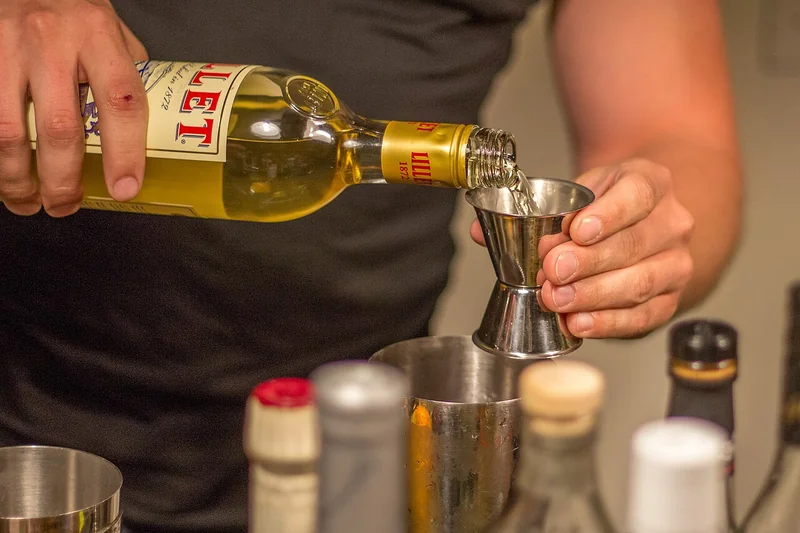
A jigger is a double-ended conical measuring vessel used to measure cocktail ingredients with precision. The standard American jigger has two ends: 1.5 oz (44 ml) and 0.75 oz (22 ml), though sizes vary by country and manufacturer. The term 'jigger' as a unit of measure (approximately 1.5 oz) is documented in American bartending literature from the late 19th century. Using a jigger ensures consistent recipe execution across different bartenders and servings. The Japanese jigger design (with straight, equal-diameter sides and precise volume markings) is considered more accurate than the traditional hourglass shape. Professional cocktail culture distinguishes 'free pouring' (estimating volume by timing) from 'jigger pouring' (measuring each ingredient).
Quick facts
- Type
- Bar Tool
Historical Development and Standardisation
The jigger as a specific bartending tool is documented in American bar equipment catalogs from the 1880s–1900s. The 'jigger' as a unit of liquid measure (1.5 fl oz, approximately 44 ml) is recorded in American cocktail writing from the same period; Jerry Thomas's 1862 guide references 'a wine glass' (approximately 2 oz) as a standard measure, while later 19th-century guides specify a 'pony' (1 oz) and 'jigger' (1.5 oz). The double-ended hourglass jigger — with different sizes at each end — became the American standard by the early 20th century. The metric jigger (25 ml / 50 ml, standard in many European markets) reflects different volume conventions. The Japanese OXO and Yukiwa jigger designs (straight-sided cylinders with etched interior measurements) emerged in the 20th century and have been adopted by precision-oriented craft bartenders globally.
Free Pouring vs. Jigger Pouring
Professional bars use one of two approaches. Free pouring relies on timing: a pourer (a device with an air-intake hole that regulates flow to a standard rate of approximately 0.5 oz/second) is inserted in the bottle, and the bartender counts time to estimate volume. A 4-count for 1 oz (with a calibrated pourer) is common. Free pouring is faster and more theatrical but is less precise — errors compound across a cocktail. Jigger pouring measures each ingredient in the jigger before adding to the glass; slower but more consistent. The craft cocktail movement from the early 2000s re-established jigger pouring as the professional standard, arguing that recipe consistency requires measurement. Volume accuracy of ±3–5% is achieved with good jigger technique; free pouring accuracy varies considerably by bartender.
Sources & further reading (1)
- encyclopedia — accessed 2026-05-08
Frequently asked questions
What are the standard jigger sizes?
The US standard double jigger: 1.5 oz / 0.75 oz. Metric equivalent: 44 ml / 22 ml. European (UK/EU) standards often use 50 ml / 25 ml or 35 ml / 17.5 ml. Japanese precision jiggers use 45 ml / 30 ml or metric equivalents. 'Pony' is a historical term for a 1 oz measure. The UKGB (UK Guild of Bartenders) specifies 25 ml and 50 ml as the legal single and double measures for licensed premises. The variety of standards reflects national alcohol regulation history.
What is the difference between a Japanese jigger and a standard American jigger?
The Japanese jigger (Yukiwa, OXO, and similar designs) has straight cylindrical sides rather than the hourglass flare of the traditional American jigger. The straight sides allow more precise reading of the liquid meniscus (the curve of a liquid surface) and typically include interior volume markings for multiple increments (15 ml, 22.5 ml, 30 ml, 45 ml in a 45/30 ml jigger). The traditional American hourglass shape is harder to read precisely because the curved walls make volume estimation less accurate at intermediate measurements.