Hawthorne Strainer
A coiled-spring metal strainer seating on shaker or mixing glass — patented in Boston, 1892.
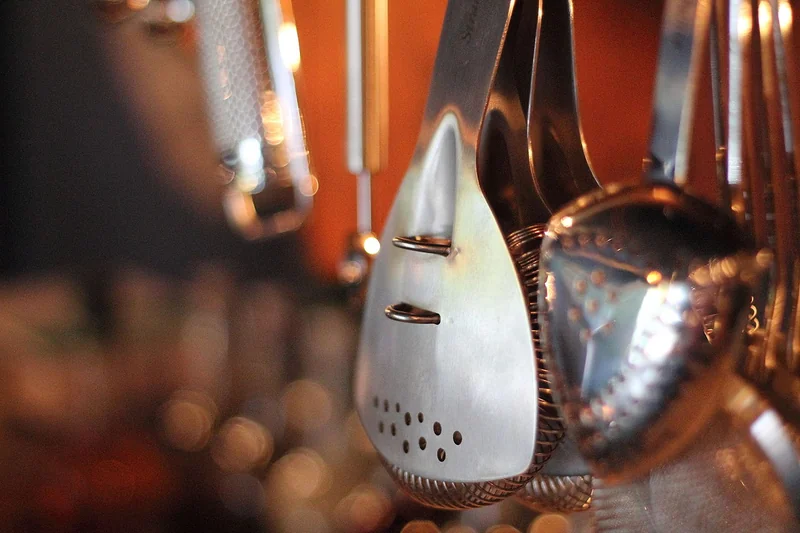
The Hawthorne strainer is a metal cocktail strainer consisting of a perforated flat metal plate with a coiled wire spring around its edge and a flat handle, used to strain cocktails from a shaker or mixing glass into a serving glass. The coiled spring acts as both a seal against the shaker rim and a filter for ice shards and fruit pulp. The design was patented in 1892 by William Wright and Dennis Sullivan, associated with the Hawthorne Café in Boston. It is the standard professional strainer for shaken cocktails (used with the Boston shaker tin) and for stirred cocktails (used with the mixing glass). A 'double strain' (using both a Hawthorne strainer and a fine mesh strainer simultaneously) is used for cocktails requiring complete removal of fine particles.
Quick facts
- Type
- Bar Tool
The 1892 Patent and Design Features
US Patent No. 480,631, filed by William Wright and Dennis Sullivan in 1892, describes the Hawthorne strainer's design: a flat, handle-equipped plate with holes, surrounded by a coiled spring that adapts to different-sized vessel openings. The Hawthorne Café in Boston is mentioned in the patent application. The spring was the key innovation: it provided a flexible, self-seating seal that could fit multiple shaker and mixing glass diameters without a fixed rim size. The perforations in the plate retain ice cubes while allowing liquid through; the spring's coils catch ice shards and fruit pulp that pass through the perforations. The four prongs (ears) on the strainer body seat on the rim of the shaker tin to prevent the strainer from sliding into the vessel.
Straining Techniques: Full Strain, Fine Strain, Double Strain
Three straining approaches are documented in professional practice. Standard strain: Hawthorne strainer placed on the shaker tin with spring fully extended; large ice cubes and major solids are held back. Tight strain (squeezing the spring): holding the strainer with thumb compressing the spring to reduce the gap between coils and the plate edge, catching more fine ice shards and citrus pulp; produces a slightly cleaner cocktail. Double strain (or fine strain): passing the cocktail through both the Hawthorne strainer on the shaker and a fine mesh tea strainer or conical strainer held over the glass simultaneously; completely removes all ice shards, foam bubbles, and citrus pulp. Double straining is standard for cocktails served up (no ice) in coupes, where ice shards would be distracting.
Sources & further reading (1)
- encyclopedia — accessed 2026-05-08
Frequently asked questions
What is the difference between a Hawthorne strainer and a julep strainer?
A julep strainer is a concave perforated metal dome on a handle, traditionally used with a mixing glass for stirred cocktails. Its dome shape seats inside the mixing glass rim rather than on top of it. The Hawthorne strainer seats on top of (outside) the shaker or mixing glass rim via its spring. In modern bartending, the Hawthorne strainer is used for both shaken (on the shaker tin) and stirred (on the mixing glass) cocktails, while the julep strainer is used primarily for stirred cocktails by some bartenders who prefer its tighter seal on a mixing glass.
Why do some Hawthorne strainers have more or fewer holes?
The size, number, and pattern of the perforations in the plate affect flow rate and filtering. More holes = faster flow but less filtration. Fewer holes = slower flow but more filtration of fine particles. Some professional strainers have a solid section at the leading pour edge to direct the flow for more controlled pouring. The wire spring coil density also affects fine filtration — a more tightly wound spring filters finer particles. High-end strainers (Cocktail Kingdom, Koriko) specify these dimensions precisely.