Espresso Martini
Vodka, fresh espresso, coffee liqueur, and sugar — Dick Bradsell's 1983 London cocktail.
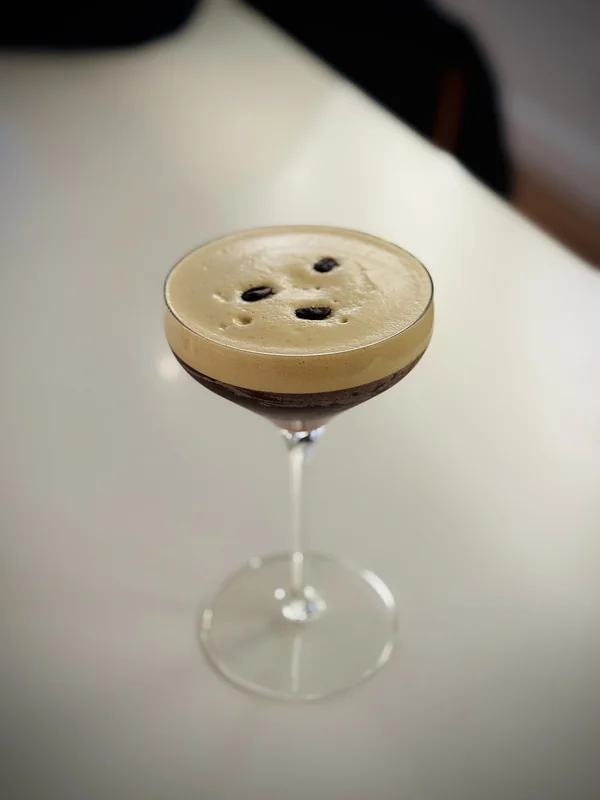
The Espresso Martini is a vodka-espresso cocktail created by Dick Bradsell at the Soho Brasserie in London around 1983–1984. The recipe combines vodka, freshly brewed espresso, coffee liqueur (typically Kahlúa or Tia Maria), and simple syrup, shaken vigorously over ice to create a thick foam, and strained into a martini glass with a garnish of three coffee beans. The drink is documented as a response to a request from a model (reportedly Kate Moss, though this attribution is disputed) to 'wake me up and f*** me up.' The Espresso Martini is a primary example of how the cocktail revival incorporated coffee culture into bar service.
Quick facts
- Type
- Modern Recipe
- Base spirits
- vodka, coffee liqueur
- Era
- 1983–present
- Origin
- London, United Kingdom
- Glass
- martini
- IBA listed
- No
Bradsell's Creation at the Soho Brasserie
Dick Bradsell worked at the Soho Brasserie on Old Compton Street, London, in the early 1980s, a period when espresso machines were becoming more common in London bars. The Soho Brasserie had an espresso machine behind the bar, which was unusual for the time. Bradsell's account: a young woman asked for a cocktail that would 'wake me up and f*** me up.' He used the espresso machine to produce fresh espresso and combined it with vodka, coffee liqueur, and sugar. The original name was 'Vodka Espresso'; it was later renamed 'Pharmaceutical Stimulant' and eventually 'Espresso Martini.' The term 'martini' in the name refers to the glass shape, not the gin-vermouth formula — a convention that became common in the 1990s for any cocktail served in a V-shaped glass.
Foam Formation and the Three-Bean Garnish
The Espresso Martini's characteristic thick foam is produced by shaking cold espresso vigorously with ice. Espresso contains surfactant compounds from coffee oils and fine coffee particles that create and stabilise foam when agitated with water; the crema from freshly brewed espresso contributes additional foam-forming compounds. The foam quality depends critically on the freshness of the espresso: coffee made more than a few minutes before shaking has lost most of its CO2 and produces minimal foam. The three-coffee-bean garnish, placed on the foam, is a traditional Italian good-luck symbol associated with Sambuca service (representing health, happiness, and prosperity) that Bradsell adopted as the garnish. Foam stability decreases within 2–3 minutes of pouring.
Sources & further reading (1)
- encyclopedia — accessed 2026-05-08
Frequently asked questions
What coffee liqueur is used in an Espresso Martini?
Kahlúa (produced in Mexico from arabica coffee, sugar cane spirit, and vanilla, 20% ABV) is the most common coffee liqueur used. Tia Maria (produced from Jamaican Blue Mountain coffee and Jamaican rum, 20% ABV) is an alternative with a slightly drier character. Premium bartenders may use specialty coffee liqueurs or make their own cold-brew-based coffee liqueur for more intense, less sweet coffee flavour. Kahlúa's vanilla note is considered part of the drink's sweetness profile.
Why must the espresso be freshly brewed?
Freshly brewed espresso contains dissolved CO2 (from the roasting and brewing process) and emulsified coffee oils that form the crema. These compounds produce the distinctive foam when shaken. As espresso cools and ages (beyond 5–10 minutes), CO2 escapes and the crema collapses — the result is a cocktail with minimal or no foam layer. Cold-brew concentrate can substitute but produces a less foamy result. The requirement for fresh espresso makes the Espresso Martini more operationally complex than most cocktails.