Boston Shaker
Two-piece metal tin and pint glass — the professional shaker standard for fast, large-batch service.
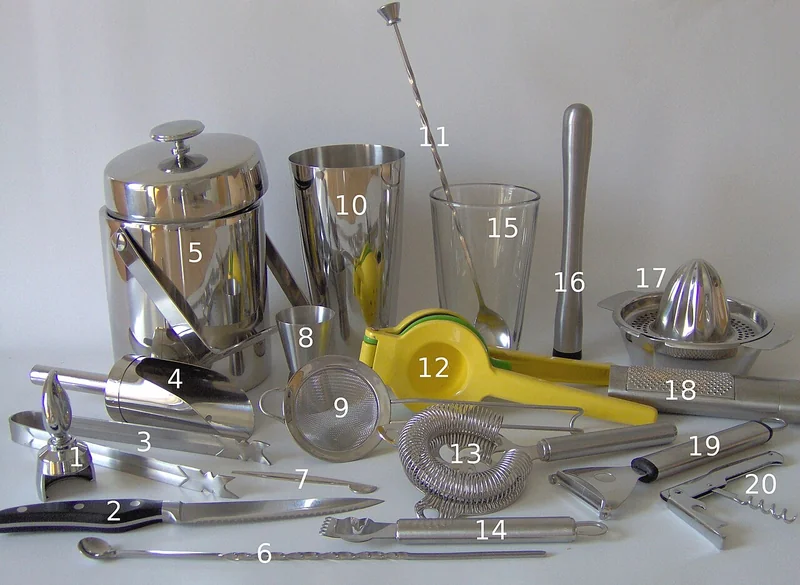
The Boston shaker is a two-component shaking vessel consisting of a metal tin (typically 28 oz / 828 ml) and a glass or smaller metal tin (typically 16 oz / 473 ml pint glass or 18 oz tin). The two pieces are joined by pressing the pint glass into the tin at a slight angle to create an airtight seal, then tapped to lock. After shaking, the seal is broken by striking the junction with the heel of the hand. The Boston shaker is the standard tool of professional bartenders for its efficiency, capacity (for batch shaking), and ease of cleaning compared to the cobbler shaker (three-piece). It requires a separate strainer (Hawthorne or julep) to strain the cocktail into the serving glass.
Quick facts
- Type
- Bar Tool
History and Professional Adoption
The cobbler shaker (three-piece with built-in strainer cap) was the dominant shaker style through the 19th century and is documented in bar equipment catalogs from the 1870s–1890s. The Boston shaker — named for its association with Boston bar culture — became the professional standard in American bars during the early 20th century, favoured for its ability to handle larger volumes, its separation from strainer (allowing different straining options), and its faster cleaning cycle in high-volume service. The French cocktail school tradition also favoured a two-piece metal-on-metal Boston shaker (no glass). The global craft cocktail movement standardised the Boston shaker as the professional tool of choice, with the cobbler shaker associated with home use.
Sealing, Shaking, and Breaking the Seal
The Boston shaker's airtight seal is achieved through the interference fit between the pint glass rim and the metal tin interior. The technique: place ingredients in the pint glass or smaller tin, add ice, insert the other piece at a slight 10–15° angle, and tap the top firmly to create the seal (the temperature differential as cold liquid contacts the warm tin also helps tighten the seal). Shake with both hands gripping the two pieces firmly, holding horizontally or at a slight upward angle. To break the seal after shaking, hold the tin firmly and strike the junction with the heel of the dominant hand at the point where the glass rim meets the tin — the resulting inward dent breaks the vacuum. The small vent of motion visible at the seam as the pieces loosen confirms the seal has broken.
Sources & further reading (1)
- encyclopedia — accessed 2026-05-08
Frequently asked questions
What is the difference between a Boston shaker and a cobbler shaker?
A cobbler shaker (three-piece) has a body, a lid with a built-in strainer, and a cap. It is easier for beginners because the strainer is integrated and sealing is simpler. The Boston shaker (two-piece) is faster for professionals, allows different straining options (Hawthorne vs. julep strainer), has no strainer holes that can clog, holds more volume, and cleans more easily. Most cocktail bars use Boston shakers. Most home bars start with cobbler shakers.
What happens if the Boston shaker seal fails during shaking?
A seal failure (typically from misalignment or from using damaged equipment) causes the cocktail to spray out during shaking. The remedy is to ensure the glass or tin is inserted at the correct angle (slightly off-axis) and tapped firmly. Very cold ice against the metal creates a vacuum-assist; room-temperature equipment seals less reliably. Modern 'tin-on-tin' Boston shakers (two metal tins) seal more consistently than glass-on-tin designs, particularly in cold environments.