Aquavit
Scandinavian spirit flavoured with caraway or dill — produced in Norway, Sweden, and Denmark.
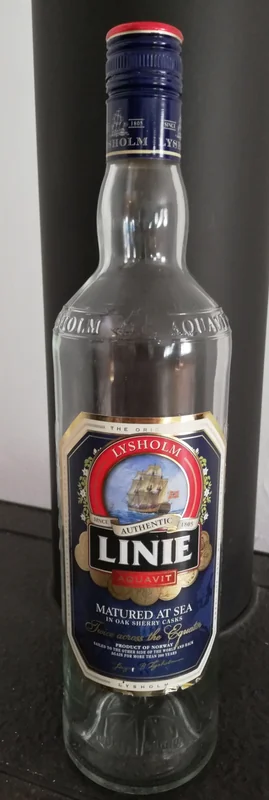
Aquavit (also akvavit, spelled both ways) is a Scandinavian distilled spirit produced from grain or potato mash and flavoured with caraway or dill seed as the primary botanical — analogous to gin's juniper requirement. EU Regulation 2019/787 defines aquavit as a spirit produced from grain or potatoes with a minimum of 37.5% ABV, in which the characteristic taste comes from caraway (Carum carvi) or dill (Anethum graveolens), with other spices permitted in smaller quantities. Production is concentrated in Norway (the largest producer), Sweden, and Denmark. Norwegian aquavit is typically aged in oak (often sherry or bourbon casks) and may be shipped across the equator and back in barrels aboard ships — the 'linie' (line-crossing) aging tradition, documented since the early 19th century.
Quick facts
- Type
- Spirit Base
- Base spirits
- aquavit
- Era
- 15th century–present
- Origin
- Scandinavia (Norway, Sweden, Denmark)
- Glass
- martini
- IBA listed
- No
Caraway and Dill: The Defining Botanicals
Caraway seed (Carum carvi) is the defining botanical of most aquavit, providing a characteristic earthy, anise-adjacent flavour from carvone (the primary aromatic compound), limonene, and other terpenes. Carvone's scent is immediately identifiable as the 'traditional rye bread' or 'sauerkraut' aroma of Central and Northern European food culture. Dill seed (Anethum graveolens, using the seed rather than the herb) also provides carvone but in different proportions alongside anethofuran and other dill-specific compounds, producing a slightly more herbal, lighter character. Swedish aquavit tends to favour dill-forward flavour profiles; Norwegian and Danish aquavit more frequently use caraway. Additional permitted botanicals include citrus peel, anise, fennel, coriander, angelica, and many regional herb varieties.
Linie Aquavit and Equator-Crossing Maturation
Norwegian Linie (Lysholm Linie Aquavit, produced since 1805) is the best-known aquavit brand, distinguished by a documented maturation method: sherry oak casks containing aquavit are loaded onto container ships and transported across the equator twice before bottling (the round trip to Australia or other southern hemisphere destinations). The label of each bottle documents the voyage and ship. The equator crossings subject the liquid to temperature variation, ship movement, and extended air exposure through the barrel staves — accelerating maturation. The tradition reportedly began when a consignment of Norwegian potatoes and aquavit sent to Batavia (Jakarta) in 1805 returned unsold; the returned aquavit was found to have improved dramatically from the sea voyage.
Sources & further reading (1)
- encyclopedia — accessed 2026-05-08
Frequently asked questions
Is aquavit a type of gin?
Aquavit and gin are both grain/potato spirits flavoured with botanicals, but they are distinct categories under EU law. Gin requires juniper to dominate; aquavit requires caraway or dill to dominate. The botanical focus is fundamentally different. Gin's flavour profile is led by piney juniper; aquavit's is led by earthy-herbal caraway or fresh dill. Both are produced in copper pot stills and redistilled with botanicals, making the production method similar but the defining botanical completely different.
How is aquavit used in cocktails?
Aquavit's caraway-herbal character has been incorporated into cocktails primarily within Scandinavian cuisine contexts and in the global craft cocktail movement from the 2010s. Its distinctive flavour works as a direct gin substitute in Nordic gin-template cocktails or as a flavour-contrasting base in sours and highballs. The 'Nordic' or 'Scandinavian' cocktail movement has developed specific aquavit formulas using other Nordic botanicals (elderflower, cloudberry, lingonberry) to build cohesive regional flavour profiles.