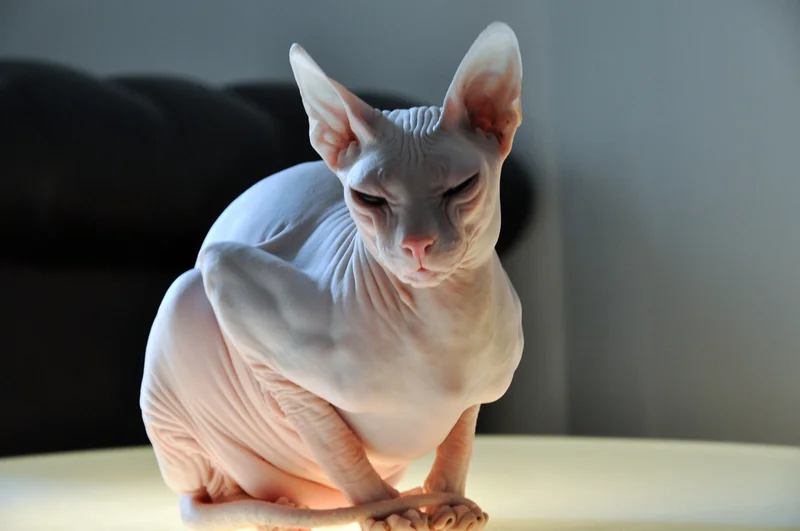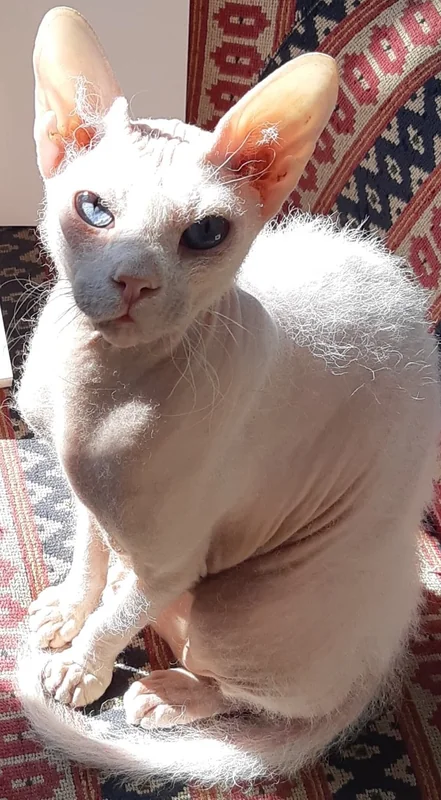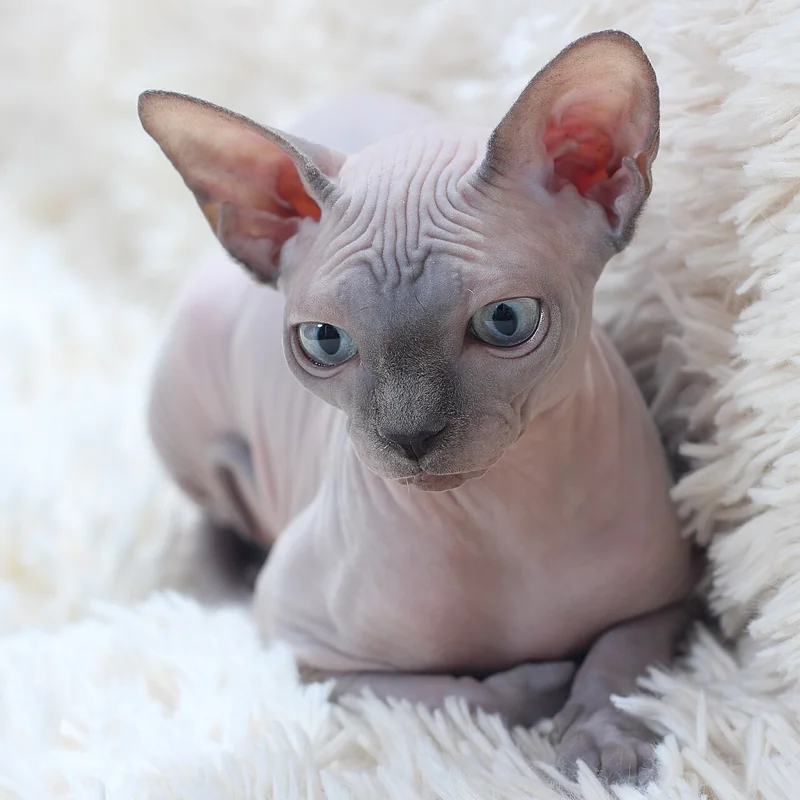
The Sphynx is a hairless domestic cat breed originating from a natural mutation in Toronto, Canada in 1966. The founding kitten, Prune, was born to a domestic shorthair queen and carried the autosomal recessive hr gene. TICA recognized the Sphynx at its 1979 founding; CFA granted championship status in 2002; FIFe recognized the breed in 2002. The standard describes a medium-sized, muscular cat with wrinkled skin, large ears, and a warm suede-textured body surface.
Quick facts
- Origin country
- Canada (Toronto, Ontario)
- Origin period
- 1966 natural hairless mutation (Prune); CFA championship 2002
- Coat type
- Hairless
- Coat colors
- All colours and patterns recognized (visible in pigmentation of the skin)
- Size category
- Medium
- Average lifespan
- 9-15 years
- Recognition
- CFA 2002 · TICA 1979 · FIFe 2002
Origin
A naturally hairless kitten named Prune was born to a domestic shorthair queen in Toronto in 1966, carrying the autosomal recessive hr (hairless) gene. The owner, Elizabeth Tica, contacted breeder Yania Bawa, who developed the early line. Independent hairless mutations in Minnesota (1975) and the Netherlands (1978) provided additional unrelated foundation stock. Dutch breeder-provided cats Ramses and Wadubast were brought to the United States by Shirley Smith, whose Devon Rex outcrosses produced the modern, health-tested Sphynx lineage that the major registries now recognize.
Recognition
The International Cat Association recognized the Sphynx at its 1979 founding in Texas. The Cat Fanciers' Association granted championship status in 2002 after the breed completed health-protocol requirements, including cardiomyopathy screening. The Fédération Internationale Féline recognized the breed in 2002. The GCCF does not maintain a Sphynx championship register; the breed is shown in the United Kingdom under TICA-affiliated or independent bodies.
Standard
The CFA standard describes a medium-sized, muscular cat that appears hairless. The skin is covered in fine downy vellus hair that produces a warm chamois or suede texture to the touch. Wrinkles appear on the muzzle, between the ears, and across the shoulders. The head is a modified wedge with prominent cheekbones, a whisker break, and very large, wide-set lemon-shaped eyes. The ears are extremely large, wide at the base, and hairless inside. All colours and patterns are recognized — colour is visible in the skin pigmentation rather than in a coat. The Sphynx runs approximately four degrees Fahrenheit warmer than the average domestic cat due to the absence of an insulating coat.
Sources & further reading (3)
- registry-breed-profile — accessed 2026-04-30
- encyclopedia — accessed 2026-04-30
- tica-standard — accessed 2026-04-30
Frequently asked questions
Is the Sphynx truly hairless?
The Sphynx carries a fine covering of downy vellus hair — similar to peach fuzz — rather than being completely bare. The autosomal recessive hr gene produces the near-hairless phenotype. The skin surface has a warm chamois or suede texture. The CFA standard describes the breed as 'apparently' hairless; absolute hairlessness is not required or expected.
When did CFA recognize the Sphynx?
The Cat Fanciers' Association granted the Sphynx championship status in 2002 after the breed completed health-protocol requirements including mandatory cardiomyopathy screening. TICA had recognized the Sphynx at its 1979 founding. FIFe also recognized the breed in 2002.
What is the origin of the Sphynx?
A naturally hairless kitten named Prune was born to a domestic shorthair in Toronto in 1966 — the documented founding event of the modern Sphynx breed. Independent hairless mutations in Minnesota (1975) and the Netherlands (1978) provided additional unrelated foundation genetics. The modern health-tested breed lineage derives primarily from Devon Rex outcrosses made by Shirley Smith using the Dutch foundation cats.