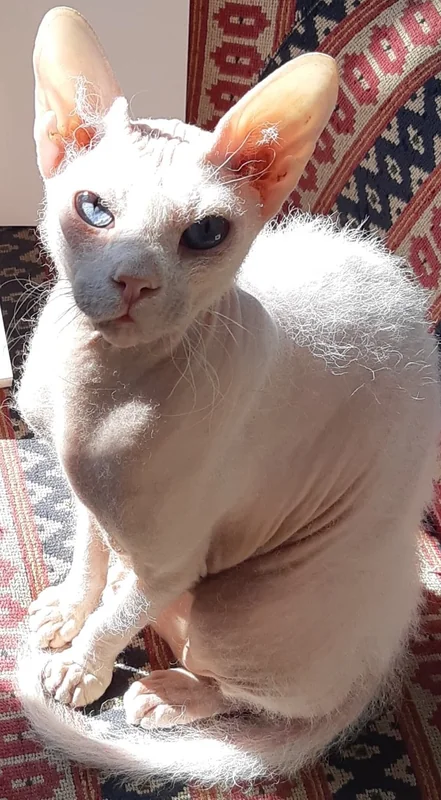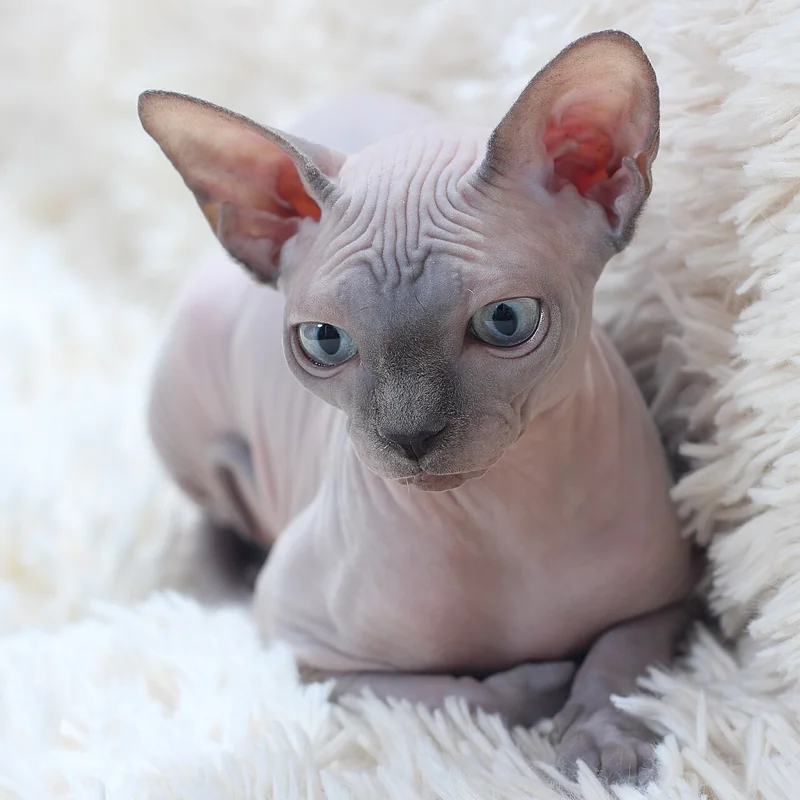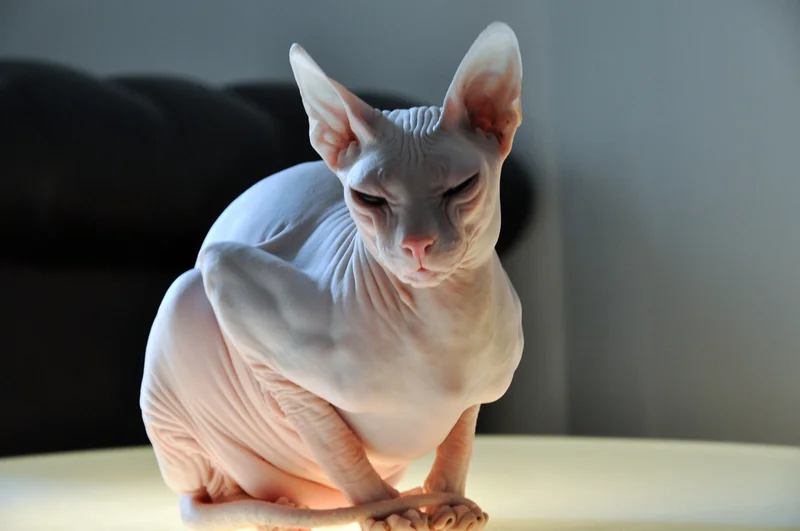
The Donskoy is a Russian hairless breed originating from a natural dominant mutation observed in 1987 in Rostov-on-Don. The foundation cat, a tortoiseshell female named Varvara, was rescued from a tree by Elena Kovaleva and gradually lost her coat over the next two years. Unlike the Sphynx (recessive hairless gene), the Donskoy carries an autosomal dominant hairless mutation. FIFe recognized the Donskoy in 1997 and TICA granted championship status in 2005. CFA does not recognize the Donskoy. The standard describes a medium-sized, muscular hairless cat with large ears.
Quick facts
- Origin country
- Russia (Rostov-on-Don)
- Origin period
- 1987 natural hairless mutation (Varvara, Elena Kovaleva); FIFe recognition 1997; TICA championship 2005
- Coat type
- Hairless
- Coat colors
- All colours and patterns recognized (visible in skin pigmentation)
- Size category
- Medium
- Average lifespan
- 12-15 years
- Recognition
- TICA 2005 · FIFe 1997
Origin
In 1987 Russian teacher Elena Kovaleva rescued a tortoiseshell female cat from a tree in Rostov-on-Don and named her Varvara. Over the following two years Varvara gradually lost her coat — an unusual progression that initially appeared to be a health condition. Veterinary investigation confirmed the hair loss was a natural genetic mutation. Varvara's offspring with a local tom included hairless kittens, confirming the dominant inheritance of the gene (designated Hbl). Russian breeder Irina Nemikina established the formal breed programme in the 1990s under the name Donskoy.
Recognition
The Fédération Internationale Féline recognized the Donskoy in 1997 — the first major international registry to do so. TICA accepted the breed for registration in the early 2000s and granted full championship status in 2005. CFA does not recognize the Donskoy on grounds of welfare concerns about the dominant hairless mutation. GCCF does not maintain a Donskoy register. WCF also recognizes the breed.
Standard
The TICA standard describes a medium-sized, muscular cat with a moderately rectangular body, well-developed musculature, and a noticeably long neck. The head is a modified wedge with prominent cheekbones, large almond-shaped eyes, and very large ears set high. The defining characteristic is the hairless skin: warm, soft, and wrinkled, particularly at the muzzle and shoulders. Four coat-type categories are recognized: rubber bald (completely hairless), flocked (peach-fuzz), velour (slightly more coat), and brush (sparse wiry coat). All colours and patterns are recognized, visible in skin pigmentation.
Sources & further reading (3)
- fife-standard — accessed 2026-04-30
- encyclopedia — accessed 2026-04-30
- tica-standard — accessed 2026-04-30
Frequently asked questions
How does the Donskoy differ from the Sphynx?
The Donskoy and Sphynx are unrelated hairless breeds with different mutations. The Sphynx carries a recessive hairless gene (hr); the Donskoy carries a dominant hairless gene (Hbl). The two breeds also differ in conformation: the Donskoy has a more rectangular body and prominent cheekbones, while the Sphynx has a softer, more rounded conformation. The Donskoy's coat may evolve over time (born hairless, develop coat, lose coat), while the Sphynx is consistently hairless throughout life.
When was the Donskoy recognized?
FIFe recognized the Donskoy in 1997. TICA granted championship status in 2005. CFA does not recognize the Donskoy on welfare grounds. GCCF does not maintain a Donskoy register.
What are the four Donskoy coat-type categories?
The TICA standard recognizes four Donskoy coat categories: rubber bald (completely hairless from birth), flocked (peach-fuzz texture), velour (slightly more coat than flocked), and brush (sparse wiry coat). Donskoys may transition between coat types throughout their life — particularly common is birth with some coat that is shed during the first two years.