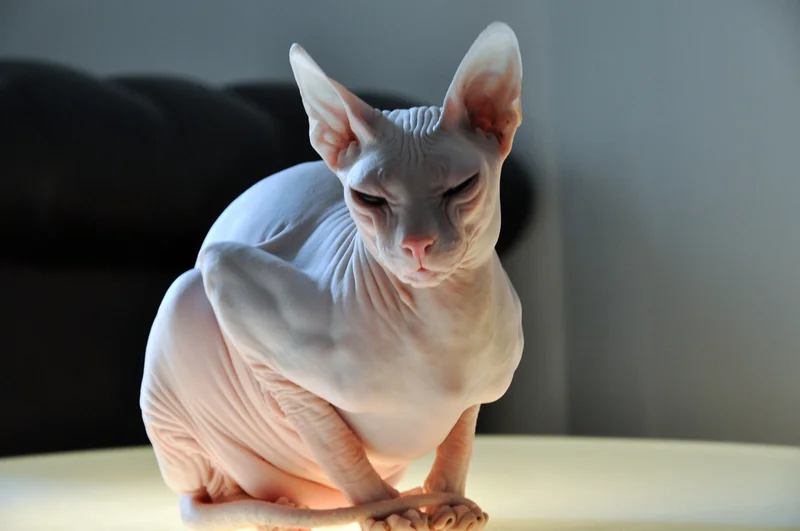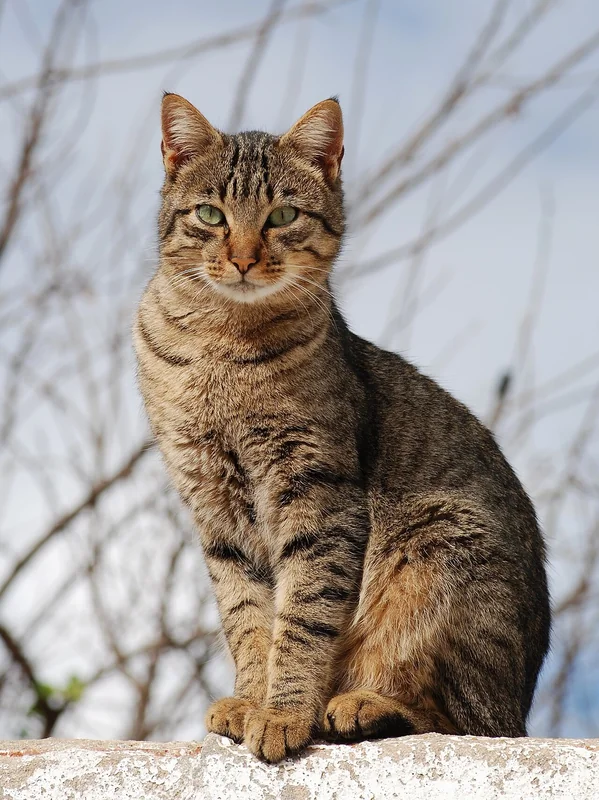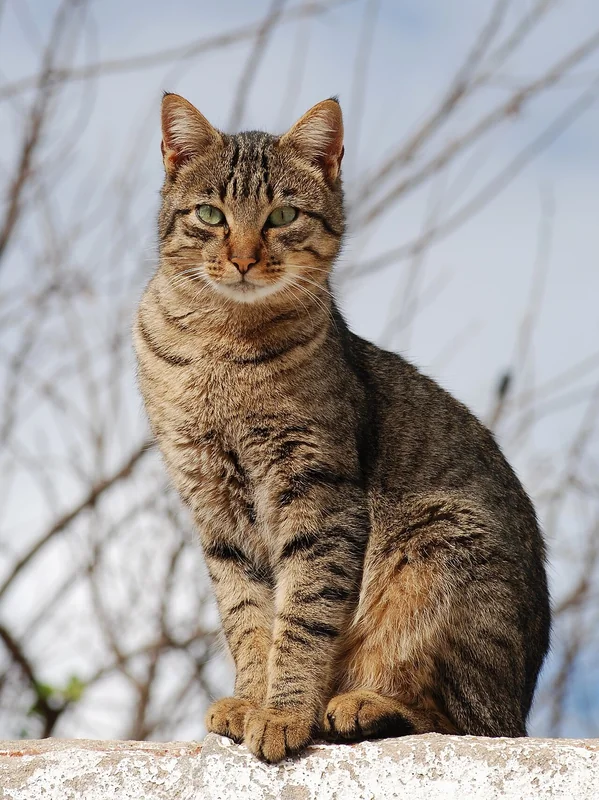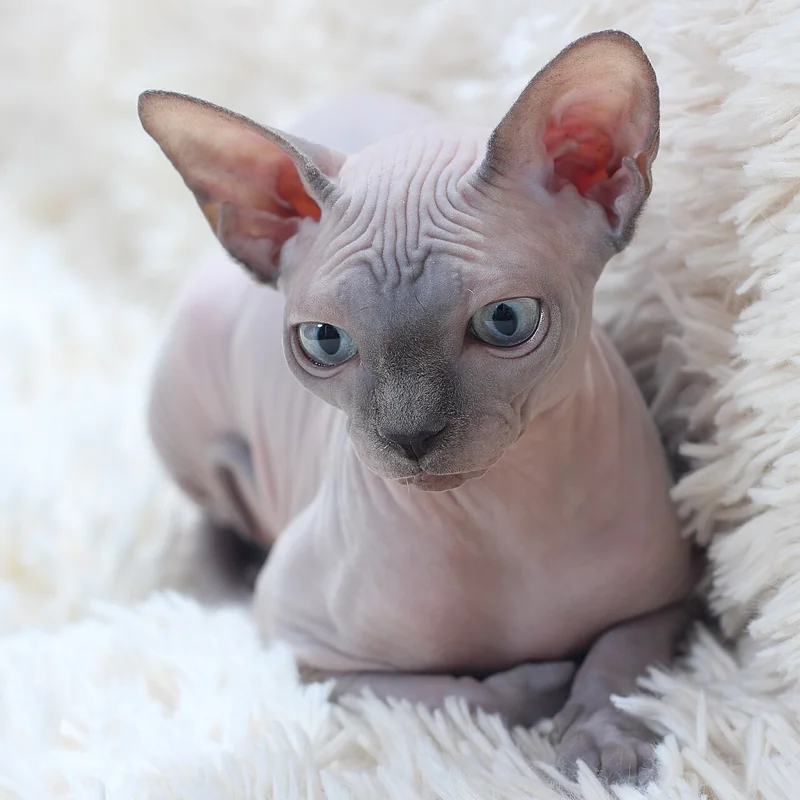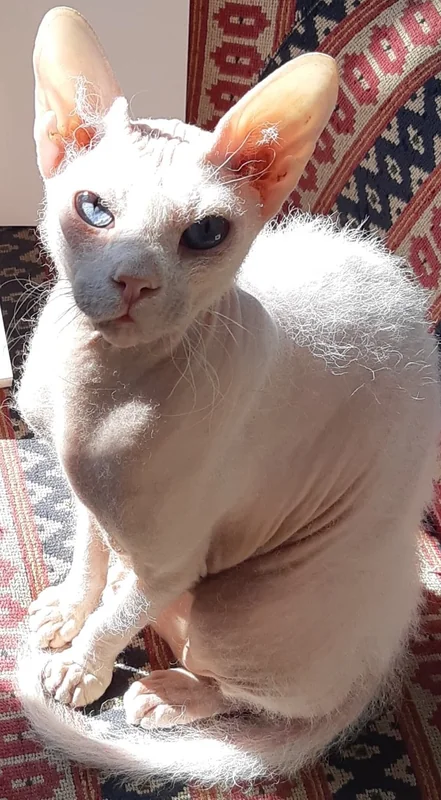
The Peterbald is a Russian hairless breed developed in 1994 by Olga S. Mironova through crosses between the Donskoy and Oriental Shorthair. The breed combines the Donskoy's dominant hairless gene with the Oriental Shorthair's elegant body type and head shape. TICA granted championship status in 1997 — making the Peterbald one of the most rapidly recognized new breeds in TICA history. FIFe recognized the breed in 2003. CFA does not recognize the Peterbald. The standard describes a medium-sized, slim, elegant hairless cat with the Oriental wedge head.
Quick facts
- Origin country
- Russia (Saint Petersburg)
- Origin period
- 1994 Donskoy x Oriental Shorthair cross by Olga S. Mironova; TICA championship 1997, FIFe recognition 2003
- Coat type
- Hairless
- Coat colors
- All colours and patterns recognized (visible in skin pigmentation)
- Size category
- Medium
- Average lifespan
- 12-15 years
- Recognition
- TICA 1997 · FIFe 2003
Origin
In 1994 Russian breeder Olga S. Mironova of Saint Petersburg crossed a Donskoy male, Afinogen Myth, with an Oriental Shorthair female, Radma vom Jagerhof. The resulting kittens combined the Donskoy's dominant hairless gene (Hbl) with the Oriental Shorthair's slim, elegant body type and long wedge head. Mironova named the breed Peterbald, referencing Saint Petersburg ('Peter') and the breed's hairless ('bald') quality. The breed was deliberately developed to combine the most extreme Oriental conformation with the Donskoy's hairless phenotype.
Recognition
TICA accepted the Peterbald for registration in 1996 and granted full championship status in 1997 — one of the most rapid championship recognitions in TICA history. The Fédération Internationale Féline recognized the breed in 2003. CFA does not recognize the Peterbald, similar to its non-recognition of the Donskoy. WCF also recognizes the breed. Outcrosses to Oriental Shorthair, Siamese, and Donskoy are permitted under TICA rules.
Standard
The TICA standard describes a medium-sized, slim, well-muscled cat with a long body, long legs, and a long whippy tail — the Oriental Shorthair body type. The head is a long tapering wedge with very large flaring ears continuing the line of the wedge, almond-shaped eyes, and prominent cheekbones. The defining characteristic is the hairless skin, which exists in five coat-type categories: ultra bald (completely hairless), flocked (peach-fuzz), velour, brush (sparse wiry coat), and straight (full coat — non-hairless siblings). All colours and patterns are recognized.
Sources & further reading (3)
- tica-standard — accessed 2026-04-30
- encyclopedia — accessed 2026-04-30
- fife-standard — accessed 2026-04-30
Frequently asked questions
How does the Peterbald differ from the Donskoy?
The Peterbald shares the Donskoy's hairless gene (Hbl, dominant) but has the Oriental Shorthair's slim, elegant body type with a long wedge head and very large flaring ears. The Donskoy has a more rectangular, muscular body with a moderate wedge head. The Peterbald's hairless phenotype expresses in five coat-type categories (one more than the Donskoy's four), including a 'straight' category for non-hairless siblings.
When was the Peterbald recognized?
TICA accepted the Peterbald for registration in 1996 and granted full championship status in 1997 — one of the most rapid championship recognitions in TICA history, only three years after the breed's foundation. FIFe recognized the breed in 2003. CFA does not recognize the Peterbald.
Why was the Peterbald created?
Olga Mironova deliberately crossed the Donskoy with the Oriental Shorthair in 1994 to combine the Donskoy's dominant hairless gene with the Oriental Shorthair's extreme slim, elegant conformation. The goal was a hairless cat with the most refined Oriental body type — distinct from the Sphynx's softer, more rounded conformation and the Donskoy's more rectangular muscular body.