Felis catus
Selkirk Rex
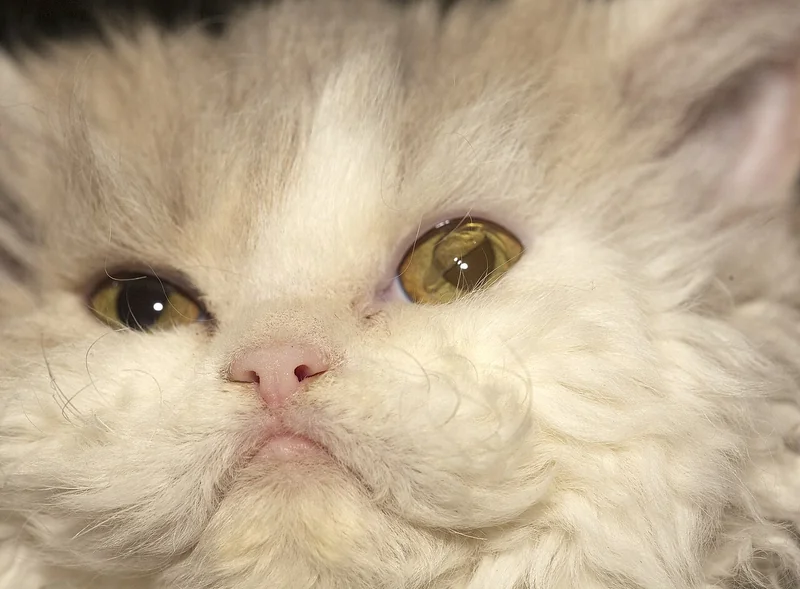 Featured photoselkirk-rex.jpg
The Selkirk Rex is a curly-coated breed originating from a natural dominant mutation in Montana, United States in 1987. The foundation female, Miss DePesto, was born in a rescue shelter in Sheridan County and adopted by Persian breeder Jeri Newman. Unlike the Cornish and Devon Rex, the Selkirk Rex mutation is autosomal dominant. CFA granted championship status in 1992; TICA recognized the breed in 1990; and FIFe in 2012.
Quick facts
- Origin country
- United States (Montana)
- Origin period
- 1987 natural curly-coat mutation; CFA championship 1992
- Coat type
- Curly
- Coat colors
- All colours and patterns recognized
- Size category
- Medium
- Average lifespan
- 10-15 years
- Recognition
- CFA 1992 · TICA 1990 · FIFe 2012
Origin
A naturally curly-coated female kitten was born in 1987 in a rescue shelter in Sheridan County, Montana. Persian breeder Jeri Newman adopted the kitten and bred her to a black Persian male; three of six resulting kittens were curly-coated, confirming an autosomal dominant mutation designated gene Se. Newman named the breed Selkirk Rex — after the Selkirk Mountains and her stepfather Cal Selkirk. The dominant inheritance distinguishes the Selkirk Rex from the Cornish and Devon Rex, which carry recessive mutations, and allows curly-coated offspring from a single Selkirk Rex parent.
Recognition
The Cat Fanciers' Association accepted the Selkirk Rex into the miscellaneous class in 1990 and granted championship status in 1992. The International Cat Association recognized the breed in 1990. The Fédération Internationale Féline published its standard in 2012. The GCCF does not maintain a separate Selkirk Rex championship register as of the mid-2020s. The breed is permitted outcrosses to Persian, Exotic Shorthair, British Shorthair, and American Shorthair under CFA rules.
Standard
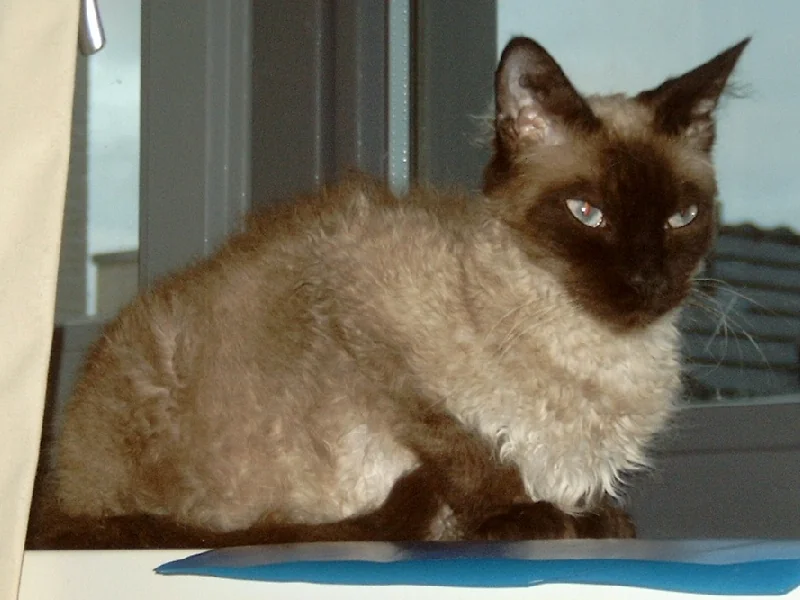
The CFA standard describes a medium to large-sized, heavy-boned, well-muscled cat with a round head, full cheeks, and a distinctive curly coat. The ears are medium-sized with curly interior furnishings. The coat may be long or short; in both lengths it is plush, loose, and individually curled rather than waved or rippled. The whiskers and eyebrows are also curly. All colours and patterns are recognized. The breed's round conformation and plush curly coat have been compared to a teddy bear, and it is sometimes called the 'Sheep Cat' — a designation shared with the LaPerm.
Sources & further reading (3)
- registry-breed-profile — accessed 2026-04-30
- encyclopedia — accessed 2026-04-30
- fife-standard — accessed 2026-04-30
Frequently asked questions
Is the Selkirk Rex mutation dominant or recessive?
The Selkirk Rex carries an autosomal dominant mutation (gene Se). This means a single copy of the gene is sufficient to produce a curly coat, and a curly-coated Selkirk Rex bred to a straight-coated cat will produce approximately 50% curly-coated offspring. This distinguishes the Selkirk Rex from the Cornish Rex (gene r) and Devon Rex (gene re), which are recessive.
When was the Selkirk Rex recognized?
The International Cat Association recognized the Selkirk Rex in 1990. The Cat Fanciers' Association granted championship status in 1992. The Fédération Internationale Féline published its standard in 2012. The GCCF does not maintain a separate Selkirk Rex championship register.
What breeds are permitted as outcrosses for the Selkirk Rex?
Under CFA rules, the Selkirk Rex is permitted outcrosses to Persian, Exotic Shorthair, British Shorthair, and American Shorthair. These outcrosses maintain the heavy-boned, round-headed body type specified in the standard and provide genetic diversity. Kittens from these crosses that carry the Se gene are registered as Selkirk Rex.