Felis catus
Kurilian Bobtail
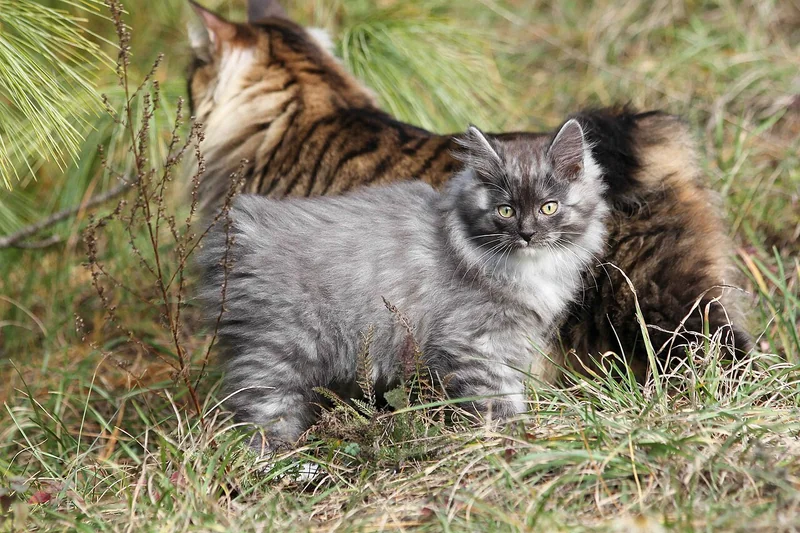 Featured photokurilian-bobtail.jpg
The Kurilian Bobtail is a natural breed from the Kuril Islands and Sakhalin of the Russian Far East, where bobtailed cats have lived for centuries. The short, kinked pom-pom tail is caused by a dominant gene distinct from the Manx and Japanese Bobtail mutations. FIFe recognized the Kurilian Bobtail in 1994; TICA in 2012. CFA and GCCF have not published Kurilian Bobtail standards. The standard describes a semi-cobby, muscular cat with a dense semi-long coat.
Quick facts
- Origin country
- Russia (Kuril Islands)
- Origin period
- Natural island breed on the Kuril and Sakhalin archipelagos; FIFe recognition 1994; TICA recognition 2012
- Coat type
- Medium
- Coat colors
- All colours and patterns recognized except colour point, chocolate, lilac, cinnamon, and fawn under FIFe standard
- Size category
- Medium
- Average lifespan
- 15-20 years
- Recognition
- TICA 2012 · FIFe 1994
Origin
Bobtailed cats have been present on the Kuril Islands and Sakhalin for at least 200 years, introduced by settlers and sailors from the Russian mainland and Japan. Russian scientists, military personnel, and tourists stationed on the islands brought Kurilian cats to mainland Russia from the mid-20th century. Russian breeders began formalizing the breed from the 1980s and developed a standard for FIFe submission. The pom-pom tail is formed by three to eight vertebrae in kinks, curves, and angles unique to each individual cat.
Recognition
The Fédération Internationale Féline published the Kurilian Bobtail standard in 1994, making it one of the few natural Russian breeds with formal international recognition. TICA recognized the Kurilian Bobtail in 2012. CFA and the GCCF have not published Kurilian Bobtail standards as of the mid-2020s. The breed is recognized in both shorthaired and longhaired coat varieties under the FIFe and TICA standards.
Standard
The FIFe standard describes a medium-sized, semi-cobby, well-muscled cat with a broad, rounded head and wide-set ears. The body is compact and powerful, higher at the hindquarters than at the shoulders. The tail is the defining characteristic: a short, 'pom-pom' tail formed by three to eight vertebrae in unique individual kinks, curves, and angles — the CFA standard specifies the tail must be visible but not extend below the hock. Both shorthaired and longhaired varieties are recognized. All colours and patterns are accepted under TICA; FIFe excludes colour point, chocolate, lilac, cinnamon, and fawn.
Sources & further reading (3)
- fife-standard — accessed 2026-04-30
- encyclopedia — accessed 2026-04-30
- tica-standard — accessed 2026-04-30
Frequently asked questions
Is the Kurilian Bobtail tail the same mutation as the Japanese Bobtail?
No. The Kurilian Bobtail and Japanese Bobtail carry different bobtail mutations that are not allelic. The Kurilian Bobtail mutation is dominant — breeding two Kurilian Bobtails produces more bobtailed kittens; the Japanese Bobtail mutation is recessive. The FIFe and TICA standards treat the two breeds as distinct. The Kuril Islands bobtail also produces a different pom-pom shape formed by more vertebrae than the typical Japanese Bobtail stub.
When was the Kurilian Bobtail recognized?
FIFe published the Kurilian Bobtail standard in 1994. TICA recognized the breed in 2012. CFA and GCCF have not published standards. The breed is primarily shown in Russia and through FIFe-affiliated bodies in Europe.
What is the typical lifespan of a Kurilian Bobtail?
FIFe breed club and Russian cattery records consistently report a lifespan of 15 to 20 years for the Kurilian Bobtail — among the longest-lived recognized breeds. The figure reflects the robust natural working-cat constitution of the island population.