Felis catus
Karelian Bobtail
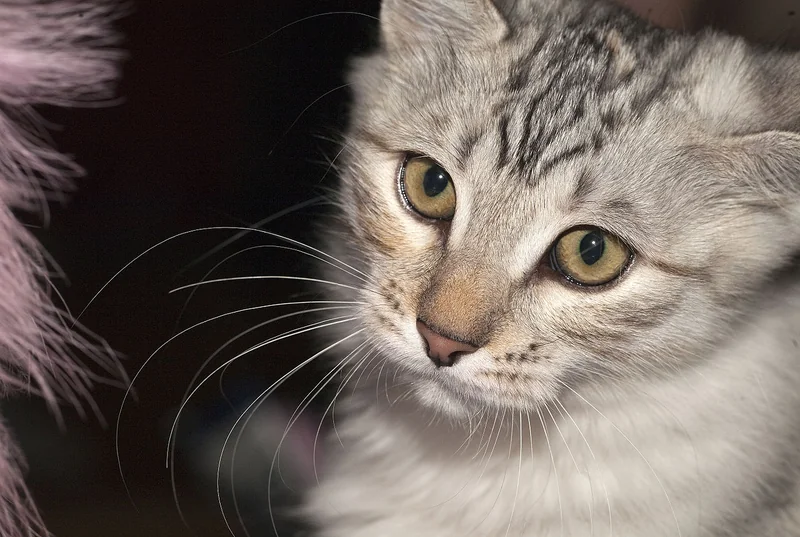 Featured photokarelian-bobtail.jpg
The Karelian Bobtail is a natural Russian breed indigenous to the Karelia and Lake Ladoga regions of northwestern Russia, where bobtailed cats have lived for centuries. The breed carries a natural recessive bobtail mutation distinct from the Kurilian Bobtail (which carries a dominant mutation), the Japanese Bobtail (recessive but allelically distinct), and the American Bobtail (dominant). FIFe accepted the Karelian Bobtail for novice status in 1992. WCF recognized the breed in 1994. CFA, TICA, and GCCF have not published Karelian Bobtail standards.
Quick facts
- Origin country
- Russia (Lake Ladoga, Karelia)
- Origin period
- Natural breed of Karelia and Lake Ladoga; FIFe novice 1992; WCF recognition 1994
- Coat type
- Medium
- Coat colors
- All colours and patterns recognized; the breed is shown in shorthair and longhair varieties
- Size category
- Medium
- Average lifespan
- 12-15 years
- Recognition
- FIFe 1992
Origin
The Karelian Bobtail is a natural Russian breed indigenous to the Karelia and Lake Ladoga regions of northwestern Russia, where bobtailed cats have lived for centuries adapted to the cold subarctic climate. Russian breeders began formalizing the breed from the 1980s, primarily in Saint Petersburg. The Karelian Bobtail bobtail gene is recessive — distinct from the dominant Kurilian Bobtail mutation despite the geographic similarity in northern Russia.
Recognition
FIFe accepted the Karelian Bobtail for novice status in 1992 — placing it on the path toward championship within the FIFe category structure. The World Cat Federation recognized the breed in 1994. CFA, TICA, and GCCF have not published Karelian Bobtail standards. The breed remains primarily Russian-affiliated and is shown through FIFe and WCF affiliates in Continental Europe and Russia.
Standard
The FIFe standard describes a medium-sized, well-muscled cat with a moderate-foreign body type and a short, kinked tail. The head is medium-sized with a well-defined wedge and rounded contours. The coat is medium length in the standard variety, with both shorthair and longhair varieties recognized. The bobtail must be at least three vertebrae and not more than half normal tail length, forming a unique kinked or curved shape per individual. All colours and patterns are recognized.
Sources & further reading (3)
- fife-standard — accessed 2026-04-30
- encyclopedia — accessed 2026-04-30
- registry-standard — accessed 2026-04-30
Frequently asked questions
How does the Karelian Bobtail differ from the Kurilian Bobtail?
The Karelian Bobtail's bobtail gene is recessive, while the Kurilian Bobtail's bobtail gene is dominant. Crossing the two breeds produces full-tailed offspring, confirming the genes are not allelic. Geographically the breeds also differ: the Karelian Bobtail is indigenous to the Karelia region of northwestern Russia, while the Kurilian Bobtail is from the Kuril Islands of the Russian Far East.
When was the Karelian Bobtail recognized?
FIFe accepted the Karelian Bobtail for novice status in 1992. The World Cat Federation recognized the breed in 1994. CFA, TICA, and GCCF have not published Karelian Bobtail standards.
What is the difference between the four major bobtail breeds?
There are four genetically distinct bobtail breeds: Manx (dominant, Isle of Man, taillessness spectrum), Japanese Bobtail (recessive, Japan, pom-pom tail), American Bobtail (dominant, North America, longer kinked tail), Kurilian Bobtail (dominant, Kuril Islands, pom-pom tail), and Karelian Bobtail (recessive, Karelia/Russia, kinked tail). Each carries a distinct mutation that is not allelic with the others.