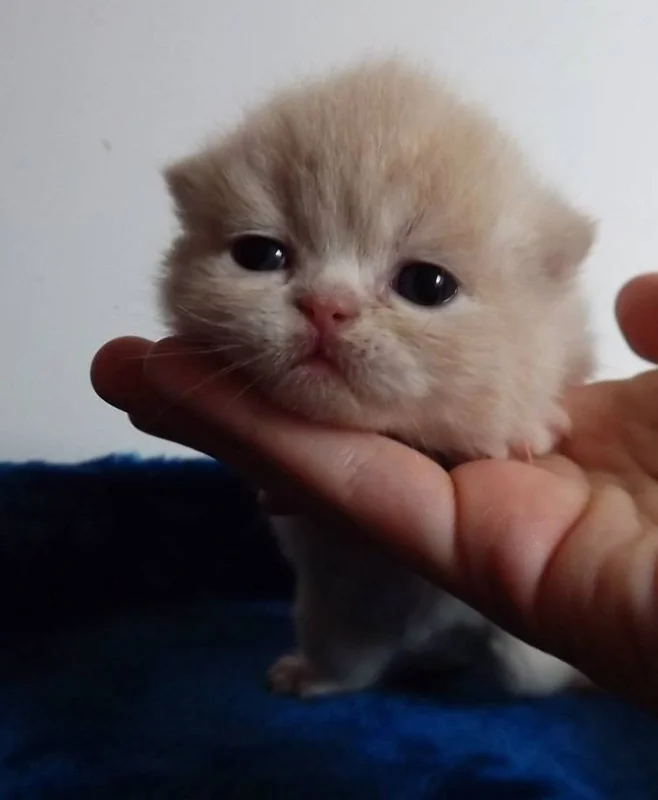
The Foldex is a Canadian breed developed by Betty-Ann Yaxley of Quebec beginning in 1992 through crosses between Scottish Folds and Exotic Shorthairs. The breed combines the Scottish Fold's dominant ear-fold gene (Fd) with the Exotic Shorthair's cobby Persian-type body. The Canadian Cat Association (CCA) recognized the Foldex in 1998. CFA, TICA, GCCF, and FIFe have not published Foldex standards. The standard describes a medium-sized, cobby cat with folded ears, a round head, and a short plush coat.
Quick facts
- Origin country
- Canada
- Origin period
- 1992 Scottish Fold x Exotic Shorthair cross by Betty-Ann Yaxley; CCA recognition 1998
- Coat type
- Short
- Coat colors
- All colours and patterns recognized except colourpoint, chocolate, lavender (Fold standard restrictions)
- Size category
- Medium
- Average lifespan
- 11-15 years
- Recognition
- —
Origin
Betty-Ann Yaxley of Quebec, Canada began developing the Foldex in 1992 by crossing Scottish Folds with Exotic Shorthairs. The breed combines the Scottish Fold's dominant ear-fold gene (Fd) with the Exotic Shorthair's cobby Persian-type body and short plush coat. The breed name combines 'Fold' (from Scottish Fold) and 'Ex' (from Exotic Shorthair).
Recognition
The Canadian Cat Association (CCA) recognized the Foldex in 1998 — the first formal registry to do so. CFA, TICA, GCCF, and FIFe have not published Foldex standards. The breed is shown primarily in Canada through CCA-affiliated bodies. International concerns about the cumulative welfare risks of combining the Scottish Fold ear-cartilage mutation with the Persian/Exotic brachycephalic skull have limited international registry adoption.
Standard
The CCA standard describes a medium-sized, cobby, well-muscled cat with substantial bone — the Exotic Shorthair body type. The head is round and large with a short broad nose and full cheeks. The defining characteristic is the ear fold: ears must fold forward and downward in the Scottish Fold style, lying flat against the skull. The coat is short, dense, and plush in the Exotic Shorthair texture. All Exotic Shorthair colour divisions are recognized except those excluded by the Scottish Fold standard (chocolate, lavender, and Himalayan pattern).
Sources & further reading (3)
- encyclopedia — accessed 2026-04-30
- registry-standard — accessed 2026-04-30
- encyclopedia — accessed 2026-04-30
Frequently asked questions
What two breeds are crossed to produce the Foldex?
The Foldex is a cross between the Scottish Fold and the Exotic Shorthair. The breed combines the Scottish Fold's dominant ear-fold gene (Fd) with the Exotic Shorthair's cobby Persian-type body and short plush coat. The breed name combines 'Fold' (from Scottish Fold) and 'Ex' (from Exotic Shorthair).
When was the Foldex recognized?
The Canadian Cat Association (CCA) recognized the Foldex in 1998. CFA, TICA, GCCF, and FIFe have not published Foldex standards. The breed is shown primarily in Canada through CCA-affiliated bodies.
Why isn't the Foldex recognized internationally?
International registries have raised concerns about the cumulative welfare risks of combining the Scottish Fold ear-cartilage mutation (associated with osteochondrodysplasia in homozygous individuals) with the Persian/Exotic brachycephalic skull. The GCCF withdrew Scottish Fold recognition in 1974 over similar concerns, and FIFe has never recognized the Scottish Fold. The Foldex inherits both controversies and has therefore had limited international adoption.