Felis catus
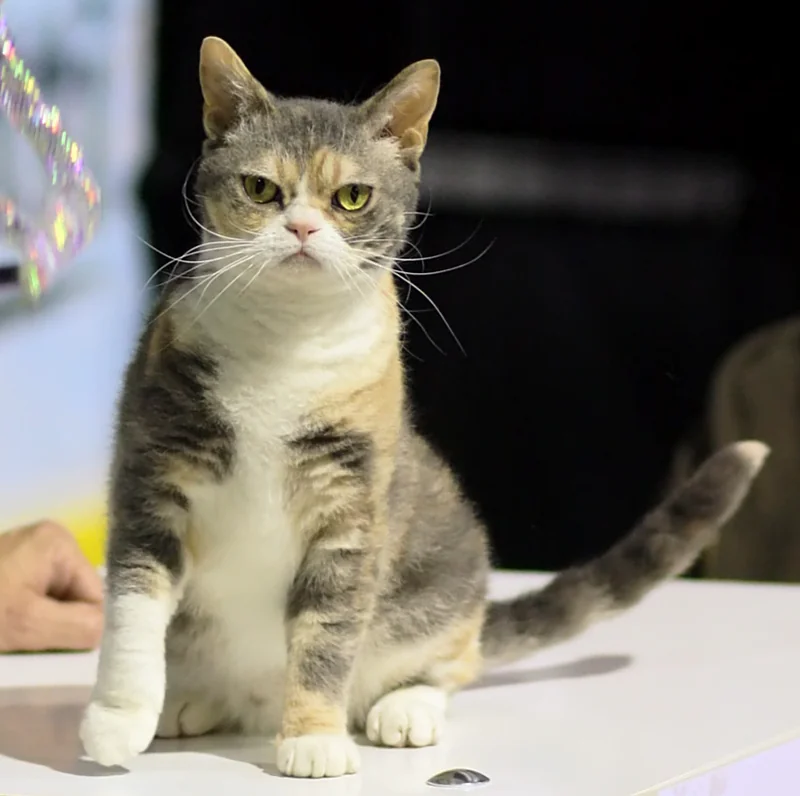
American Wirehair
 Featured photoamerican-wirehair.jpg
The American Wirehair is a breed defined by a natural dominant mutation causing the coat hairs to be crimped, hooked, or bent rather than straight. The foundation male, Council Rock Farm Adam, was born in Vernon, New York in 1966. Breeder Joan O'Shea developed the breed. CFA granted championship status in 1978. TICA has not published a separate American Wirehair standard. The standard describes a medium-sized, well-built cat conforming to the American Shorthair standard except for coat texture.
Quick facts
- Origin country
- United States (Vernon, New York)
- Origin period
- 1966 natural wiry-coat mutation (Council Rock Farm Adam; Joan O'Shea); CFA championship 1978
- Coat type
- Wirehaired
- Coat colors
- All colours and patterns recognized (same as American Shorthair)
- Size category
- Medium
- Average lifespan
- 14-18 years
- Recognition
- CFA 1978
Origin
A wiry-coated red-and-white male kitten named Council Rock Farm Adam was born on a farm in Vernon, New York in 1966 from two straight-coated domestic parents, making this a natural spontaneous dominant mutation (gene Wh). Breeder Joan O'Shea purchased Adam and crossed him with a straight-coated American Shorthair female; three of six resulting kittens were wiry-coated, confirming the autosomal dominant inheritance. O'Shea developed the breed programme and submitted the American Wirehair to CFA.
Recognition
CFA granted the American Wirehair championship status in 1978. TICA, GCCF, and FIFe have not published American Wirehair standards. The breed is recognized solely by CFA and is among the rarest CFA championship breeds, with a small breeding population concentrated in North America. Outcrosses to American Shorthair are permitted under CFA rules to maintain genetic diversity.
Standard
The CFA standard describes the American Wirehair as conforming to the American Shorthair standard in all respects except coat texture. The coat is medium-length, dense, and resilient — each individual hair is crimped, hooked, or bent, producing a wiry texture unlike any other recognized domestic cat breed. The texture must be springy rather than soft, with distinct density. Whiskers are often crimped or curled as well. All American Shorthair colour classes are recognized. The wiry coat texture is assessed by feel rather than by visual appearance; the CFA standard specifies 'dense, resilient, crimped, and hooked coat' as the essential characteristic.
Sources & further reading (3)
- registry-breed-profile — accessed 2026-04-30
- encyclopedia — accessed 2026-04-30
- tica-standard — accessed 2026-04-30
Frequently asked questions
When was the American Wirehair recognized?
CFA granted the American Wirehair championship status in 1978. TICA, GCCF, and FIFe have not published American Wirehair standards. The breed is one of the rarest recognized by CFA.
Is the American Wirehair gene dominant or recessive?
The American Wirehair's wiry coat is caused by the autosomal dominant Wh gene. A single copy produces the wiry coat; crossing a Wirehair with a straight-coated American Shorthair produces approximately 50% wiry-coated offspring. Homozygous (Wh/Wh) individuals may have an even more extreme wiry coat texture.
How is the American Wirehair different from the Rex breeds?
The American Wirehair (Wh gene) produces individually crimped, hooked, or bent hairs across all coat layers — guard hairs, awn hairs, and down hairs — resulting in a dense, springy, wiry texture. The Rex breeds carry mutations that eliminate or reduce the guard hair layer, producing soft curly or wavy coats. The American Wirehair's texture is described as springy and harsh rather than soft, distinguishing it from the Cornish, Devon, and Selkirk Rex coats.