Diomedea exulans
Wandering Albatross (Diomedea exulans)
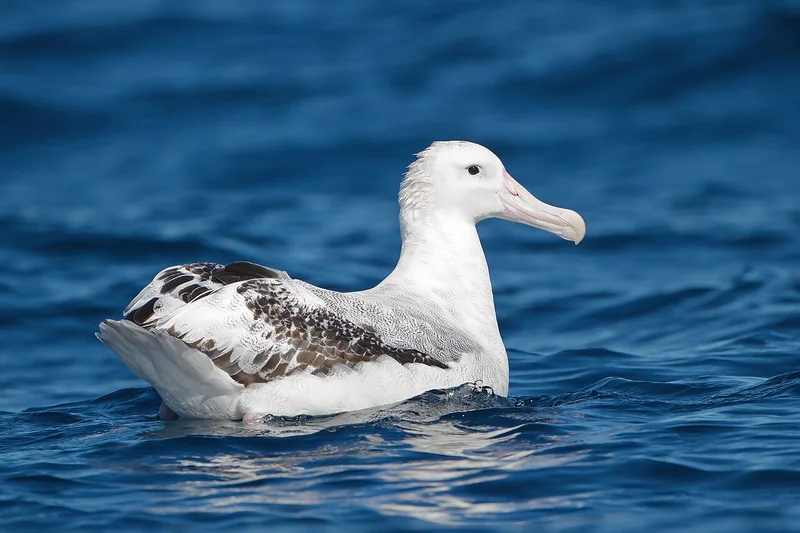 Featured photowandering-albatross.jpg
Diomedea exulans, the wandering albatross, has the largest wingspan of any living bird — adults routinely reach 3.5 m, with the longest measured at 3.7 m. Body length is 1.07 to 1.35 m and adult mass 6 to 11.3 kg. Adult plumage is mostly white with black wingtips; juveniles are uniformly chocolate brown. The IUCN lists the species as Vulnerable, reflecting major population declines from longline-fisheries bycatch. Wandering albatrosses can fly 10,000 km in a single foraging trip without rest.
Quick facts
- Habitat
- The open Southern Ocean and surrounding pelagic waters. Breeds on a small number of subantarctic islands; spends nearly all of life at sea, returning to land only every two years to breed.
- Range
- Circumpolar Southern Ocean. Breeds on a small number of subantarctic islands — South Georgia, Crozet, Kerguelen, Marion and Prince Edward Islands, plus a few others. Foraging range covers the entire Southern Ocean from the antarctic convergence north to the subtropical convergence.
- Size
- 107–135 cm body · 250–370 cm wingspan · 6–11.3 kg
- Plumage
- Adult males are mostly white with black wingtips and a fine pinkish spot at the base of the bill. Adult females are similar but show more brown speckling on the breast. Juveniles are uniformly chocolate brown with a white face, gradually whitening with each annual moult over about ten years until the adult mostly-white plumage is reached. The full plumage progression to mature adult is one of the longest of any bird.
- Song
- Mostly silent at sea. At breeding colonies, pairs perform elaborate sky-pointing displays accompanied by guttural honks, bill-clattering, and grunting. The vocalizations are quiet relative to most colonial seabirds.
- Migration
- Vast pelagic dispersals. Non-breeding birds may circumnavigate the antarctic continent multiple times in a year. Breeding adults make foraging flights of 10,000 km from the breeding island and back over a span of about two weeks, then exchange incubation duties with their mate.
- Conservation
- Vulnerable (VU)
Overview
Diomedea exulans is one of the largest of about twenty-two extant albatross species and has the largest wingspan of any living bird. The species' Latin epithet 'exulans' means 'wandering' or 'in exile', a reference to the species' nearly continuous oceanic flight. Wandering albatrosses pair for life and can live over fifty years; some individually banded birds at South Georgia have been documented breeding into their sixties.
Conservation status
The IUCN lists wandering albatross as Vulnerable, reflecting major population declines from longline-fisheries bycatch. Albatrosses scavenging on baited longline hooks are dragged underwater and drowned at substantial rates — the bycatch was the leading cause of decline in the late twentieth century. Mitigation measures (bird-scaring tori lines, weighted hooks, night setting) have reduced bycatch in regulated fisheries but illegal and unregulated longline fishing continues to be a major threat.
Dynamic soaring
Wandering albatrosses fly on dynamic soaring — a flight technique that exploits the wind gradient near the ocean surface to extract energy without flapping. The bird descends with the wind to gain speed, banks into the wind near the surface, climbs against the wind to gain altitude, and repeats the cycle indefinitely. The technique is so energy-efficient that an albatross's heart rate during long-distance flight is barely above resting; the bird can fly 10,000 km in a single foraging trip with only a small fraction of the energy a powered flier would need.
Sources & further reading (2)
- iucn-red-list — accessed 2026-04-30
- encyclopedia — accessed 2026-04-30
Frequently asked questions
How big is a wandering albatross's wingspan?
Wandering albatross has the largest wingspan of any living bird — adults routinely reach 3.5 m, with the longest reliably measured at 3.7 m. The huge wing area supports dynamic-soaring flight on the wind gradients of the Southern Ocean. Several extinct birds (the Pleistocene Argentavis, Cretaceous flying reptiles) had longer wingspans, but among living species the wandering albatross is the unchallenged record-holder.
How do albatrosses fly so far without flapping?
Albatrosses use dynamic soaring — a flight technique that exploits the wind gradient near the ocean surface. The bird descends with the wind to gain speed, banks into the wind near the surface, climbs against the wind to gain altitude, and repeats. The cycle is so energy-efficient that the bird's heart rate during long-distance flight is barely above resting. The species can fly 10,000 km in a single foraging trip with only a small fraction of the energy a powered flier would expend.
Why are wandering albatrosses threatened?
Major declines through the late twentieth century were driven by longline-fisheries bycatch. Albatrosses scavenging on baited longline hooks are dragged underwater and drowned. Even modest annual mortality of breeding adults causes severe population decline because of the species' very slow reproductive rate (one chick every two years). Mitigation measures (bird-scaring tori lines, weighted hooks, night setting) have reduced bycatch in regulated fisheries but illegal longline fishing remains a major threat.