Bubo scandiacus
Snowy Owl (Bubo scandiacus)
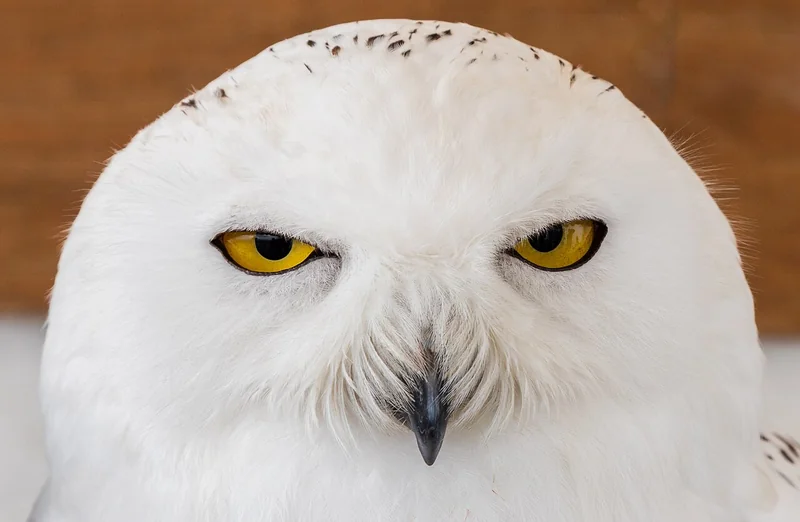 Featured photosnowy-owl.jpg
Bubo scandiacus, the snowy owl, is a large diurnal owl of the high arctic, with a circumpolar breeding range. Adults are 52 to 71 cm long with a wingspan of 1.25 to 1.5 m and weigh 1.6 to 2.95 kg. Adult males are mostly pure white with sparse dark spotting; females and juveniles are heavily barred with dark brown. The IUCN lists the species as Vulnerable, reflecting recent declines linked to changes in arctic prey populations and warming climate. The snowy owl is among the heaviest northern owls and one of the few owls that hunts routinely by day.
Quick facts
- Habitat
- Open tundra, coastal flats, agricultural fields (in the wintering range), and any treeless open landscape. Outside the breeding season, the species turns up at airports, beaches, and farmland across the northern temperate zone.
- Range
- Circumpolar arctic — breeds across the high latitudes of North America, Europe, and Asia. Winter range extends south irregularly to the central United States, central Europe, and central Asia depending on prey-driven 'irruption' years.
- Size
- 52–71 cm body · 125–150 cm wingspan · 1.6–2.95 kg
- Plumage
- Adult males are mostly pure white with very sparse fine dark flecking. Adult females show a heavily dark-barred white plumage; juveniles and first-year birds are even more heavily barred and mottled. Females and juveniles average larger than adult males. Reverse-sexual size dimorphism — females larger than males — is characteristic of most owls but particularly pronounced in this species.
- Song
- Males give a loud booming 'krooh-krooh' or hooting series during territorial display; both sexes give various barks and screeches near the nest. The species is much more silent in the wintering range, where vocalizations are rare.
- Migration
- Highly variable and irruptive. Some birds remain on the arctic breeding range year-round; others move south depending on lemming crash years. Major southerly irruption years bring large numbers to temperate latitudes every few years.
- Conservation
- Vulnerable (VU)
Overview
Bubo scandiacus is the only Bubo owl restricted to arctic and subarctic latitudes. The species' breeding range covers the circumpolar high arctic, and individuals routinely move thousands of kilometres between winters depending on prey conditions. The owl is famous from its appearance as Hedwig in the Harry Potter novels and films, which contributed to a documented post-2001 surge in unauthorized owl ownership and subsequent welfare problems across multiple countries.
Lemming dependence
Snowy owl breeding success on the arctic tundra tracks lemming population cycles closely. In peak lemming years, female snowy owls lay clutches of nine or more eggs and successfully fledge full broods; in lemming crash years, breeding is largely skipped or fails. The decadal lemming cycle therefore drives most of the demographic variation in the species. Recent shifts in arctic snow conditions have disrupted lemming population cycles in several regions, and snowy owl reproductive success has correspondingly declined — one of the proposed drivers of the species' Vulnerable IUCN listing.
Irruptions
Most years, snowy owls remain near the arctic breeding range. In 'irruption' years — usually following a lemming crash — large numbers of owls move south to unusually low latitudes. The 2013-14 irruption brought hundreds of snowy owls to the eastern United States as far south as Florida and Bermuda. Irruption years are unpredictable and driven by post-breeding-season prey availability, not winter cold.
Sources & further reading (2)
- iucn-red-list — accessed 2026-04-29
- encyclopedia — accessed 2026-04-29
Frequently asked questions
Why are snowy owls listed as Vulnerable?
The IUCN uplisted the species to Vulnerable in 2017 reflecting evidence of significant population decline. Drivers include changes in arctic snow conditions disrupting lemming population cycles (and therefore breeding success), increased mortality at low-latitude wintering grounds, and possibly climate-driven shifts in arctic ecosystems. The decline is one of the most concerning among large arctic-breeding birds.
What is a snowy owl irruption?
An irruption is a year in which large numbers of snowy owls move much further south than typical, sometimes reaching the central or even southern United States. Irruption years usually follow a peak-then-crash lemming cycle: high lemming numbers produce many fledged owls, then the lemming crash leaves them without sufficient food on the breeding range, and the surplus owls move south. The 2013-14 irruption brought hundreds of owls to the eastern US as far south as Florida.
Are male and female snowy owls really differently coloured?
Yes. Adult males are mostly pure white with very sparse fine dark flecking. Adult females and juveniles are heavily barred with dark brown — substantially darker overall. Males become whiter with each annual moult, with the oldest males approaching pure white. The colour difference is one of the most marked sexual plumage dimorphisms among owls and serves both crypsis on the breeding tundra (the female matches mottled snow-and-rock; the male is more conspicuous) and possibly mate-choice signalling.