Arenaria interpres
Ruddy Turnstone (Arenaria interpres)
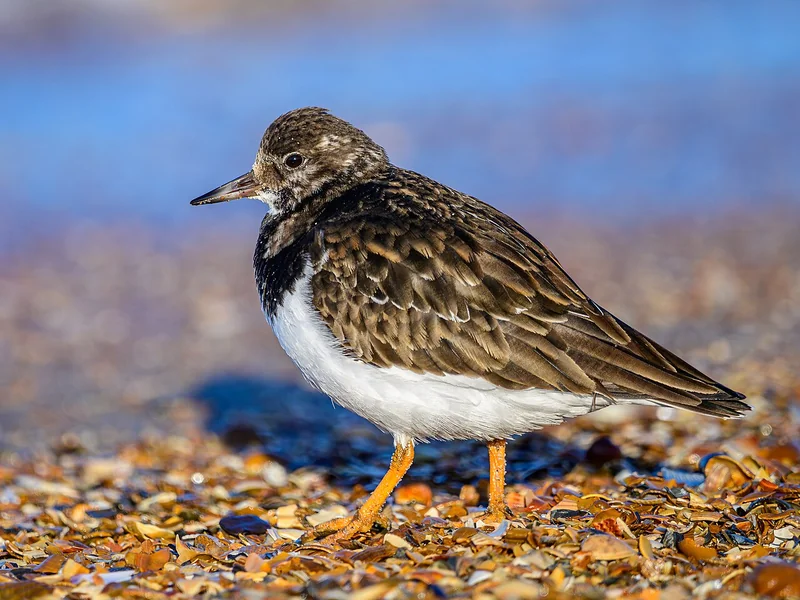 Featured photoruddy-turnstone.jpg
Arenaria interpres, the ruddy turnstone, is a small shorebird with one of the broadest non-breeding distributions of any bird. Adults are 22 to 24 cm long with a wingspan of 50 to 57 cm and weigh 84 to 190 g. Breeding plumage shows a striking pied pattern of chestnut-and-black above and bright white underparts; non-breeding plumage is duller. The IUCN lists the species as Least Concern. The species is named for its distinctive foraging technique — using the wedge-shaped bill to flip stones, shells, and seaweed to expose invertebrates underneath.
Quick facts
- Habitat
- Rocky and pebbly seashores, tidal flats, beaches with abundant seaweed, and coastal mudflats during the non-breeding season; high Arctic coastal tundra during breeding.
- Range
- Breeds on high Arctic coastal tundra of North America, Greenland, Scandinavia, and Russian Arctic. Winters on rocky and pebbly coasts across the Americas, Europe, Africa, Asia, and Australia.
- Size
- 22–24 cm body · 50–57 cm wingspan · 84–190 g
- Plumage
- Breeding adults show a striking pied pattern — chestnut-red back and wings boldly marked with black, a black-and-white striped face, bright white underparts, and orange legs. Non-breeding adults are duller — replacing the chestnut and black with mottled grey-brown, but retaining the orange legs and short heavy bill. Both sexes are similar; males are slightly more saturated in breeding plumage.
- Song
- A short rattling 'tuk-a-tuk-tuk' contact call delivered constantly by foraging flocks. The species' breeding-territory call is rarely heard outside the high Arctic; the rattling contact call is the species' acoustic signature on coasts worldwide.
- Migration
- Long-distance migrant. Arctic breeders travel south to coasts across nearly every continent. Annual round-trip migrations of 10,000-20,000 km are typical.
- Conservation
- Least Concern (LC)
Overview
Arenaria interpres is one of two Arenaria turnstones (with the black turnstone A. melanocephala of the Pacific coast). The Latin epithet 'interpres' means 'messenger' or 'interpreter' — the application to this species is unclear and may date to medieval European folk taxonomy. The English name 'turnstone' directly references the species' distinctive stone-flipping foraging technique that is unique among shorebirds.
Stone-flipping
Ruddy turnstones forage by using the short, slightly upturned, wedge-shaped bill to flip over stones, shells, kelp, driftwood, and other coastal debris — exposing invertebrates hiding underneath. The bill is anatomically specialized for this technique: the upturned profile and stout structure provide leverage for flipping objects substantially larger than the bird's head. The behaviour is unique among the world's shorebirds and is the source of the species' English name. Foraging flocks systematically work along a beach overturning every stone and shell available.
Wide non-breeding distribution
Ruddy turnstones have one of the broadest non-breeding distributions of any bird. Arctic breeders travel south to coasts across nearly every continent — the Americas, Europe, Africa, Asia, and Australia all support major non-breeding populations. The species is one of the most-encountered shorebirds along non-tropical coasts worldwide and is a cosmopolitan member of the global shorebird fauna.
Sources & further reading (2)
- iucn-red-list — accessed 2026-04-30
- encyclopedia — accessed 2026-04-30
Frequently asked questions
Why are turnstones named for stone-flipping?
Ruddy turnstones forage by using the short, slightly upturned, wedge-shaped bill to flip over stones, shells, kelp, and other coastal debris — exposing invertebrates hiding underneath. The behaviour is unique among the world's shorebirds, and the English name 'turnstone' directly references the technique. Foraging flocks systematically work along a beach overturning every stone and shell available, and the action is loud enough that the rustling shell-flipping is often the first identification cue.
How widely distributed is the ruddy turnstone?
Ruddy turnstones have one of the broadest non-breeding distributions of any bird. Arctic breeders travel south to coasts across the Americas (from Alaska to Tierra del Fuego), Europe, Africa, Asia, and Australia — virtually every coastline outside the polar ice zones supports turnstone populations during the non-breeding season.
Are ruddy turnstones related to other sandpipers?
Yes — turnstones are members of the family Scolopacidae alongside sandpipers, snipes, godwits, and curlews. The two Arenaria turnstones are placed in their own genus within the family on the basis of their distinctive bill morphology and foraging technique. Molecular phylogeny supports the Arenaria genus as a distinct lineage within Scolopacidae, but the broader family relationships are clear.