Dacelo novaeguineae
Laughing Kookaburra (Dacelo novaeguineae)
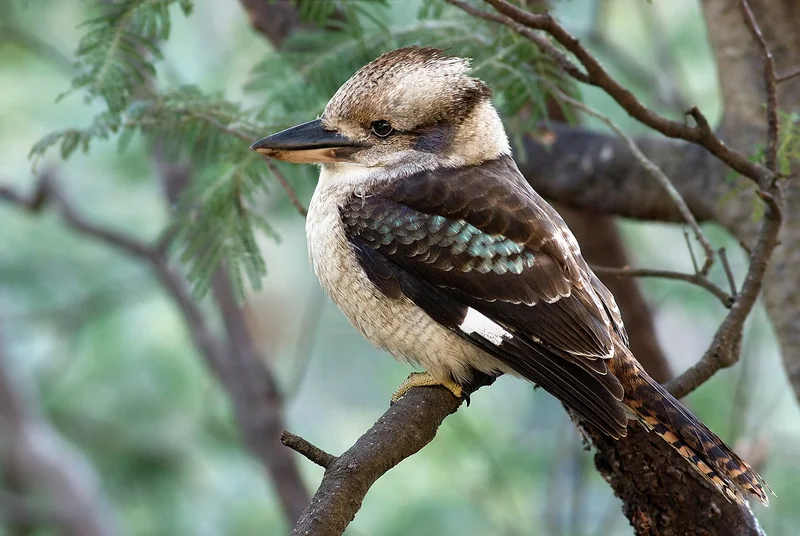 Featured photolaughing-kookaburra.jpg
Dacelo novaeguineae, the laughing kookaburra, is a large terrestrial kingfisher of the family Alcedinidae, native to eastern Australia. Adults are 41 to 47 cm long with a wingspan of 65 cm and weigh 207 to 480 g. The plumage is mostly cream-coloured with brown wings and back, dark stripes through the eye, and a heavy black bill. The IUCN lists the species as Least Concern. The species' raucous laughing call is one of the most recognizable bird sounds in the world and is a signature soundtrack of the Australian bush.
Quick facts
- Habitat
- Open eucalyptus woodland, dry forest edges, and the suburbs of southeastern Australian cities. Despite the species' classification as a kingfisher, the laughing kookaburra rarely fishes and is largely a terrestrial predator.
- Range
- Native to eastern Australia from northern Queensland south through New South Wales to Victoria and South Australia. Introduced and established in southwestern Australia and Tasmania.
- Size
- 41–47 cm body · 60–70 cm wingspan · 207–480 g
- Plumage
- Adults show cream-white head and underparts, a brown back and wings (with bright blue patches on the upperwing visible in flight), a dark brown stripe running from the bill back through the eye, and a heavy black bill with a paler lower mandible. Both sexes look alike; juveniles have shorter bills and slightly duller plumage.
- Song
- The famous 'laughing' call — a loud cackling, descending series sounding remarkably like raucous human laughter. Pairs and family groups join in chorus, particularly at dawn and dusk; the chorus carries over a kilometre. The call is one of the most recognizable bird sounds in the world and is the textbook 'jungle' or 'bush' sound used in films and TV.
- Migration
- Sedentary across the entire native and introduced range. Local movements occur but no regular migration.
- Conservation
- Least Concern (LC)
Overview
Dacelo novaeguineae is one of four Dacelo kookaburra species — large terrestrial kingfishers of Australia and New Guinea. The species is the largest kingfisher in the world and is one of the most familiar Australian birds. The English name 'kookaburra' is from the Wiradjuri language of the Murray-Darling region. The species' Latin epithet 'novaeguineae' (meaning 'New Guinea') is misleading — the species does not occur in New Guinea, and the original specimen was incorrectly labelled when described in 1788.
Distribution
The native range covers eastern Australia. The species was introduced to southwestern Australia and Tasmania during the early twentieth century and has established self-sustaining populations in both regions. Suburban populations across southeastern Australian cities (Sydney, Melbourne, Brisbane) have grown alongside the cities and are now common — the species adapts readily to gardens with mature trees.
Cooperative breeding
Laughing kookaburras are cooperative breeders. Adult breeding pairs are typically assisted by the previous year's offspring (and sometimes earlier years' offspring), who help defend the territory and feed the next year's brood. Family groups of three to six birds are typical and often hold the same territory across multiple years. The cooperative breeding strategy is unusual among kingfishers and is one of several traits that distinguish kookaburras from typical fishing kingfishers.
Sources & further reading (2)
- iucn-red-list — accessed 2026-04-30
- encyclopedia — accessed 2026-04-30
Frequently asked questions
Why does the kookaburra laugh?
The famous 'laughing' call is the species' territorial proclamation — a loud cackling descending series that carries over a kilometre. Pairs and family groups join in chorus, particularly at dawn and dusk, with each bird calling at a slightly different pitch to produce the distinctive raucous laughing effect. The call announces territory holding and warns off intruders. The dawn chorus is one of the most familiar sounds of the Australian bush.
Do kookaburras really eat snakes?
Yes. Laughing kookaburras routinely take snakes — including small venomous snakes — as prey. The bird hunts from a perch by drop-and-strike attacks: when a snake is detected on the ground, the kookaburra dives onto it, seizes it behind the head with the heavy bill, and slams it repeatedly against the perch or ground to subdue it. Lizards and large insects are taken by similar techniques. The 'kingfisher' name is misleading — laughing kookaburras rarely take fish.
Why are they called 'kingfishers' if they don't fish?
The kingfisher family Alcedinidae includes both fishing species (the typical kingfishers) and predominantly terrestrial species (the kookaburras and many tropical Asian and African genera). The English name 'kingfisher' was historically applied across the family despite the dietary diversity. Within the family, the four Dacelo kookaburra species are largely terrestrial predators of snakes, lizards, and insects, with fish making up only a small fraction of the diet.