Yunnan Dianhong
Yunnan Province's full-bodied black tea — prominent golden tips, cocoa-malt character, and large leaf size.
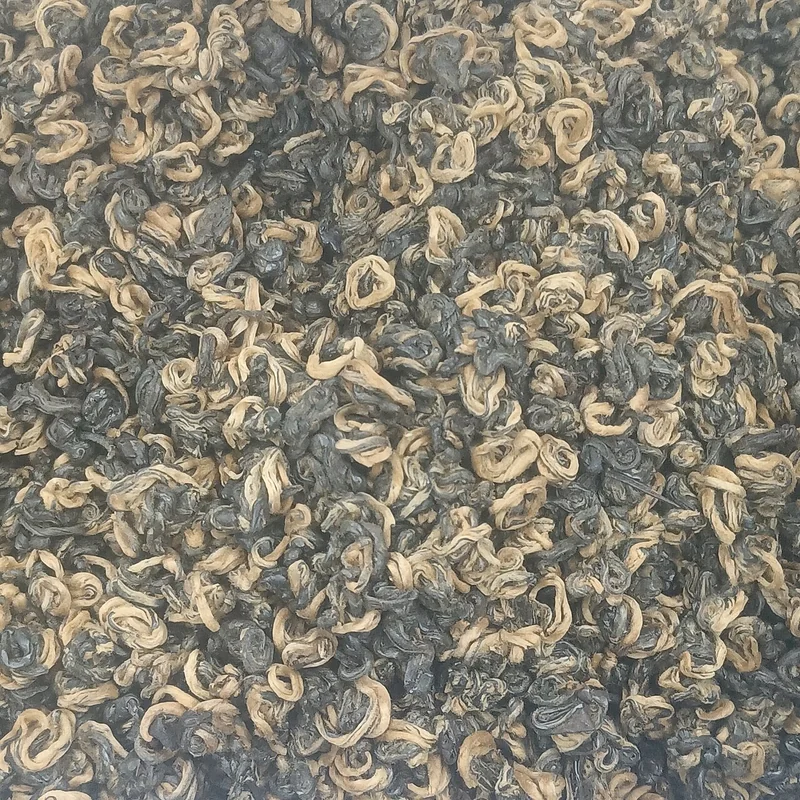
Yunnan Dianhong (滇紅, 'Yunnan Red') is a black tea produced in Yunnan Province, southwestern China, introduced commercially in 1939 by Feng Shaoqiu during the Second Sino-Japanese War as an alternative export to Indian teas whose supply was disrupted. Produced from Camellia sinensis var. assamica — the same large-leaf variety as Assam — Yunnan Dianhong is known for its large, robust leaves, prominent golden-yellow tips (buds), a rich amber-red infusion, and a flavour profile characterised by cocoa, malt, and honey. Premium grades, such as Dian Hong Jin Ya (Golden Buds), consist almost entirely of golden tips and are among the most expensive Chinese black teas.
Quick facts
- Type
- Tea
- Origin
- China (Yunnan Province, Lincang, Fengqing, Simao)
- Oxidation
- Black (full)
- Caffeine
- High
- Astringency
- Low to moderate, less than Indian assamica
- Sweetness
- Natural honey, cocoa sweetness
- Body
- Full, rich
- Tasting notes
- cocoa, malt, honey, dried fruit, tobacco
Introduction in 1939 and Wartime Context
Feng Shaoqiu, a graduate of Fuzhou's tea technical school, was sent to Yunnan by the Chinese National Tea Corporation in 1938 to establish black tea production as India and Ceylon supplies became uncertain during wartime. In 1939, Feng produced the first batches of Yunnan black tea at the Shunning Experimental Tea Factory (now Fengqing County). The initial export shipment was sent to London and reportedly commanded higher prices than contemporary Darjeeling teas, establishing Dianhong's commercial value. Production expanded during the 1940s and was incorporated into state enterprise during the People's Republic era, with Kunming Tea Factory becoming a key producer.
Golden Tips and Leaf Grades
The golden appearance of Dianhong's tips results from the high density of fine hairs (called trichomes) on the young bud. These hairs are naturally golden-yellow in Yunnan's assamica varieties before processing. During rolling and oxidation, the hairs — protected from full oxidation by their waxy surface — remain yellow while the leaf tissue turns dark brown. The ratio of golden tips to leaf determines grade: Dian Hong Jin Ya (Golden Buds), composed almost entirely of tips, is the most prized and expensive. Lower grades mix buds with one or two leaves. The large leaf size of Yunnan assamica — among the largest of any tea plant — contributes to the tea's robust character.
Production Regions
Yunnan Dianhong is produced across Yunnan's southwestern districts, with the primary areas being Lincang (Fengqing County), Xishuangbanna (Menghai and Jinghong), Simao (now called Pu'er City), and Baoshan (Dehong). Each sub-region produces teas with slight regional variations: Fengqing Dianhong is often considered the most balanced and is the historical production centre; Xishuangbanna teas tend to be more tropical in character. The high altitude of Yunnan's tea gardens (800–2,200 metres) combined with the subtropical climate produces large, robust leaves with distinctive flavour.
Sources & further reading (2)
- encyclopedia — accessed 2026-05-07
- specialty-reference — accessed 2026-05-07
Frequently asked questions
Why is Yunnan Dianhong called 'red tea' in Chinese?
In Chinese tea nomenclature, what English speakers call 'black tea' is called 'hong cha' (紅茶, 'red tea') because of the reddish-amber colour of the infusion. 'Dianhong' means 'Yunnan Red' — Dian is an abbreviation for Yunnan Province, and hong means red. This naming convention across East Asian languages (Japanese: kōcha, Korean: hongcha) contrasts with the English 'black tea,' which refers to the colour of the dried leaf.
What are the golden tips in Yunnan Dianhong?
Golden tips are the young buds of the tea plant, covered in fine hair-like structures called trichomes. In Yunnan's assamica varieties, these trichomes are naturally golden-yellow. During processing, the trichomes remain light-coloured while the leaf oxidises to dark brown, creating the visual contrast. The proportion of golden tips is a key quality indicator — high-tip grades like Dian Hong Jin Ya (Golden Buds) are the most premium, commanding the highest prices.
How does Yunnan Dianhong compare to Assam black tea?
Both use Camellia sinensis var. assamica and produce full-bodied black teas, but Yunnan Dianhong is typically less astringent and more honey-like, with a cocoa-malt character. Assam tends to have a more pronounced malty, brisk quality well-suited to milk. Dianhong's higher proportion of tip material contributes sweeter notes. The two are often grouped as 'large-leaf' black teas but differ distinctly in flavour due to terroir and processing.