Sheng Pu-erh (Raw)
Yunnan's living pressed tea — raw pu-erh undergoes gradual fermentation over years, transforming from bitter to smooth.
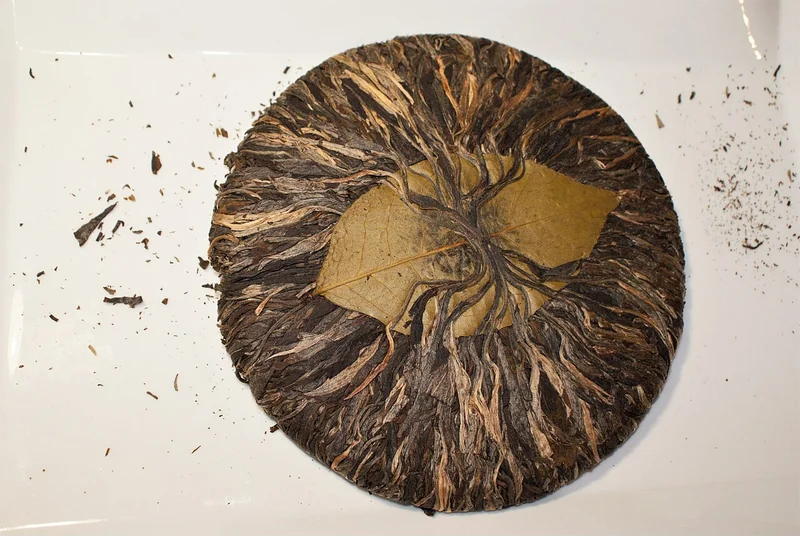
Sheng pu-erh (生普洱, raw pu-erh) is a compressed tea made from sun-dried Yunnan large-leaf maocha (晒青毛茶) that undergoes gradual post-fermentation through slow microbial and enzymatic activity over months to decades. Unlike shou pu-erh, which is artificially fermented in weeks, sheng pu-erh changes slowly — new cakes are vegetal, astringent, and bitter; well-aged cakes (10–30+ years) become complex, mellow, and smooth with notes of dried fruits, camphor, and aged wood. Sheng pu-erh is pressed into cakes (饼, bǐng), bricks (砖, zhuān), and tuocha (沱) for storage and aging. The Yunnan tea mountains — Menghai, Yiwu, Lao Banzhang — are significant geographic markers of quality and provenance.
Quick facts
- Type
- Tea
- Origin
- China (Yunnan Province — Xishuangbanna, Lincang, Simao)
- Cultivar
- Yunnan large-leaf assamica varieties; Yiwu, Menghai, Bulang mountain trees
- Oxidation
- Post-fermented
- Caffeine
- Medium
- Umami
- Deep, evolving umami in aged versions
- Astringency
- High when young, diminishes significantly with age
- Sweetness
- Camphor, dried fruit, aged honey in mature versions
- Body
- Light when young, full and complex when aged
- Tasting notes
- camphor, dried mushroom, aged wood, prune, smoke
Maocha: The Raw Material
Sheng pu-erh production begins with harvesting large-leaf Camellia sinensis var. assamica leaves from Yunnan's old-growth tea trees. The leaves undergo a unique processing sequence: withering, brief hand pan-firing (sha qing) that stops some but not all enzymatic activity, rolling, and sun-drying. The resulting sun-dried leaf is called maocha (毛茶, 'rough tea'). Critically, maocha retains residual enzymatic activity and natural microorganisms — its production stops short of the complete kill-green and thorough drying used for regular green tea. This retained biological activity is what enables aging. Maocha is then typically compressed using steam and hydraulic press into disc or cake shapes, or sold as loose-leaf.
Aging and Microbial Transformation
Properly stored sheng pu-erh undergoes gradual transformation through two main pathways. The first is continued enzymatic oxidation of polyphenols — the catechins in the tea slowly oxidise, reducing astringency and deepening colour. The second is microbial fermentation by naturally occurring organisms including Aspergillus niger, various yeasts, and bacteria that colonise the compressed cake during storage. These organisms produce enzymes that further break down complex polyphenols, convert starches, and create new aromatic compounds. The speed of transformation depends heavily on temperature, humidity, and airflow during storage. Traditional storage in Hong Kong or Guangdong's humid, warm climate (called 'wet storage') produces faster transformation; drier 'dry storage' in Kunming produces slower, cleaner aging.
Old-Growth Trees and Terroir
The value of sheng pu-erh is strongly influenced by the age of the tea trees used. Yunnan's ancient tea groves — particularly in Xishuangbanna's Yiwu, Bulang, Nannuo, and Jingmai areas — contain trees hundreds or even thousands of years old. Old-growth trees (gushu, 古樹, 'ancient tree') have extensive root systems that draw from a different mineral and microorganism profile than younger plantation trees. The resulting maocha is considered more complex, less bitter, and more capable of aging gracefully. Premium sheng pu-erh by famous old-growth estate trees (e.g., Lao Banzhang, Bingdao) commands extraordinary prices at auction. Authentication of gushu pu-erh remains challenging due to limited independent verification.
Sources & further reading (2)
- encyclopedia — accessed 2026-05-07
- specialty-reference — accessed 2026-05-07
Frequently asked questions
How is sheng (raw) pu-erh different from shou (ripe) pu-erh?
Sheng (raw) pu-erh is minimally processed and aged naturally over years to decades, undergoing gradual microbial and enzymatic fermentation. Young sheng is often bitter and astringent; aged sheng is complex and smooth. Shou (ripe) pu-erh uses a 1970s-developed wet-piling process (wo dui) that artificially accelerates fermentation in 45–60 days by exposing moist maocha to heat and microbial inoculation, producing a tea that resembles aged sheng without the years of waiting. The two have distinct flavour profiles — shou is earthier and darker from the start.
How should sheng pu-erh be stored for aging?
Sheng pu-erh ages best in conditions with stable temperature (15–30°C), moderate humidity (60–80 percent), good airflow, and no strong odours. It must be kept away from light, strong smells (tea absorbs odours readily), and excessive moisture (which can cause mould). Traditional Hong Kong storage uses naturally humid conditions; 'dry storage' in lower-humidity environments produces slower, cleaner aging. Compressed cakes age more consistently than loose-leaf.
What makes an old-growth (gushu) pu-erh different?
Old-growth (gushu) trees, hundreds or thousands of years old, have deeper, more extensive root systems than plantation trees. Their leaves draw from a different mineral and microorganism profile and are generally less uniform in their biology, contributing to greater complexity. Gushu pu-erh is typically less bitter, slower to oxidise, and considered more capable of long-term aging. However, gushu authentication is difficult — many products claim old-growth origin without independent verification.