Rooibos
South Africa's endemic herbal infusion — Aspalathus linearis from the Cederberg, naturally caffeine-free.
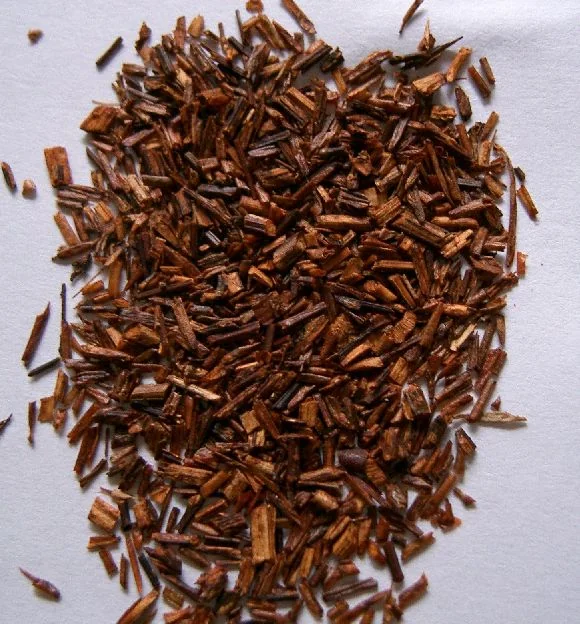
Rooibos (Afrikaans: 'red bush'), botanical name Aspalathus linearis, is a leguminous shrub endemic to a narrow strip of the Cederberg mountain region of the Western Cape, South Africa. The plant's needle-like leaves and stems are used to produce a caffeine-free herbal infusion that is one of South Africa's major agricultural exports. Standard (fermented) rooibos undergoes an oxidation process called fermentation in industry terminology — the cut and bruised leaves are left to oxidise in moist piles for 8–24 hours, turning red-brown and developing a characteristic sweet, slightly vanilla and honey flavour. Green rooibos skips fermentation, retaining a lighter, grassier character.
Quick facts
- Type
- Herbal Infusion
- Origin
- South Africa (Cederberg Mountains, Western Cape)
- Caffeine
- Caffeine-free
- Astringency
- Very low
- Sweetness
- Natural honey-vanilla sweetness
- Body
- Light to medium
- Tasting notes
- vanilla, honey, dried fruit, caramel, earth
Botanical Origins and Geographic Restriction
Aspalathus linearis is a member of the Fabaceae (legume) family, not related to Camellia sinensis. It grows only in the Cederberg and surrounding areas of the Western Cape, at elevations of 400–1,000 metres, in the Fynbos biome — a globally recognised biodiversity hotspot. Early attempts to cultivate rooibos outside this region have largely failed due to its specific soil (typically sandy, low-nutrient soils) and climate requirements. The Khoi and San indigenous peoples of the Cederberg region used rooibos long before commercial cultivation; colonial-era documentation from the 17th–18th centuries records its use as a beverage. Commercial cultivation began in earnest in the early 20th century, driven by Benjamin Ginsberg, a Cape Town tea merchant who promoted rooibos internationally.
Fermented and Green Rooibos
Standard rooibos production involves harvesting the needle-like leaves and stems, cutting them into small pieces, and allowing them to undergo an oxidation process (called fermentation in the industry, though it differs from microbial fermentation of pu-erh). The bruised plant material is moistened and heaped for 8–24 hours, during which enzyme-driven oxidation transforms the green plant matter to the characteristic reddish-brown colour, simultaneously reducing the grassy volatiles and developing vanilla, caramel, and honey compounds. Green rooibos skips this step — the cut plant material is immediately dried without heaping — preserving a lighter colour, more subtle flavour, and higher levels of certain phytochemicals. Green rooibos has gained premium market status as consumers become aware of the different profiles.
South African Export and Certification
South Africa exports approximately 14,000–16,000 tonnes of rooibos annually, with Germany, the Netherlands, Japan, the United Kingdom, and the United States as major markets. Rooibos received a Protected Designation of Origin (PDO) under South African law in 2021, restricting the name to product grown and processed in the defined Cederberg area. This designation followed years of lobbying by the South African rooibos industry to prevent competitors in other countries from producing rooibos-branded products using different plant materials. The PDO certificate issued in 2021 was a significant trade achievement for the South African tea industry.
Sources & further reading (2)
- encyclopedia — accessed 2026-05-07
- industry-association — accessed 2026-05-07
Frequently asked questions
Is rooibos a tea?
In botanical terms, rooibos is not tea — 'tea' strictly refers to infusions from Camellia sinensis. Rooibos is made from Aspalathus linearis, a different plant entirely. It is correctly classified as a herbal tisane or herbal infusion. However, in common usage and commerce, rooibos is widely referred to as a tea, and it is prepared and consumed similarly to tea. The distinction is botanical, not culinary.
What is the difference between red and green rooibos?
Red (standard) rooibos undergoes an oxidation step in which the bruised, cut plant material is heaped and allowed to oxidise for 8–24 hours, turning reddish-brown and developing sweet vanilla and caramel notes. Green rooibos skips this step, retaining a lighter yellow-green colour and a milder, grassier flavour with a more neutral character. Green rooibos tends to command higher prices as a specialty product.
Where does rooibos grow and why only there?
Rooibos grows only in the Cederberg mountain area of the Western Cape, South Africa. The plant requires a very specific combination of acidic, sandy, low-nutrient soils of the Fynbos biome, a Mediterranean climate (wet winters, dry summers), and a specific altitude range. Repeated attempts to cultivate it in other countries with similar climates (Australia, parts of South America) have not produced commercially viable results. Its geographic restriction has contributed to its Protected Designation of Origin certification.