Peppermint
A tisane from Mentha x piperita — a spearmint-watermint hybrid and the world's most consumed herbal infusion.
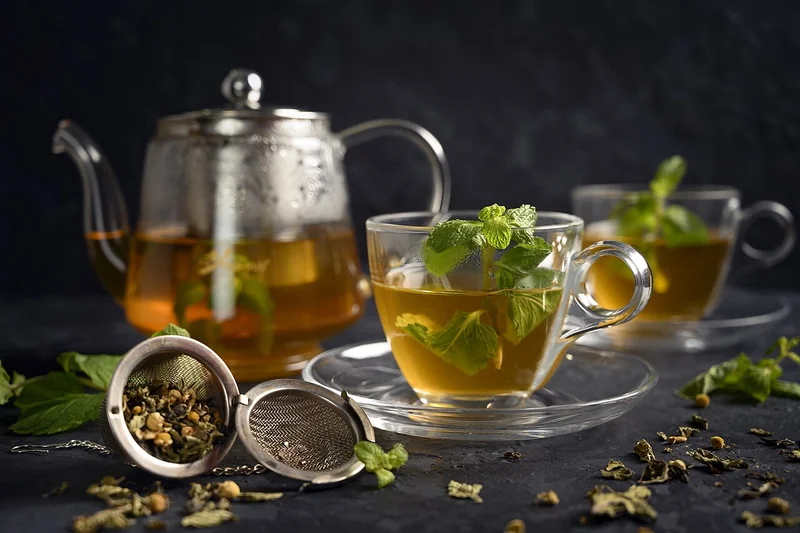
Peppermint tisane is prepared from the dried leaves of Mentha × piperita, a sterile hybrid of spearmint (Mentha spicata) and watermint (Mentha aquatica) that originated in England around the 1750s. The characteristic cooling sensation of peppermint infusion comes primarily from menthol, the principal volatile compound in peppermint oil, which activates the TRPM8 cold-receptor proteins in the mouth and throat without actually changing temperature. Peppermint is cultivated in numerous countries — the United States (Washington, Oregon, Idaho), Germany, India, Morocco, and China are major producers. It contains no caffeine. Peppermint is by volume one of the most consumed herbal infusions globally.
Quick facts
- Type
- Herbal Infusion
- Origin
- England (origin); primarily USA, Germany, India, Morocco
- Caffeine
- Caffeine-free
- Astringency
- Very low
- Sweetness
- Clean, minty freshness
- Body
- Light
- Tasting notes
- menthol, cool mint, fresh grass, light herbal
Botanical Origin and Cultivar
Mentha × piperita is a sterile hybrid — it produces few viable seeds and reproduces primarily by underground stolons (rhizomes). It was first documented in England in 1753 by botanist John Ray, and Carl Linnaeus formally described the species in 1753. Because it cannot self-reproduce by seed, commercial cultivation depends entirely on vegetative propagation. The dominant commercial cultivar in the United States is 'Black Mitcham,' developed from plants introduced to Mitcham, Surrey, England, in the 18th century. The essential oil content of the leaf (0.5–4 percent by weight) determines quality and flavour intensity; menthol typically constitutes 35–55 percent of the essential oil, with additional compounds including menthone, menthyl acetate, and limonene.
Cultivation and Processing
Commercial peppermint is grown in temperate climates with adequate moisture and well-drained soils. In the United States, the Willamette Valley of Oregon and the Columbia Basin of Washington and Idaho are the principal regions. Peppermint fields are harvested by mechanical cutting in late summer, just before full bloom, when essential oil content is at its peak. The cut material is either dried directly or steam-distilled immediately for essential oil extraction. For tea production, the dried leaves are sold whole or cut to standardised particle sizes for tea bag filling. Morocco has emerged as a significant producer of dried peppermint herb, particularly for the European market.
Menthol and the Cooling Sensation
The cooling sensation from peppermint is a documented neurological response, not an actual temperature change. Menthol — the primary volatile compound in peppermint (35–55 percent of essential oil) — binds to and activates TRPM8, a thermoreceptor protein in nerve cells that normally responds to temperatures below 26°C. When menthol binds to TRPM8, the nerve fires as though exposed to cold temperatures, producing the characteristic cooling sensation in the mouth and throat. This is purely a sensory effect. The same mechanism explains why peppermint feels cooling even in hot tea. Menthol is also used in commercial products including toothpaste, chewing gum, and respiratory preparations where the cooling effect is desired.
Sources & further reading (2)
- encyclopedia — accessed 2026-05-07
- regulatory — accessed 2026-05-07
Frequently asked questions
Why does peppermint tea taste cool even when hot?
Menthol, the main aromatic compound in peppermint (35–55 percent of its essential oil), activates TRPM8 thermoreceptors in the mouth and throat — nerve proteins normally responsible for detecting cold temperatures below 26°C. When menthol binds TRPM8, these nerves fire as if the tissue were cold, producing the characteristic cooling sensation. The actual temperature of the hot tea is unchanged; the cooling is entirely a neurological response to menthol.
What is the difference between peppermint and spearmint?
Spearmint (Mentha spicata) is one of the parent species of peppermint (Mentha × piperita, a spearmint × watermint hybrid). Spearmint contains carvone as its primary aromatic compound (50–80 percent of essential oil), producing a milder, sweeter, less intensely cool flavour than peppermint. Peppermint's dominant compound is menthol (35–55 percent), which produces a much stronger, more intense cooling sensation. Both are used in tisanes, but peppermint is generally considered the more intense and commercially dominant variety.
How long should peppermint be steeped?
Peppermint is typically steeped at 95–100°C for 5–7 minutes. Longer steeping (up to 10 minutes) increases menthol extraction and produces a stronger, more intensely cooling flavour. Unlike Camellia sinensis teas, peppermint does not develop bitterness or excessive tannins with extended steeping. Cold-brewing peppermint (cold water, 6–8 hours) produces a refreshing, less intense result — popular as a summer drink.