Moroccan Mint Tea
North Africa's ceremonial green tea with spearmint — a three-pour hospitality ritual judged by its foam.
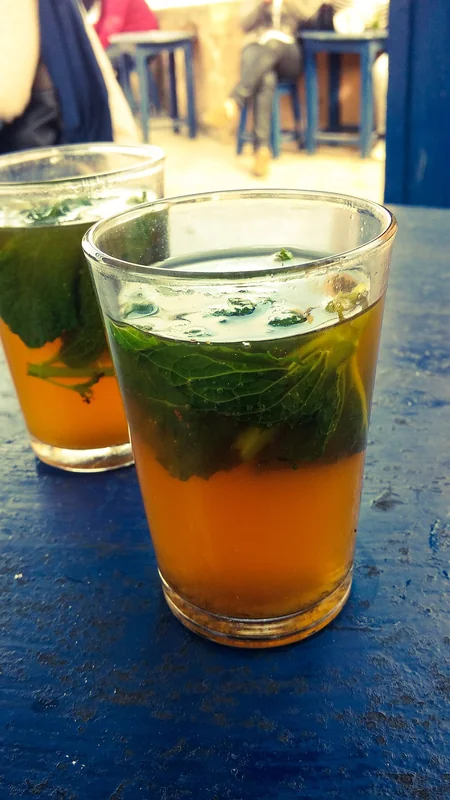
Moroccan mint tea (atay, أتاي) is a sweetened green tea brewed with fresh spearmint (Mentha spicata) and poured from height to create a characteristic foam. Prepared and served in three successive glasses — each with its own flavour intensity — the drink is a cornerstone of Moroccan hospitality and social life. The preparation uses Chinese gunpowder green tea (pearl-rolled Zhejiang tea) as its base, combined with a generous amount of fresh mint and large quantities of sugar. The tea is brewed in a small silver-coloured metal teapot, then poured repeatedly between pot and glass to blend and aerate before the final high pour into decorated Moroccan tea glasses. Refusing the tea is considered impolite; accepting and drinking all three glasses is the expected social protocol.
Quick facts
- Type
- Tea Culture
- Culture
- Moroccan mint tea
Hospitality and Social Protocol
Atay is offered to guests in Morocco as an immediate act of hospitality — in homes, shops, and business meetings. The host prepares the tea in view of guests, and the preparation itself is part of the social performance. The traditional three-glass sequence has a well-known saying attributed to it: 'the first glass is as gentle as life, the second is as strong as love, the third is as bitter as death' — though in practice, the sugar level is often consistent across all three, and the saying reflects flavour perception as the mint and tannins evolve across glasses. The high pour from the teapot (from 30–50 cm above the glass) is both functional — it creates the foam that signals a properly made glass — and theatrical. In the Saharan region and among Tuareg and other Berber communities, the tea is often made even more strongly and may involve three separate, sequential brews with the same leaves.
Gunpowder Tea and Spearmint Base
The foundational ingredient is Chinese gunpowder green tea — so called because the leaves are rolled into small pellets that resemble black powder shot. Gunpowder tea (珠茶, Zhu Cha) from Zhejiang Province, China, became the basis of Moroccan tea culture after trade routes between Chinese green tea producers and North African and Levantine markets developed in the 18th and 19th centuries. Gunpowder tea's dense rolling preserves freshness during long transport, making it well-suited for trade to distant regions. The spearmint used (nana mint, Mentha spicata) is grown widely in Morocco — the Meknes region is a significant producer. The quantity of mint is substantial: a full handful of fresh sprigs is added to the pot, contributing the characteristic cooling, herbal character that distinguishes atay from plain green tea.
Preparation Technique
Traditional Moroccan mint tea preparation begins with a brief rinse of the teapot and glasses with a small amount of boiling water to warm them. Gunpowder tea is added to the pot, followed by boiling water; the first brew is often poured off after a few seconds — this rinse step reduces bitterness and wakes the leaves. Fresh mint sprigs and a substantial quantity of sugar (typically 3–5 large sugar lumps or equivalent) are added, and boiling water is poured over the combination. The pot is placed on a low heat source or left to steep. Before serving, the host pours a glass from the pot, then pours it back — repeated several times to blend the flavours. The final pour into each glass is made from height, creating the foam layer that is the mark of a well-prepared atay. The glasses are refilled and the process is repeated for the second and third glasses.
Sources & further reading (2)
- encyclopedia — accessed 2026-05-07
- specialty-reference — accessed 2026-05-07
Frequently asked questions
What type of green tea is used in Moroccan mint tea?
Chinese gunpowder green tea (珠茶, Zhu Cha) from Zhejiang Province is the standard base for Moroccan mint tea. The tea is named 'gunpowder' for the pellet-like shape of the rolled leaves. This variety was historically preferred for North African trade because its dense rolling preserved freshness during long transport. Today, gunpowder tea is exported in large quantities specifically for the Moroccan and broader North African market, making Morocco one of the world's largest importers of Chinese green tea.
Why is the tea poured from a height?
The high pour — from 30–50 cm or more above the glass — serves two purposes: it aerates the liquid, creating the foam on the surface that is considered a sign of a well-prepared glass; and it cools the very hot tea slightly before it reaches the glass. The foam is both visual and functional — it indicates proper blending and aeration. A host who cannot produce a good foam is considered to have prepared the tea poorly. The technique requires practice and is a skill point of pride.
Is it impolite to refuse Moroccan mint tea?
In Moroccan social custom, refusing the offered tea is generally considered impolite — it signals rejection of the host's hospitality. Guests are expected to accept and drink all three glasses when the three-glass sequence is offered. In commercial settings (carpet shops, markets), the tea is also offered as a social gesture, though the expectation of purchase is sometimes associated with the offer. Visitors are advised to accept the tea in both social and commercial contexts as a sign of respect for the custom.