Matcha Whisking
Traditional matcha preparation — sifting, two-stage water addition, and W-motion whisking into froth.
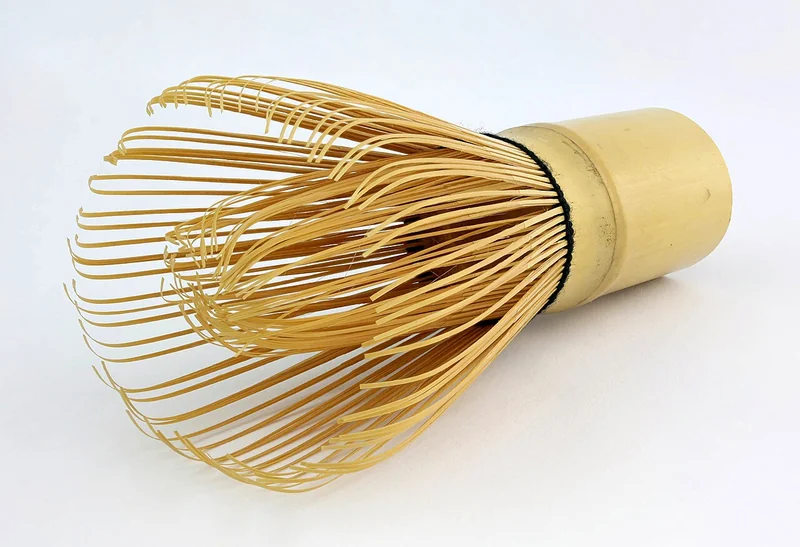
Matcha whisking is the process of preparing powdered matcha tea by combining matcha powder with hot water and whisking with a bamboo chasen until the powder is fully suspended and the surface is frothy. Unlike steeped teas, matcha does not dissolve — it forms a suspension of 5–10 micron particles in water. The standard usucha (thin tea) preparation uses 1.5–2 grams of matcha sifted into a warmed chawan (bowl), added with 70–80 ml of 75–80°C water in two stages, then whisked in a rapid W or M motion. Koicha (thick tea) uses 3–4 grams per 40–50 ml and requires a slower, circular folding motion to form a thick, paste-like suspension without foam.
Quick facts
- Type
- Brewing Method
Usucha and Koicha Preparation
Matcha is prepared in two main styles. Usucha (薄茶, thin tea) is the everyday style: 1.5–2 grams of sifted matcha is added to a warmed, dried chawan, 10–15 ml of 75–80°C water is added and the powder is worked into a paste with the chasen, then 60–70 ml of water is added and whisked vigorously in a W or M motion at 1–2 Hz for 30–60 seconds until a fine, uniform froth develops across the surface. Koicha (濃茶, thick tea) uses 3–4 grams per 40–50 ml of water; the chasen is moved in slow, deliberate circles and folds rather than rapid whisking, producing a thick, smooth, paste-like liquid without surface foam. Koicha requires higher-grade matcha from the first flush of premium cultivars.
Sifting and Temperature Control
Matcha powder is hygroscopic (absorbs moisture) and tends to clump during storage. Sifting the powder through a fine mesh sieve (80–100 mesh) before preparation breaks up clumps, ensuring uniform dispersion when water is added. Unsifted matcha can form persistent lumps that the chasen cannot fully disperse. Water temperature is critical: 75–80°C is standard to avoid bitterness from catechin overextraction. After boiling water is prepared, it is cooled in a yuzamashi (水差し, water cooler) or allowed to cool briefly in the kettle. The chawan is pre-warmed with hot water and dried before adding matcha — a cold bowl lowers the water temperature upon contact.
The Chasen and Whisking Technique
The chasen (茶筅, tea whisk) is made from a single piece of bamboo that is scored and split into 60–120 tines, depending on the style. Thin tines (100–120) are used for usucha, where fine froth is desired; thicker tines (60–80) suit koicha's folding motion. The chasen is soaked in warm water before use to soften the tines and prevent breakage. Correct whisking technique holds the handle lightly, keeping the wrist relaxed, and moves the tines rapidly in a W or M pattern across the surface — not the bottom — of the liquid. The chasen should be rinsed and dried immediately after use and stored on a chasen stand (kusenaoshi) to preserve its shape.
Sources & further reading (2)
- encyclopedia — accessed 2026-05-07
- industry-association — accessed 2026-05-07
Frequently asked questions
Why does matcha need to be sifted before whisking?
Matcha powder is very fine (5–10 microns) and hygroscopic — it absorbs moisture from the air and forms clumps during storage. These clumps do not fully disperse when water is added and cannot be broken up by whisking alone. Sifting through a fine mesh (80–100 mesh) immediately before preparation breaks up these clumps, ensuring the powder disperses uniformly in water and the chasen can produce a smooth, frothy suspension.
What is the difference between usucha and koicha?
Usucha (thin tea) uses 1.5–2 grams per 70–80 ml water, whisked vigorously to produce a frothy, light green drink. Koicha (thick tea) uses 3–4 grams per 40–50 ml water, worked slowly into a thick, smooth, syrupy suspension without foam. Koicha requires much higher-grade matcha (first-flush from premium cultivars) and a different technique. In formal tea ceremony, koicha is presented first (being the more prestigious preparation) and multiple guests share from the same bowl.
How do I prevent matcha from forming lumps?
Sift the matcha immediately before preparation using an 80–100 mesh sieve. Add a small amount of water (10–15 ml) first and work the paste smooth with the chasen before adding the remaining water. Use water at 75–80°C — cooler water is less effective at dispersing the powder. Store matcha in an airtight, opaque container in the refrigerator; allow to reach room temperature before opening to prevent condensation forming on the cold powder.