Longjing (Dragon Well)
China's most celebrated green tea — pan-fired by hand into flat, smooth leaves with a chestnut-sweetness.
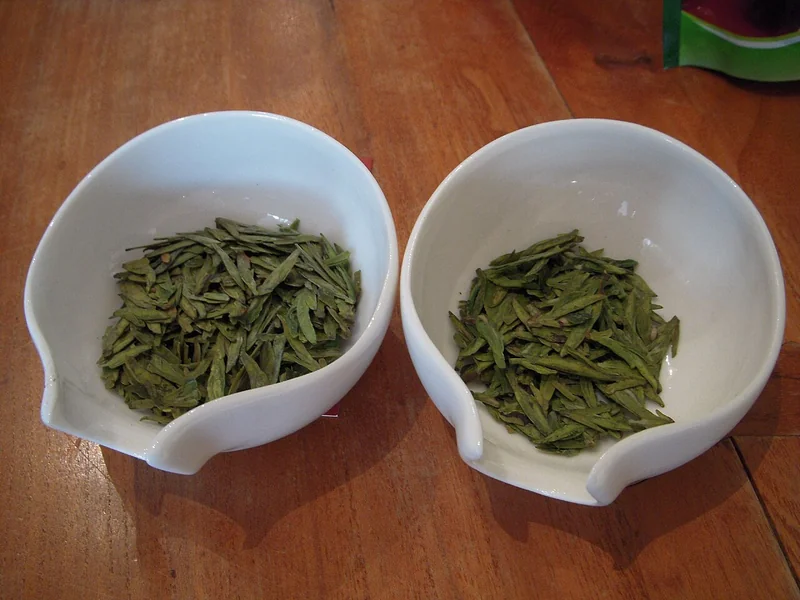
Longjing, known in English as Dragon Well tea, is a pan-fired green tea produced in the West Lake district of Hangzhou, Zhejiang Province, China. Unlike Japanese green teas fixed by steam, longjing leaves are pressed and dried in a heated iron wok using bare hands, a technique called sha qing (kill-green). The skilled hand movements — pressing, pushing, flicking — simultaneously fix the leaf and impart its characteristic flat, smooth shape. The highest grade, Xihu Longjing (West Lake Dragon Well), is produced from specific villages around West Lake and has enjoyed imperial patronage since the Qing dynasty. Authentic West Lake longjing carries a Geographical Indication (GI) designation.
Quick facts
- Type
- Tea
- Origin
- China (West Lake, Hangzhou, Zhejiang)
- Cultivar
- Longjing 43, Qunti (mass-variety)
- Oxidation
- Green (unoxidised)
- Caffeine
- Medium
- Umami
- Light umami, less pronounced than Japanese shaded teas
- Astringency
- Low to moderate
- Sweetness
- Clean, chestnut-like sweetness
- Body
- Light, clean
- Tasting notes
- chestnut, fresh grass, orchid, toasted grain
Pan-Firing and the Sha Qing Technique
The defining production step for longjing is sha qing (殺青, 'kill-green'), in which freshly harvested leaves are placed in a preheated iron wok at 200–240°C. A skilled tea worker presses, rolls, and spreads the leaves using bare hands, simultaneously stopping oxidation and shaping the leaf. The hand movements — typically ten specific gestures — apply varying pressure that flattens the leaf against the hot surface and expels moisture. Traditional hand-processing allows the artisan to feel and respond to the changing texture and moisture of the leaves in real time. Modern production increasingly uses mechanical wok machines for the initial sha qing, reserving hand-finishing for premium grades.
West Lake Longjing and Geographical Origin
The original and most prized longjing comes from specific villages around West Lake in Hangzhou, including Longjing village, Meijiawu, and Wengjiashan. This area was designated a Geographical Indication product by China's national authorities in 2001, restricting the label 'Xihu Longjing' (West Lake Dragon Well) to tea from defined geographic coordinates. Teas labeled simply 'Longjing' or 'Dragon Well' may come from broader Zhejiang Province or even other provinces, and can vary significantly in quality and price. The Xihu designation commands premiums of five to fifty times the price of regional longjing. First-flush teas harvested before the Qingming festival (early April) are considered most prized and labeled 'pre-Qingming' (Mingqian).
Imperial History and Cultural Standing
Longjing tea has been associated with imperial approval since at least the Song dynasty, but its status was cemented in the Qing dynasty when Emperor Qianlong (r. 1735–1796) reportedly visited the Hu Gong temple in Longjing village and designated 18 specific tea plants as imperial tribute trees. Those 18 trees — still present and fenced off today — represent the origin story of imperial longjing. The Qianlong emperor also composed poems about longjing. During the Cultural Revolution (1966–1976), the prestige of longjing was subdued along with other traditional cultural forms, but it recovered in the reform era and has since been extensively promoted in international tea culture.
Sources & further reading (2)
- encyclopedia — accessed 2026-05-07
- specialty-reference — accessed 2026-05-07
Frequently asked questions
What makes West Lake Longjing different from other longjing?
West Lake Longjing (Xihu Longjing) comes from defined geographic villages around West Lake in Hangzhou, where specific soil minerals, rainfall patterns, and microclimate conditions affect flavour. The Geographical Indication designation restricts the label to this area. Regional longjing from broader Zhejiang or other provinces shares the pan-fired production method but lacks the specific terroir of the West Lake zone, generally producing less complex flavours at lower price points.
Why are longjing leaves flat?
The flat shape is a direct result of the sha qing pan-firing technique, in which tea workers press the leaves against the hot iron wok surface during processing. The combination of heat and pressure compresses the leaf structure and expels moisture directionally. Unlike rolled or twisted teas, longjing's flat profile gives it a distinctive visual identity and affects how it unfurls in the cup.
What is 'pre-Qingming' longjing?
Mingqian (明前) longjing is harvested before the Qingming festival, which falls around April 4–6. At this early date, the new shoots are at their most tender, with concentrated amino acids and delicate flavour. Mingqian teas are typically the most expensive longjing, with very short production windows. Yüqian (雨前, before the Grain Rain festival around April 20) is the second tier, also prized but more accessible than Mingqian.