Korean Darye
Korea's tea ritual — respectful, graceful tea service rooted in Confucian values and Buddhist heritage.
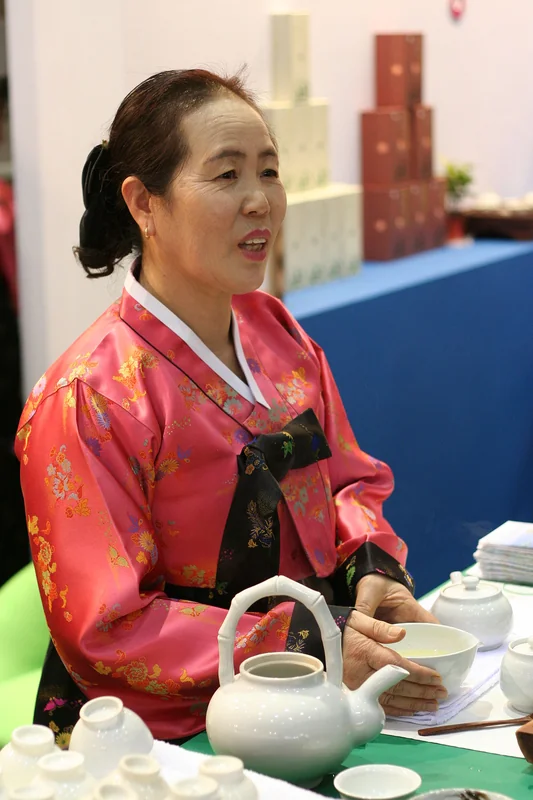
Darye (다례, 茶禮, 'tea rites') refers to the Korean tradition of tea preparation and service as a formal cultural and social practice. The term encompasses court tea ceremony from the Goryeo (918–1392) and Joseon (1392–1897) periods, Buddhist temple tea practice, and the revived scholarly tea culture of the 20th century. Korean tea culture developed from Chinese tea traditions introduced through Buddhist monks and underwent significant suppression during the Joseon period's shift toward Confucian values (tea being associated with Buddhism). A modern revival began in the 1970s–80s, led by figures including the monk Hyodang Choi Beom-sul, who codified the Chamseon ilmi (禪茶一味, 'Zen and tea are one taste') tradition. Korean darye emphasises simplicity, grace, and harmony with nature.
Quick facts
- Type
- Tea Culture
- Culture
- Korean darye
Historical Development
Tea culture entered the Korean peninsula through Buddhist monks studying in Tang-dynasty China, with documented use in the Silla kingdom (57 BCE–935 CE). During the Goryeo dynasty (918–1392), tea held significant social and ritual importance — tea pavilions, tea officials, and tea gardens were established, and tea was offered at Buddhist ceremonies and court events. The transition to the Joseon dynasty (1392–1897), which promoted Confucianism and viewed Buddhist practices with suspicion, suppressed much of Korea's tea culture. Tea gardens fell into disuse, and tea knowledge narrowed to Buddhist temples and remote scholar communities. The Japanese colonial period (1910–1945) further disrupted what remained. The modern revival, particularly from the 1970s onward, reconnected modern Koreans with this pre-Joseon heritage.
20th Century Revival and Codification
The monk Hyodang Choi Beom-sul (1904–1979) is considered a central figure in the modern Korean tea revival. His establishment of the Chamseon ilmi ('Zen and tea are one taste') school of tea practice drew on Buddhist tea traditions preserved in temple communities through the Joseon period. His student Heo Il-do and other practitioners documented and transmitted a distinctly Korean tea aesthetic emphasising simplicity, natural materials, and unhurried preparation. Concurrently, scholars and artists worked to distinguish Korean darye from Japanese chanoyu — particularly the formality and rigid protocol of the Japanese ceremony — positioning Korean tea as more spontaneous, nature-attuned, and Confucian in its social orientation. Several organisations, including the Korean Tea Masters Association, now maintain darye curricula and certification.
Vessels and Materials
Traditional Korean tea culture uses unglazed or simply glazed ceramic vessels in a tradition distinct from Chinese Yixing clay and Japanese Raku. Buncheong ware (분청사기) — grey-green slip-coated stoneware — and white porcelain (백자) are associated with Joseon court and scholar tea culture. Celadon (청자) from the Goryeo period represents the highest tier of historical Korean ceramics and tea vessels. Contemporary darye practitioners often use vessels from contemporary Korean potters working in these historical traditions. The tea used in modern darye is typically Korean green tea (hand-fired, pan-fired) — sejak, ujeon, or jaksul grade — served at lower temperatures in a slow, attentive manner.
Sources & further reading (2)
- encyclopedia — accessed 2026-05-07
- specialty-reference — accessed 2026-05-07
Frequently asked questions
How is Korean darye different from Japanese chanoyu?
Japanese chanoyu is highly codified, with specific movement sequences (temae), defined school lineages, and emphasis on matcha. Korean darye, particularly the modern revival, emphasises simplicity, spontaneity, and natural harmony over rigid protocol. Korean tea uses loose-leaf green tea rather than matcha. Darye practitioners often cite a more nature-connected, less theatrical aesthetic compared to the formal choreography of chanoyu. The underlying philosophical differences also differ: chanoyu draws on Zen Buddhism and wabi aesthetics; darye draws on Confucian social harmony and Buddhist simplicity.
Why did Korean tea culture nearly disappear during the Joseon period?
The Joseon dynasty (1392–1897) promoted Confucianism as the state ideology and viewed Buddhism — with which tea culture was closely associated — as superstition to be suppressed. Tea gardens, Buddhist temple teas, and court tea traditions were dismantled or neglected. Tea knowledge survived primarily in Buddhist mountain temples that maintained some autonomy. The Japanese colonial period (1910–1945) introduced Japanese tea culture (chanoyu, Japanese green teas) and further displaced indigenous Korean practice.
What tea is typically used in Korean darye?
Modern Korean darye uses Korean-produced green tea — typically hand-fired pan-roasted varieties from Hadong or Boseong. The grades most associated with formal darye practice are ujeon (first-flush, before Grain Rain) and sejak (second-flush, after Grain Rain). These are brewed at 60–75°C in small quantities with careful attention to steeping time. Korean green tea preparation in darye emphasises the tea's natural character — no milk or sugar is added.