Japanese Chanoyu
The Japanese tea ceremony — Sen no Rikyu's art of preparing matcha through wabi aesthetics and hospitality.
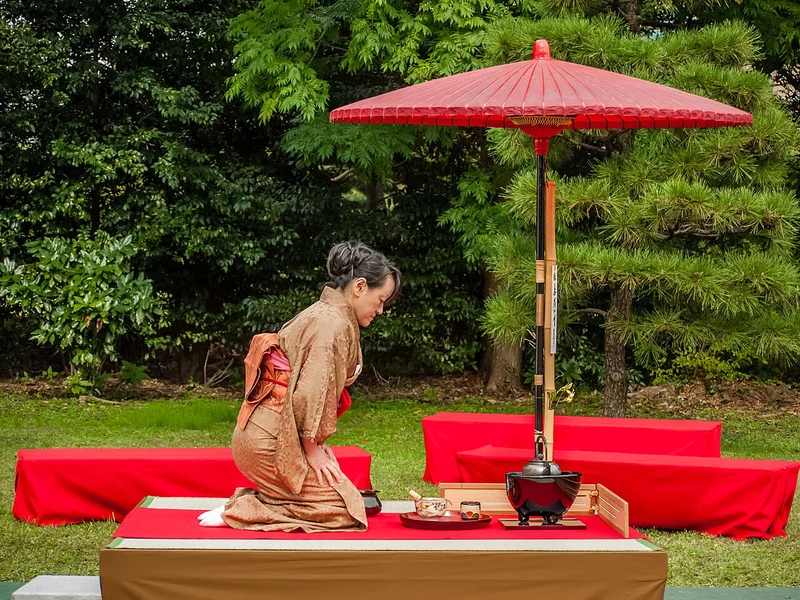
Chanoyu (茶の湯, 'hot water for tea'), also called chado or sado (茶道, 'way of tea'), is the Japanese ceremonial preparation and presentation of matcha to guests. Developed from Chinese powdered tea culture introduced by Buddhist monks in the 9th–12th centuries and codified into its classical form by the tea master Sen no Rikyu (1522–1591), chanoyu integrates principles of wabi (austere simplicity), ichigo ichi-e (one time, one meeting), and harmony (wa), respect (kei), purity (sei), and tranquility (jaku). It encompasses specific architectural spaces (chashitsu), gardens (roji), utensils (chadogu), and movements (temae) that are transmitted through three principal lineages: Ura Senke, Omote Senke, and Mushanokoji Senke.
Quick facts
- Type
- Tea Culture
- Culture
- Japanese chanoyu
Sen no Rikyu and Wabi-Cha
Tea in Japan prior to Sen no Rikyu (1522–1591) was associated with lavish displays of Chinese ceramics and tea equipment among samurai and aristocratic classes — a practice called karamono suki (love of Chinese things). Rikyu, working under the patronage of the warlords Oda Nobunaga and then Toyotomi Hideyoshi, systematically replaced imported luxury with rustic Japanese-made objects: rough Raku clay bowls instead of polished tenmoku wares; simply constructed tea rooms of natural bamboo and earthen walls instead of elaborately decorated chambers; a small, low entrance (nijiriguchi) into the tea room to force all visitors — samurai and commoner alike — to bow in entry. This philosophy, called wabi-cha, elevated deliberate simplicity and imperfection as aesthetic ideals. Rikyu was ordered to commit ritual suicide by Hideyoshi in 1591 — the reasons remain historically debated — and died having defined the classical form of Japanese tea ceremony.
Three Senke Schools
Sen no Rikyu's descendants founded three main schools (iemoto) of chanoyu that continue today. Ura Senke (behind the Senke compound) is the largest school internationally, with branches in dozens of countries; it tends toward slightly more relaxed and accessible teaching. Omote Senke (in front of the Senke compound) follows a more conservative, quiet aesthetic aligned with classical Rikyu tradition. Mushanokoji Senke is the smallest of the three main schools. Each school has its own headmaster lineage, specific variations in temae (procedure), and preferred utensils. The three schools trace their lineage from Rikyu through his grandson Sen Sotan (1578–1658), who distributed the three residences among his sons.
The Four Principles: Wa, Kei, Sei, Jaku
The four principles attributed to Sen no Rikyu as the foundation of chanoyu are wa (和, harmony), kei (敬, respect), sei (清, purity), and jaku (寂, tranquility). Harmony refers to the relationship between host, guest, and environment — the appropriate correspondence between the occasion, the season, the tea selected, and the objects used. Respect refers to the genuine regard between host and guest and toward the utensils and the space. Purity refers to cleanliness of the utensils, the garden, and the mind brought to the encounter. Tranquility is the quality of stillness that emerges from the other three — the state both host and guest inhabit during a well-conducted ceremony.
Sources & further reading (2)
- encyclopedia — accessed 2026-05-07
- institution — accessed 2026-05-07
Frequently asked questions
What does 'ichigo ichi-e' mean in the context of chanoyu?
Ichigo ichi-e (一期一会, 'one time, one meeting') is a principle in chanoyu meaning that each tea gathering is a unique, unrepeatable event. The specific combination of people, objects, season, and weather will never occur again exactly as it does in this moment. The principle calls on both host and guest to be fully present and to prepare and participate as if the encounter were once-in-a-lifetime. The phrase is attributed to Ii Naosuke (1815–1860), though the concept traces to Rikyu.
Why is the tea room entrance (nijiriguchi) so small?
The nijiriguchi (躙り口, 'crawl-through entrance') is a low, narrow door requiring guests to bow deeply or crawl to enter the tea room. Sen no Rikyu introduced this design to enforce equality inside the space: samurai entering had to remove their swords (which could not fit through the low opening), and all guests, regardless of social status, adopted the same humble posture of entry. The architectural form thus embodied the social egalitarianism of the wabi-cha philosophy within the tea room.
What are the three main schools of chanoyu and how do they differ?
The three main schools — Ura Senke, Omote Senke, and Mushanokoji Senke — trace their lineage from Sen no Rikyu through his grandson Sen Sotan. Ura Senke is the largest internationally and tends toward accessible teaching. Omote Senke follows a more conservative aesthetic. Mushanokoji Senke is the smallest. All three share the same philosophical foundation but differ in specific procedures (temae), preferred vessels, and organisational style. Differences include how the tea bowl is wiped and how the chasen is positioned.