Gyokuro
Japan's premier shaded green tea, covered 20+ days before harvest to concentrate umami and suppress bitterness.
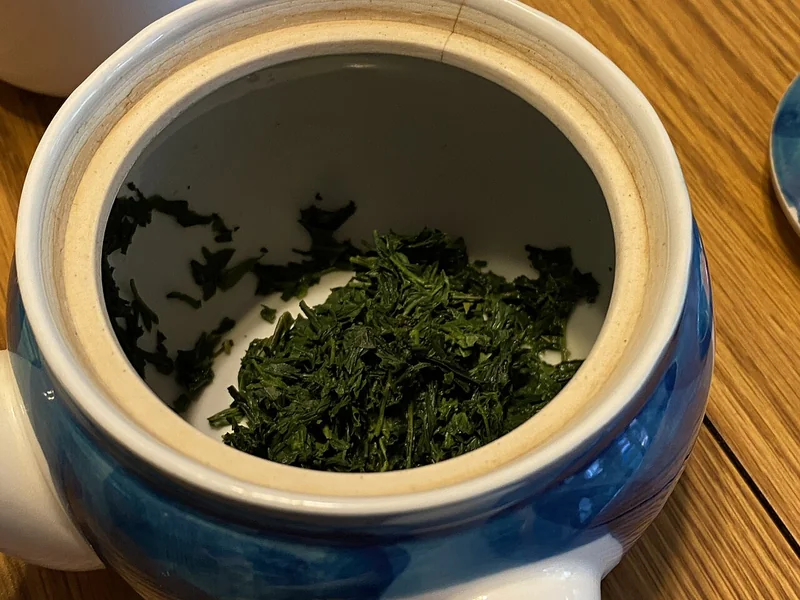
Gyokuro (literally 'jade dew') is the highest-grade Japanese loose-leaf green tea, produced by shading the plants for a minimum of 20 days before the first-flush harvest in April or May. Shading materials — historically straw (wara) and now black mesh — reduce sunlight by 70–90 percent, slowing photosynthesis and causing the leaf to accumulate L-theanine at the expense of catechin production. The result is a tea with intense umami, pronounced sweetness, and very low bitterness. Primary production regions are Uji (Kyoto Prefecture), Yame (Fukuoka), and Asahina (Shizuoka). Gyokuro is brewed at unusually low temperatures of 50–60°C.
Quick facts
- Type
- Tea
- Origin
- Japan (Uji, Yame, Asahina)
- Cultivar
- Yabukita, Asahi, Okumidori, Saemidori
- Oxidation
- Green (unoxidised)
- Caffeine
- High
- Umami
- Very pronounced umami, characteristic iodine-like depth
- Astringency
- Very low
- Sweetness
- Persistent, honey-like sweetness
- Body
- Full-bodied, syrupy texture
- Tasting notes
- seaweed, iodine, honey, cream, fresh grass
Shading and Its Effect on Leaf Chemistry
When sunlight is reduced by 70–90 percent for 20 or more days, tea plants cannot photosynthesize efficiently. L-theanine, an amino acid synthesized in the roots, normally converts to catechins (bitter polyphenols) in the leaf under sunlight. Shading breaks this conversion pathway, allowing L-theanine to accumulate in the leaf. L-theanine contributes directly to umami flavour and a relaxed sensation without drowsiness. Simultaneously, chlorophyll increases as the plant tries to capture more of the reduced light, deepening the leaf's green colour. Total catechin content — responsible for astringency — falls significantly relative to unshaded sencha.
Processing and Brewing
After harvest, gyokuro is processed similarly to sencha — steam, roll, dry — but the raw material (the shaded leaf) contains a fundamentally different chemical composition. Gyokuro is brewed at 50–60°C, far below the 70–80°C used for sencha. At these temperatures, only umami compounds and sweet amino acids are efficiently extracted while bitter catechins dissolve minimally. A small quantity of leaf — 5 grams per 30 ml of water — is steeped for 90–120 seconds. Multiple infusions are possible from the same leaves, with later infusions revealing different aromatic facets.
History and Regional Styles
Gyokuro is said to have been developed in Uji, Kyoto, by Yamamoto Kahei in 1835, who reportedly first covered tea plants with dried grass. Uji gyokuro remains highly regarded and is associated with the Uji tea tradition that predates gyokuro itself. Yame gyokuro from Fukuoka uses traditional wara (straw) shading and is noted for having a slightly different flavour profile compared to Uji teas. Asahina gyokuro from Shizuoka has grown in recognition for its value at lower price points. Gyokuro accounts for less than 1 percent of Japan's total tea production and commands the highest prices among loose-leaf Japanese teas.
Sources & further reading (2)
- encyclopedia — accessed 2026-05-07
- industry-association — accessed 2026-05-07
Frequently asked questions
Why is gyokuro brewed at such a low temperature?
Gyokuro contains very high levels of L-theanine (umami) and relatively low catechins (astringency). At 50–60°C, amino acids extract efficiently while catechins dissolve only minimally, preserving the sweet, umami-dominant character. Higher temperatures would extract more catechins and produce an unbalanced, bitter cup that would mask the tea's defining quality.
What distinguishes gyokuro from matcha?
Both are shaded Japanese teas from the same first-flush harvest, but gyokuro is steeped as whole rolled leaves and the leaves are discarded. Matcha is made from tencha (de-stemmed, de-veined shaded leaves) that are stone-ground into a fine powder and fully consumed suspended in water. Gyokuro offers a clearer, more nuanced infusion; matcha is richer and consumed as a full-leaf suspension.
Can gyokuro be brewed like regular green tea?
Technically yes, but the results will be less balanced. At standard sencha brewing temperatures (70–80°C), gyokuro becomes excessively bitter and the characteristic umami is overwhelmed by catechin extraction. Gyokuro is specifically calibrated for low-temperature brewing with small quantities of hot water and high leaf-to-water ratios.