Gongfu Cha (Brewing Method)
The Chinese technique of precise, attentive brewing — small vessel, high leaf ratio, and multiple short infusions.
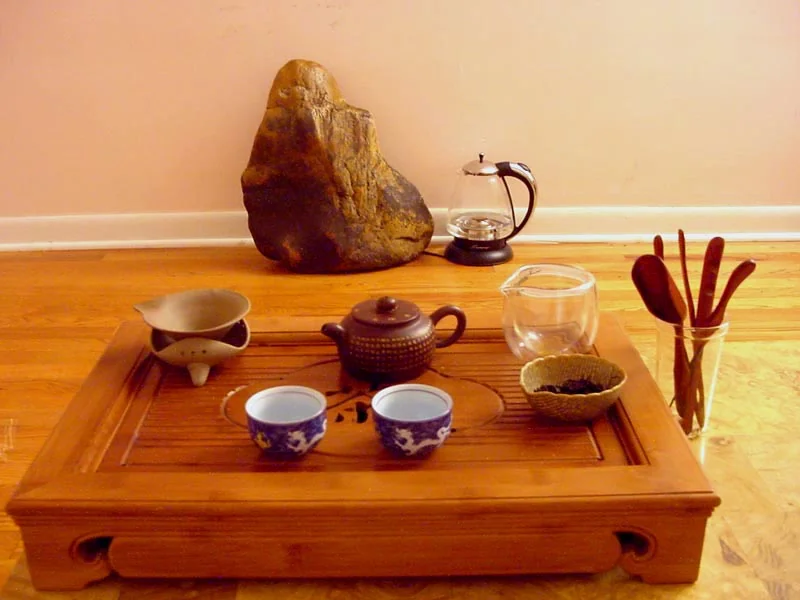
Gongfu cha (工夫茶, literally 'skilled tea' or 'effort tea') is a Chinese approach to tea preparation emphasising precision, skill, and multiple short infusions from a small quantity of tea. The method typically uses a small gaiwan or Yixing teapot (50–150 ml), a high leaf-to-water ratio (5–8 grams per 100 ml), water at 85–100°C depending on the tea type, and steeping times that begin at 15–30 seconds and increase incrementally with each infusion. A single session may produce 5–10 or more cups from the same leaves. Gongfu cha is the dominant preparation method for premium oolongs, pu-erh, and some white teas in China and Taiwan, and has been adopted globally by the specialty tea community.
Quick facts
- Type
- Brewing Method
Technique and Parameters
The gongfu cha session begins with heating all vessels — teapot or gaiwan, cha hai (fairness pitcher), and cups — with boiling water to stabilise temperature. This first rinse is discarded. Tea leaves are added at a high ratio: 5–8 grams per 100 ml of vessel capacity for oolongs and pu-erh; slightly less for white or delicate teas. The first infusion (typically 15–30 seconds) is often a brief rinse that opens the leaves and is either discarded or drunk immediately. Subsequent infusions increase by 5–15 seconds each, allowing complete extraction over the full session. Water is poured directly onto leaves in the gaiwan or teapot, and the infusion is decanted immediately and completely into the cha hai to prevent over-steeping. From the cha hai, tea is poured into small (30–50 ml) cups.
Vessels and Equipment
Traditional gongfu cha employs several specific vessels. The gaiwan (lidded bowl, 100–150 ml) is the most versatile: the lid can serve as a filter when pouring. The Yixing teapot (unglazed clay, 100–200 ml) is traditional for oolongs and pu-erh. The cha hai (fairness pitcher, 200–300 ml) receives the infusion from the brewing vessel and equalises its concentration before distributing to individual cups — ensuring every cup in the session receives the same strength. Tea boats (trays with drainage) catch overflow. A thermometer is useful for temperature control. Gongfu cha equipment ranges from inexpensive to extremely costly; high-quality Yixing teapots by recognised masters command prices from hundreds to tens of thousands of US dollars.
History and Geographic Origin
The gongfu cha tradition is documented in Chaozhou (Chaoshan), a coastal region of Guangdong Province, from at least the 17th century, and was likely practiced earlier. The Chaozhou tradition used small ceramic or clay pots to brew highly compressed oolong from Wuyi Mountain. The tradition spread to Fujian and Taiwan as tea culture evolved. In Taiwan during the 1970s–90s, the gongfu cha aesthetic was codified and popularised through the tea masters, tea shops, and tea competitions that developed around Taiwanese oolongs. The global specialty tea movement of the 2000s–2020s has spread gongfu cha worldwide, with communities of practitioners in North America, Europe, Australia, and East Asia.
Sources & further reading (2)
- encyclopedia — accessed 2026-05-07
- specialty-reference — accessed 2026-05-07
Frequently asked questions
What does 'gongfu' mean in gongfu cha?
Gongfu (工夫 or 功夫) means 'skill achieved through practice' or 'effort applied over time.' In the context of tea, it refers to the deliberate attention, precision, and repeated practice required to prepare tea well using small vessels and multiple infusions. The same term 'gongfu' (often romanised as 'kung fu' in English) is used to describe Chinese martial arts — the connection is the same concept of disciplined skill development.
Why use a cha hai (fairness pitcher) in gongfu cha?
When a teapot or gaiwan is poured into small cups sequentially, the first cup receives the weakest tea (first liquid to exit) while the last receives the most concentrated (last liquid). The cha hai (fairness pitcher) collects the entire infusion first, homogenising the concentration, then distributes it equally to all cups. This ensures each guest receives identical strength tea — hence the alternative name 'fairness pitcher.'
Which teas are best suited for gongfu cha?
Gongfu cha is best suited to teas that produce multiple distinct and evolving infusions from the same leaves: oolongs (Tieguanyin, Da Hong Pao, Oriental Beauty), pu-erh (both sheng and shou), and some white teas (Silver Needle). These teas have complex aromatic compounds that reveal themselves progressively across 5–10 infusions. Delicate green teas like sencha can also be brewed gongfu-style at lower temperatures, but standard steeping often works equally well.