Gaiwan Brewing
Brewing tea directly in the lidded Chinese bowl — a versatile Ming-dynasty method ideal for observing leaf and colour.
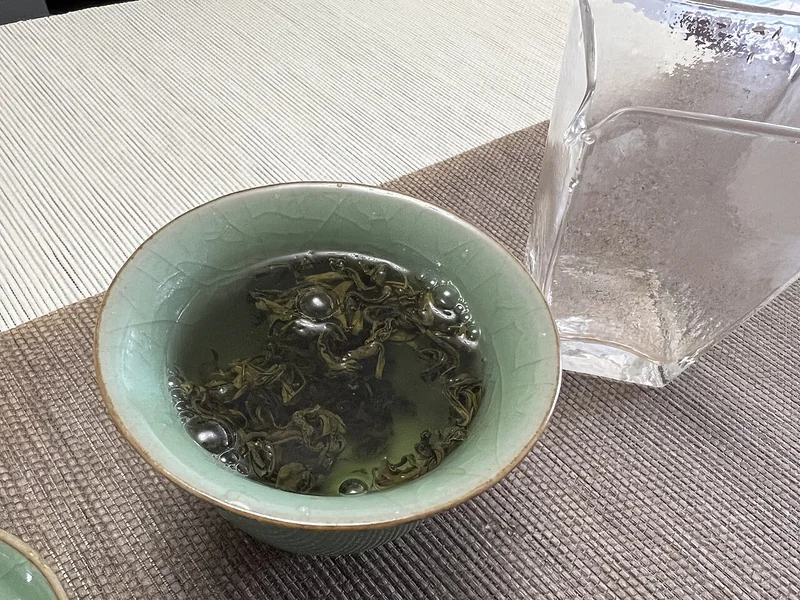
Gaiwan brewing is a Chinese method of preparing tea in a gaiwan (盖碗, 'lidded bowl') — a ceramic cup with a saucer below and a domed lid above. Tea leaves are placed directly in the gaiwan, hot water is poured in, and after steeping, the lid is tilted slightly to create a gap that acts as a filter while the infusion is poured out. The gaiwan serves simultaneously as steeper, infuser, and — in informal settings — drinking vessel. Because it has no clay composition to absorb flavour (unlike Yixing clay), the gaiwan is particularly suited to neutral tasting of different teas in gongfu cha sessions. It is the most versatile and widely used brewing vessel in Chinese tea practice.
Quick facts
- Type
- Brewing Method
Origin and Design of the Gaiwan
The gaiwan in its current three-piece form (saucer, cup, lid) emerged during the Ming dynasty (1368–1644) and was widely used by the Qing dynasty (1644–1912). Before the Ming dynasty, Song dynasty tea culture used a wider, shallower bowl (jian) for whisked powdered tea. The shift to loose-leaf tea during the Ming period brought the need for vessels that could steep leaves and separate infusion from leaf when pouring. The gaiwan's design elegantly solves this: the lid provides a filtration surface (tilted to allow liquid to flow while retaining leaves), the cup holds the steeping tea, and the saucer insulates the hand from heat. Standard gaiwan volume is 100–150 ml for gongfu cha; larger versions (200–300 ml) exist for casual group serving.
Technique: Pouring with the Lid
Correct gaiwan pouring requires controlling the lid to create a precise gap for filtration while avoiding burns. The standard hold: the thumb and middle finger grip opposite sides of the gaiwan rim, and the index finger rests on the lid's button to control its angle. The gaiwan is tilted forward, and the lid is held slightly ajar — typically 2–5 mm — creating a gap through which liquid passes while leaves are retained inside. The pour is complete and fast to avoid over-steeping. Some practitioners use a specialized lid-and-cup grip that keeps the index finger clear of hot steam. With practice, the motion becomes smooth and requires only seconds to execute per infusion.
Advantages as a Neutral Brewing Vessel
Glazed ceramic gaiwans do not absorb tea flavours between sessions, making them ideal for neutral comparison of different teas — unlike Yixing clay teapots, which accumulate flavour from repeatedly brewed teas. A gaiwan can be used for green tea in the morning, oolong in the afternoon, and white tea in the evening without interference from prior sessions. This neutrality also makes gaiwans the standard vessel for tea competition and professional tasting. They are easier to clean than teapots (no spout) and can be inspected visually during steeping. Gaiwans are also suitable for Western-style single steeping, simply by steeping longer and pouring directly into a cup.
Sources & further reading (2)
- encyclopedia — accessed 2026-05-07
- specialty-reference — accessed 2026-05-07
Frequently asked questions
Why is the gaiwan easier to use than a small Yixing teapot?
A gaiwan is larger and more open than a small Yixing teapot, making it easier to measure and observe leaves. There is no narrow spout to clog. The lid-gap filtration system is visually transparent — the brewer can see the leaves, check the colour, and control the pour directly. It is also much easier to clean. The main challenge is heat management — the thin ceramic conducts heat, requiring technique to avoid burns, which is why the grip technique matters.
Can all types of tea be brewed in a gaiwan?
Yes. The gaiwan's neutral glazed ceramic surface makes it suitable for all tea types: green, white, yellow, oolong, black, and pu-erh. It is particularly valued for comparing different teas without cross-contamination of flavour. Some teas (compressed pu-erh) require breaking up a portion before adding to the gaiwan. Herbal tisanes and blended teas with very fine particles can be harder to filter with the lid gap and may benefit from a separate mesh strainer.
How is a gaiwan different from a Yixing teapot for brewing?
A glazed ceramic gaiwan is neutral — it does not absorb or impart any flavour between sessions. A Yixing clay teapot is porous and gradually accumulates tea flavours, potentially enhancing dedicated single-tea use over time. For tasting different teas objectively, a gaiwan is preferred. For developing long-term seasoning to enhance a specific tea type (particularly premium oolongs and pu-erh), a Yixing teapot is the traditional choice.