Gaiwan
The three-piece Chinese lidded bowl — saucer, cup, and lid — the most versatile vessel in the Chinese tea tradition.
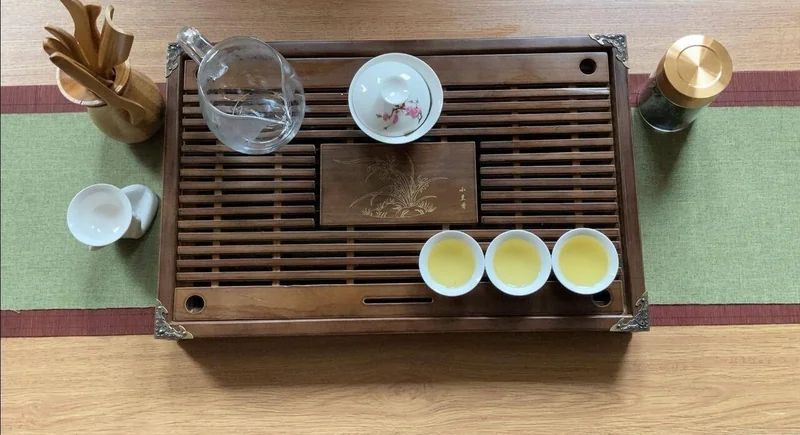
The gaiwan (盖碗, 'lidded bowl') is a three-piece Chinese tea vessel consisting of a saucer (tuodie), a bowl-shaped cup (wan), and a domed lid (gai). It emerged during the Ming dynasty as loose-leaf tea replaced Song dynasty powdered tea culture. Standard gaiwan volume ranges from 100–150 ml for gongfu cha brewing to 150–250 ml for individual drinking. Made from glazed porcelain, glass, or occasionally clay, the gaiwan can serve as steeping vessel, drinking cup, or serving vessel depending on the context. Unlike Yixing clay teapots, the glazed ceramic surface absorbs no flavour between sessions, making the gaiwan particularly suited to comparative tea tasting and versatile daily use.
Quick facts
- Type
- Tea Ware
Design and Components
The traditional gaiwan consists of three pieces. The saucer (tuodie, 托碟) elevates the cup, insulates it from the table surface, and catches drips. It is typically wider than the cup's base, allowing stable placement. The cup (wan, 碗) has a slightly flared rim — this design feature allows the lid to rest at an angle for filtration while pouring. The lid (gai, 盖) has a domed profile with a small button (niu) at the top for handling, and its rim sits inside the cup's flared edge, preventing it from sliding. The three-piece construction allows the lid to be tilted during pouring to create a gap that retains leaves while liquid flows out. Common materials are white porcelain (Jingdezhen), celadon, and glass; the translucency of glass allows observation of the infusion colour.
Gaiwan as Drinking Vessel
In Chinese tea culture, the gaiwan can be used as a personal drinking vessel, not only as a brewing instrument. In this use, tea is brewed directly in the gaiwan, and the drinker holds the saucer in the palm while tipping the lid to create a small gap, sipping from the edge. This method is traditional in northern Chinese tea culture and in formal settings where multiple gaiwans are provided for individual guests. In modern gongfu cha practice, the gaiwan is more commonly used as a steeping vessel from which infusions are poured into a cha hai (fairness pitcher) and then distributed to small cups.
Symbolic Three-Piece Meaning
In Chinese classical thought, the gaiwan's three-piece design is sometimes associated with the concept of heaven, human, and earth: the lid represents heaven (above), the cup represents human (middle), and the saucer represents earth (below). This interpretation appears in tea culture texts and is part of the poetic description of the vessel in traditional tea writings. Whether this symbolic interpretation was part of the original design intent or a later literary overlay is debated among historians, but it contributes to the gaiwan's cultural resonance in Chinese tea practice.
Sources & further reading (2)
- encyclopedia — accessed 2026-05-07
- specialty-reference — accessed 2026-05-07
Frequently asked questions
What sizes of gaiwan are available and which should I use?
Gaiwans range from very small (60–80 ml, for single-person gongfu cha with very high leaf ratios) to medium (100–150 ml, the most common for gongfu cha) to large (150–250 ml, suitable as a personal drinking vessel or for serving two people). For standard gongfu cha with 5–8 grams of tea, a 100–130 ml gaiwan is practical. Larger gaiwans (200+ ml) are used for casual single-steeping or serving directly from.
Is porcelain or glass better for a gaiwan?
Porcelain is the traditional material — it insulates better than glass, is more durable, and produces a more classic tea session aesthetic. White porcelain highlights the infusion colour against the background. Glass is valued for visual transparency — the colour evolution of the infusion is clearly visible from all angles, which is useful for tea comparison and appreciation. Both materials are glazed and equally neutral (neither absorbs flavour). Glass is more fragile and conducts heat faster to the hands.
How do I pour from a gaiwan without burning my fingers?
Standard gaiwan pouring technique: hold the saucer in the palm of the non-dominant hand; grip the gaiwan at the rim (not the sides) with the dominant hand's thumb on one side and middle finger on the other; rest the index finger on the lid's button to control its angle. Tilt the gaiwan forward and angle the lid to create a 2–5 mm gap for filtration. This keeps fingers clear of steam. Alternative: use a cloth to insulate the saucer and cup. With practice, the pour becomes a smooth, fast motion.