Dong Ding
Taiwan's classic medium-oxidised oolong from the Lugu area — tightly rolled, with balanced roasted-floral character.
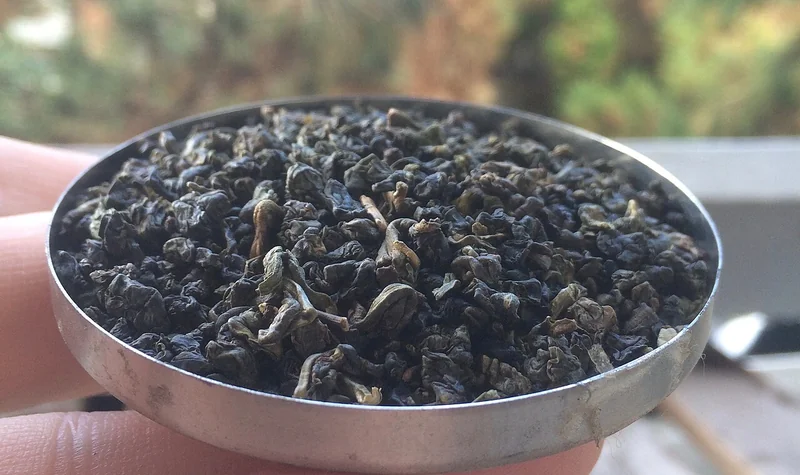
Dong Ding (凍頂, 'Frozen Summit') oolong is produced primarily in the Lugu Township of Nantou County, Taiwan, at elevations of 700–1,000 metres. The tea is traditionally produced from the Qingxin cultivar (also called Ruanzhi or Soft Stem), partially oxidised to 20–50 percent, and roasted to varying degrees in charcoal or electric ovens. The result is a tightly rolled green-to-brown pellet that brews a golden to amber infusion with a characteristic warm, roasted-floral profile. Dong Ding is considered Taiwan's most traditional oolong style — the roasted version (traditionally processed) is contrasted with the more contemporary, lighter, barely-oxidised Taiwanese high mountain oolongs.
Quick facts
- Type
- Tea
- Origin
- Taiwan (Lugu Township, Nantou County)
- Cultivar
- Qingxin (Ruanzhi, Soft Stem)
- Oxidation
- Oolong (partial)
- Caffeine
- Medium
- Umami
- Moderate, particularly in traditionally roasted versions
- Astringency
- Low to moderate
- Sweetness
- Roasted honey, dried fruit
- Body
- Medium
- Tasting notes
- roasted grain, honey, light caramel, osmanthus flower, warm spice
Origin and the Lin Feng Chi Seed Legend
The most commonly cited origin of Dong Ding oolong involves Lin Feng Chi, a student from Lugu who is said to have brought 36 tea plants from Wuyi Mountain, Fujian, back to Taiwan in the 1850s. These plants — planted on Dong Ding Mountain — are said to have become the progenitors of the local cultivar. Documentary evidence for the exact date and identity is limited, but the story is widely repeated in Taiwanese tea culture. What is better documented is that by the mid-20th century, Dong Ding had established itself as a distinct and valued product from Lugu Township. The Farmers' Association Tea Competition (competition teas) system, in which Dong Ding regularly features, has helped define and maintain quality standards.
Traditional vs. Light Roast Styles
Contemporary Dong Ding exists in a spectrum from lightly roasted (qingxiang, 'light fragrance') to medium-roasted (zhongbei) to heavily roasted (zhongbeihuo) forms. Lightly roasted versions, popular since the 1990s alongside Taiwan's high-mountain oolong trend, show more floral and green character but depart from the traditional Dong Ding profile. Traditionally roasted Dong Ding involves multiple rounds of charcoal or electric oven roasting at 100–130°C, with resting periods of weeks between each roasting. This process develops caramel and dried fruit notes, deepens the colour of the rolled pellets, and produces a warmer, more substantial cup. Specialty tea shops and competition-grade Dong Ding typically emphasise the traditional roasted style.
Farmers' Association Competitions
Taiwan's tea competition system has been formative in maintaining Dong Ding quality. The Lugu Farmers' Association holds spring and winter competitions annually, in which growers submit samples that are evaluated by expert tasters in blind cupping. Award tiers — from special grade down to grade four — are designated with ribbons, and competition-grade Dong Ding commands significant price premiums. Winning a top-tier competition certificate is a major commercial milestone for a Lugu grower. The competition system has been credited with preserving traditional roasting practices even as market trends shifted toward lighter oolongs.
Sources & further reading (2)
- encyclopedia — accessed 2026-05-07
- specialty-reference — accessed 2026-05-07
Frequently asked questions
How is Dong Ding different from Taiwanese high-mountain oolong?
Taiwanese high-mountain oolongs (Alishan, Li Shan, Da Yu Ling) are grown at higher altitudes (1,000–2,500 metres), lightly oxidised, and typically not roasted, producing highly floral, delicate teas. Dong Ding from Lugu (700–1,000 metres) is traditionally more oxidised and roasted, producing a warmer, richer character with honey and caramel notes. The two represent different philosophical approaches to Taiwan's oolong tradition.
What is the Qingxin cultivar?
Qingxin (清心, also called Ruanzhi 軟枝 or Soft Stem) is the most widely planted tea cultivar in Taiwan, used for Dong Ding, Ali Shan, Li Shan, Da Yu Ling, and other Taiwanese oolongs. Originally introduced from Fujian, it was selected and propagated in Taiwan over generations. Qingxin is known for its sensitivity to terroir and processing — the same cultivar produces dramatically different teas at different altitudes and with different levels of oxidation and roasting.
Why is Dong Ding associated with competition teas?
Lugu Township's Farmers' Association has run seasonal tea competitions since the 1970s, which have become central to how Dong Ding's quality is defined and marketed. Competition-grade teas are evaluated by expert tasters and marked with award ribbons. This system gives buyers a verified quality signal and has incentivised growers to maintain traditional roasting standards. Competition-grade Dong Ding is a distinct sub-market from regular commercial production.