Da Hong Pao
The most legendary Wuyi rock oolong — 'Big Red Robe' — famed for its mineral 'rock rhyme' character.
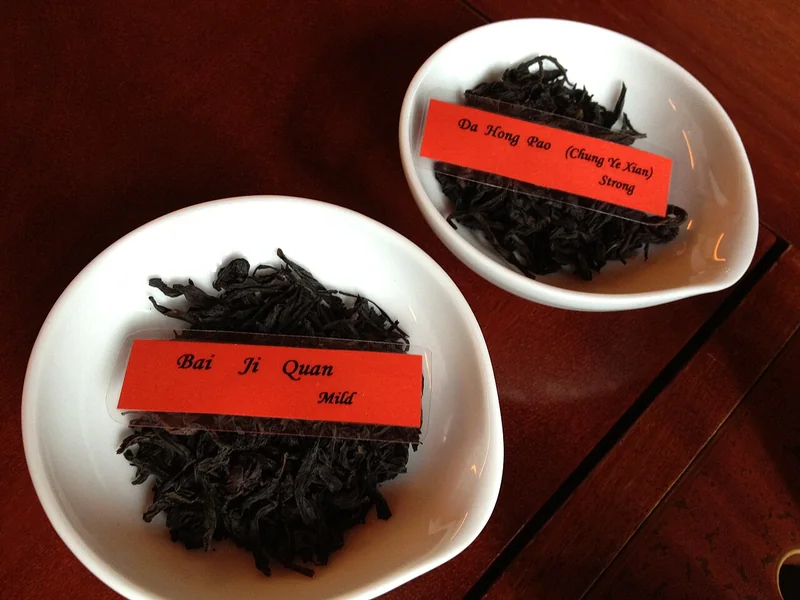
Da Hong Pao (大紅袍, 'Big Red Robe') is a heavily oxidised and roasted oolong tea produced in the Wuyi Mountains of Fujian Province, China, and is the most celebrated of the Wuyi Yancha (rock teas). Six original Da Hong Pao mother trees, growing in a rocky cleft on Mount Wuyi, are considered the origin of the cultivar. From 2002, the Wuyishan municipal government banned further harvesting from the six mother trees. Commercial Da Hong Pao today is produced from cuttings of the original trees or blended from premium Wuyi rock oolongs. The tea is known for its yan yun (岩韻, 'rock rhyme') — a persistent mineral and roasted character unlike any other tea.
Quick facts
- Type
- Tea
- Origin
- China (Wuyi Mountains, Fujian Province)
- Cultivar
- Da Hong Pao (named cultivar from mother trees)
- Oxidation
- Oolong (partial)
- Caffeine
- Medium
- Umami
- Deep, mineral umami
- Astringency
- Moderate, pleasant
- Sweetness
- Caramel, dried fruit sweetness
- Body
- Full, complex
- Tasting notes
- roasted mineral, charcoal, caramel, dried longan, mineral stone
The Six Mother Trees
Six tea trees growing on a precipitous cliff of Mount Wuyi's Tianxin Rock are venerated as the origin of Da Hong Pao. Historical documents mention these trees as far back as the Ming dynasty. The trees are of uncertain age — some accounts claim over 300 years — and a precise botanical assessment has never been conducted. Their leaves yield a very small quantity of tea annually; the last public auction of Mother Tree Da Hong Pao in 2005 sold 20 grams for 208,000 yuan (approximately USD 25,000 at the time). The Wuyishan city government has since prohibited harvesting from the mother trees, and the small quantity preserved in a national museum is not available commercially.
Yan Yun: The Rock Rhyme
Yan yun (岩韻, 'rock rhyme' or 'cliff aura') is the defining quality concept for Wuyi rock oolongs, with Da Hong Pao considered its finest expression. The term describes a complex mineral quality — a persistent, deep, almost stony sensation that lingers in the throat — attributed to the unique rocky terroir of the Wuyi Mountains. Tea plants grown within the designated 'scenic area' of Wuyi Mountain (zhengyan, 'authentic cliff') produce teas with stronger yan yun than those grown on the surrounding plains (waishan). Scientific analysis has identified elevated levels of specific mineral compounds in Wuyi zhengyan teas compared to surrounding areas, but yan yun also encompasses roasting and aromatic qualities that cannot be fully reduced to mineralogy.
Roasting and Multiple Editions
Da Hong Pao is typically heavily roasted over charcoal in multiple sessions — traditional roasting involves 4–6 rounds of roasting and resting over several weeks. The roasting temperature and duration dramatically affect the final character: light roasting preserves more floral notes and green character; medium roasting develops caramel and dried fruit; heavy roasting produces the classic deep charcoal-mineral and mineral-roast profile. Premium Da Hong Pao is also distinguished by whether it is pure varietal (from cuttings of the mother trees) or a blend (the most common commercial form, combining multiple Wuyi rock oolong cultivars). Pure mother-tree-cutting Da Hong Pao is extremely rare and expensive.
Sources & further reading (2)
- encyclopedia — accessed 2026-05-07
- specialty-reference — accessed 2026-05-07
Frequently asked questions
Why is original Da Hong Pao so expensive?
The six original mother trees on Mount Wuyi produce extremely small quantities of tea — typically 500 grams or less annually — and harvesting has been banned since 2002. The last auctioned lot of 20 grams sold for 208,000 yuan in 2005. Commercial Da Hong Pao is made from cuttings of the original trees or blends of Wuyi rock oolongs; at this level, prices reflect quality and terroir rather than original-tree scarcity.
What is 'rock rhyme' (yan yun) in Da Hong Pao?
Yan yun (岩韻) describes the characteristic mineral, deep, and persistent quality of Wuyi rock oolongs. It manifests as a complex stony or mineral sensation that lingers in the throat after swallowing. It is attributed to the unique rocky terroir of the Wuyi Mountains — zhengyan (authentic cliff) teas grown among the rocks show stronger yan yun than those from surrounding areas. Roasting and aromatic compounds also contribute to the overall yan yun experience.
What is the difference between zhengyan and waishan Da Hong Pao?
Zhengyan (正岩, 'authentic cliff') Da Hong Pao is grown within the defined Wuyi scenic area on rocky terrain. Waishan (外山, 'outside mountain') refers to teas grown outside this core area. Zhengyan is associated with stronger yan yun and commands significantly higher prices; waishan produces a similar style at lower price points with less mineral intensity. Both are considered genuine Da Hong Pao in style, though only zhengyan carries the core terroir designation.