Chinese Gongfu Cha Culture
The Chinese art of skilled, attentive tea preparation — embedding tea in social hospitality and aesthetic appreciation.
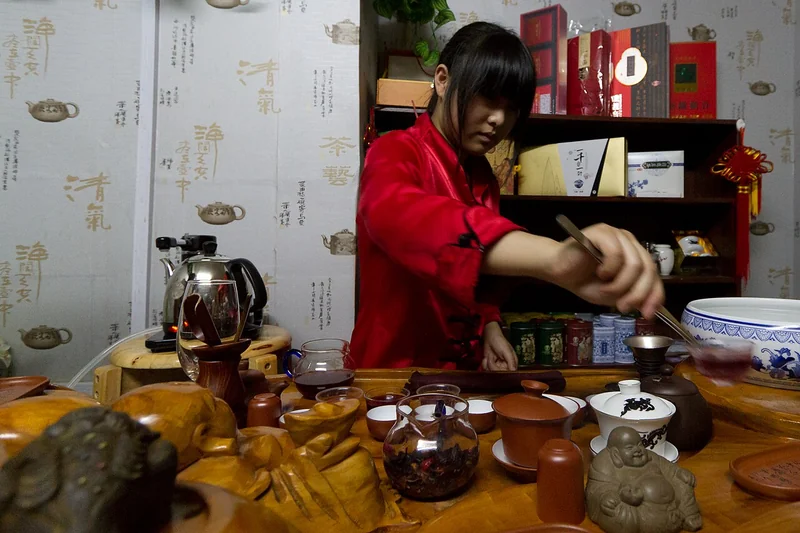
Gongfu cha (工夫茶) as a cultural practice refers to the Chinese tradition of precise, attentive tea preparation that centres on the tea session as a social and aesthetic event. Originating in the Chaozhou-Shantou region of Guangdong and spreading through Fujian and Taiwan, gongfu cha culture emphasises quality tea, skilled preparation, appropriate vessels, and the relationship between host and guest. The practice has codified conventions: specific vessel choices, the warming and rinsing of all cups, the sharing of aroma, the sequential progression through multiple infusions, and the conversation and appreciation that accompany each cup. Gongfu cha culture shapes how premium oolongs, pu-erh, and white teas are understood, marketed, and enjoyed globally.
Quick facts
- Type
- Tea Culture
- Culture
- Chinese gongfu
Historical Development
Gongfu cha culture as a documented practice traces its roots to the Chaozhou (Chaoshan) region of eastern Guangdong Province, where records of small-vessel, high-leaf-ratio brewing appear in texts from the Ming and Qing dynasties. The Chaoshan practice used small clay pots to brew compressed or high-quality oolong teas from Wuyi Mountain in Fujian. The tradition spread along mercantile networks as Chaoshan traders extended their commercial reach throughout southern China and Southeast Asia. In Taiwan during the 1970s–90s, gongfu cha experienced a revival as domestic oolong production improved and tea culture became a point of national cultural identity. From Taiwan, the refined aesthetic of modern gongfu cha — including specific tea furniture, specially designed cups, and a codified session structure — spread to mainland China and internationally.
Social and Hospitality Dimensions
Gongfu cha culture is fundamentally about the relationship between host and guest. The host's attention to every element of the session — the selection of appropriate tea for the occasion, the preparation of the vessel, the temperature of the water, the timing of each infusion — signals respect and care for the guests. Conversation during gongfu cha sessions typically focuses on the tea itself: its origin, the differences between infusions, the quality of the material. Guests are expected to participate in appreciation — commenting on the aroma, colour, and taste. This shared attention creates a focused, slower social interaction distinct from casual beverage service. Gongfu cha sessions can last from 30 minutes to several hours when premium aged teas with many infusions are involved.
Tea Spaces and Material Culture
A dedicated gongfu cha practice has generated a specific material culture: tea trays (chapan) with drainage for overflow; tea towels (chayi); specialised storage for tea cakes (tong); specific furniture proportions for the host and guest positions; and collections of teaware assembled over time. In Taiwan and mainland China, dedicated tea rooms (cha shi) or tea corners within homes serve as sites for the practice. The market for premium gongfu cha vessels — Yixing teapots, high-quality porcelain gaiwans, handblown glass cha hai, ceramic cups — extends from accessible everyday products to collector-level art objects. The practice has expanded internationally through the specialty tea movement, with tea bars in major cities offering gongfu cha sessions.
Sources & further reading (2)
- encyclopedia — accessed 2026-05-07
- specialty-reference — accessed 2026-05-07
Frequently asked questions
What distinguishes gongfu cha from casual Chinese tea drinking?
Gongfu cha involves specific attention to every aspect of preparation: water temperature, leaf quantity, steeping time, vessel choice, and the sequential management of multiple infusions. Casual Chinese tea drinking may use a large mug or glass with a single long steeping — functional but without the precision. Gongfu cha is also a social practice structured around hospitality conventions, with specific roles for host and guest. It is the dedicated mode of tea engagement, not casual refreshment.
What teas are best suited for gongfu cha culture?
Oolongs are historically the core of gongfu cha — particularly Wuyi rock oolongs (Da Hong Pao), Tieguanyin, Dong Ding, and Oriental Beauty from Taiwan. Aged pu-erh (both sheng and shou) is also a major gongfu cha domain. Premium white teas (Silver Needle, White Peony) are increasingly brewed gongfu style. The common requirement is that the tea produces meaningfully distinct, evolving infusions across 5 or more steepings — the essence of the gongfu cha experience.
Is gongfu cha related to kung fu?
Yes, in the sense that both use the same Chinese term. 'Gongfu' (工夫 or 功夫) means 'skill achieved through practice and effort.' In martial arts, gongfu refers to physical discipline developed over time. In tea, gongfu refers to the attentive skill required to prepare tea well — precision of water temperature, timing, vessel management, and guest attention. The connection is the underlying concept: excellence achieved through dedicated, repeated practice.