Chawan
The Japanese ceramic bowl for preparing and drinking matcha — the most evaluated object in the chanoyu ceremony.
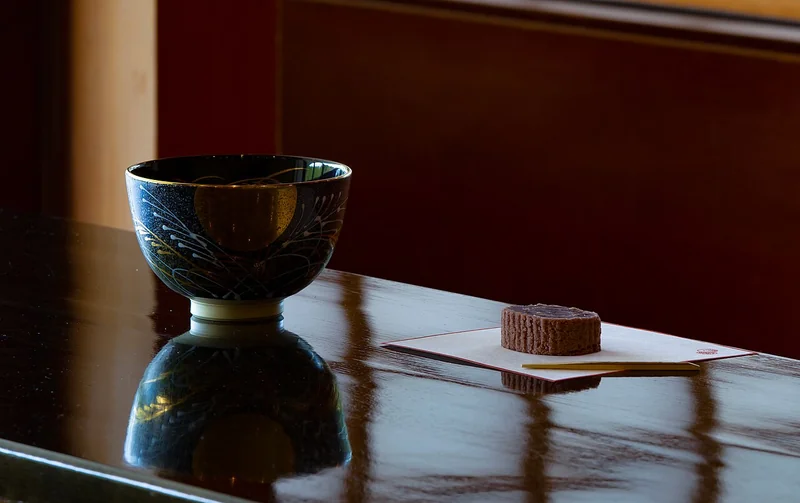
Chawan (茶碗, 'tea bowl') are ceramic bowls used in the Japanese tea ceremony (chanoyu) for the preparation and drinking of matcha. The chawan is the central and most aesthetically significant object in the tea ceremony, evaluated on all aspects of its form, glaze, texture, and how it feels in the hands. Chawan come in dozens of named styles based on their origin, shape, and glaze tradition: Raku ware (hand-shaped, low-fired lead-free earthenware), Hagi ware (Yamaguchi Prefecture, rustic feldspar glaze), Karatsu ware (Saga Prefecture, iron glaze), and Chinese-influenced styles such as tenmoku. Seasonal form conventions exist: wide, flat bowls (hiragata, flat shape) for summer (allowing the tea to cool faster); tall, deep bowls (tsutsugata, cylinder shape) for winter (retaining heat).
Quick facts
- Type
- Tea Ware
Aesthetic Evaluation of Chawan
The evaluation of a chawan in chanoyu tradition considers multiple sensory dimensions beyond visual appearance. The feel of the bowl in the hands — weight, texture, temperature conduction — is primary. The inner surface's smoothness or texture affects how matcha whisks. The rim's thickness and curvature determines how the bowl is held when drinking. The foot ring (kodai) at the base is examined as an index of the potter's skill and aesthetic judgment. The traditional order of beauty for chawan ranked Raku ware first, followed by Hagi, then Karatsu — an evaluation attributed to Sen no Rikyu (1522–1591). The patina that develops on Raku and Hagi ware from use in the ceremony is valued as evidence of the bowl's history.
Raku Ware
Raku (楽焼) is the most revered chawan tradition in Japanese tea ceremony, created by the Raku family of potters, whose lineage begins with Chojiro (c. 1516–1592) — a tile-maker who produced chawan at Sen no Rikyu's request. Raku chawan are hand-shaped (not wheel-thrown), fired at low temperature (800–1100°C), and typically left black (kuro Raku) or red (aka Raku). The firing process — pieces are individually removed from the kiln at peak temperature — creates unique surface variations. Raku pieces are considered complete expressions of wabi (rustic simplicity) aesthetics. The Raku family has produced 16 generations of potters, and Raku ware carries special ceremony significance compared to other chawan styles.
Seasonal and Formal Use
Chawan selection in chanoyu follows seasonal conventions. Wide, shallow bowls (hiragata) are used in summer — their flat profile allows the matcha to cool quickly in the bowl, avoiding overheating on warm days. Tall, narrow cylindrical bowls (tsutsugata) are used in winter — the narrower opening and greater height retain heat in the bowl, keeping the matcha warm. Spring and autumn use intermediate forms. Formal ceremony context also influences chawan selection: the most valued and appropriate chawan for a formal ceremony is distinct from what might be used in a casual tea gathering. Host and guest each have roles in appreciating the chawan formally — turning, examining the foot ring, and commenting are part of the ceremony protocol.
Sources & further reading (2)
- encyclopedia — accessed 2026-05-07
- museum-reference — accessed 2026-05-07
Frequently asked questions
What makes Raku ware the most prized chawan style?
Raku ware is hand-shaped rather than wheel-thrown, fired individually at low temperature with each piece unique, and associated with the highest levels of chanoyu tradition — Sen no Rikyu himself worked with the first Raku potter Chojiro. Raku bowls embody the wabi aesthetic (austere simplicity) better than more technically refined porcelain. The 16-generation Raku family lineage and the historical context of each piece's creation add symbolic value beyond purely visual aesthetics.
Why are different chawan shapes used in summer and winter?
Wide, flat chawan (hiragata) used in summer have a larger surface area that allows the matcha to cool faster, which is desirable in warm weather. Tall, narrow cylindrical chawan (tsutsugata) used in winter retain heat longer due to reduced surface area and greater depth. This practical consideration is integrated into the ceremony's seasonal aesthetic — the selection of appropriate bowls reflects attention to the guest's comfort and to seasonal awareness.
How should a chawan be held when drinking matcha?
In formal chanoyu, the bowl is received with both hands. It is then rotated clockwise two to three quarter-turns before drinking — this turns the 'front' (most aesthetically significant side) of the bowl away from the drinker, out of respect. After drinking, the rim is wiped with a small cloth, and the bowl is returned rotated back to face the host. The rotation convention varies by tea school (Ura Senke, Omote Senke, Mushanokoji Senke).