Cha Hai (Fairness Pitcher)
The gongfu cha fairness pitcher — the full infusion decants here first, then pours equally into each cup.
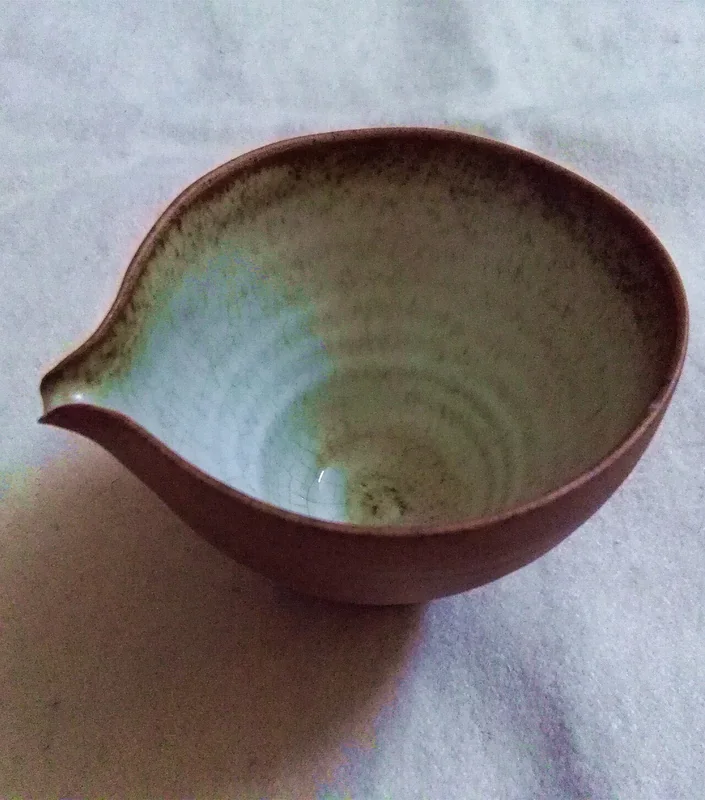
Cha hai (茶海, 'tea sea') — also called gong dao bei (公道杯, 'fairness cup') or sharing pitcher — is a pouring vessel used in Chinese gongfu cha between the teapot or gaiwan and the individual drinking cups. When a teapot or gaiwan is poured sequentially into small cups, the first cup receives the weakest, early-extracted liquid while the last receives the most concentrated. The cha hai eliminates this imbalance: the entire infusion is first poured into the cha hai, where all the liquid mixes and reaches uniform concentration, then distributed equally from the cha hai to each cup. The vessel typically holds 150–300 ml — enough for 3–6 small cups per infusion — and is made from glass, porcelain, or clay.
Quick facts
- Type
- Tea Ware
Function and Position in Gongfu Cha
In a typical gongfu cha sequence, the chain of vessels is: brewing vessel (gaiwan or teapot) → cha hai → individual cups. After the steeping time is complete in the gaiwan or teapot, the entire infusion is decanted at once and completely into the cha hai. This step is critical because allowing liquid to remain in the brewing vessel continues extraction and strengthens the tea unevenly. The cha hai holds the infusion briefly while cups are prepared; from the cha hai, the host pours equal portions into each small cup. The cha hai's straightforward pouring design — wider mouth than the gaiwan, with a pointed or angled spout — makes controlled distribution easy.
Glass as Preferred Material
Glass cha hai are widely used because the transparency allows the host and guests to observe the colour and clarity of the infusion — an important part of tea appreciation in gongfu cha. The colour of the infusion as it sits in the cha hai is one of the first sensory evaluations in a tea session. Glass also does not absorb flavour or colour between sessions, making it neutral across different teas. Porcelain and zisha clay cha hai also exist, with porcelain offering a more formal aesthetic. Some experienced practitioners prefer the way a heavy clay or porcelain cha hai retains heat slightly longer than glass, keeping the infusion warm during pouring.
Social Role in Tea Service
The cha hai's role is explicitly about fairness and hospitality in a group tea session. Its Chinese name gong dao bei (公道杯, 'righteousness cup') reflects this: the vessel ensures that every guest receives tea of identical quality and strength, regardless of their seating position relative to the host. The host's attention in filling the cha hai completely and distributing equally signals respect for all guests equally. The cha hai also prevents the host from needing to rush the distribution before the tea becomes too strong — the cha hai holds the infusion at a stable, completed extraction state while cups are arranged.
Sources & further reading (2)
- encyclopedia — accessed 2026-05-07
- specialty-reference — accessed 2026-05-07
Frequently asked questions
Why is the cha hai also called the 'fairness cup'?
When tea is poured directly from a teapot or gaiwan into multiple small cups in sequence, the first cup receives lighter, early-extracted liquid and the last cup receives the strongest, most concentrated tea. The cha hai (gong dao bei, 'fairness cup') collects the entire infusion first, homogenising it to a single concentration, then distributes equal-strength tea to every cup. The name reflects its function: ensuring fair, equal treatment of all guests.
What size cha hai is appropriate for different group sizes?
For 2 people using a 100 ml gaiwan: a 150–200 ml cha hai is sufficient. For 3–4 people using a 130–150 ml gaiwan: 200–250 ml. For 5–6 people or two teapots: 250–350 ml. The cha hai should be large enough to hold the full infusion from the brewing vessel plus a small safety margin, but not so large that a single infusion barely covers the bottom.
Is the cha hai necessary for solo gongfu cha?
For solo brewing, the cha hai is optional. A single person can pour from the gaiwan directly into their cup. However, the cha hai still provides a useful function even solo: it stops extraction by fully draining the gaiwan, and it allows observation of the infusion colour before drinking. Many solo practitioners continue to use a small cha hai as part of a full gongfu cha setup for this reason.