Camellia sinensis var. assamica (Assam Tea Plant)
The large-leaf Assam tea plant — source of robust black teas from India, Sri Lanka, and East Africa.
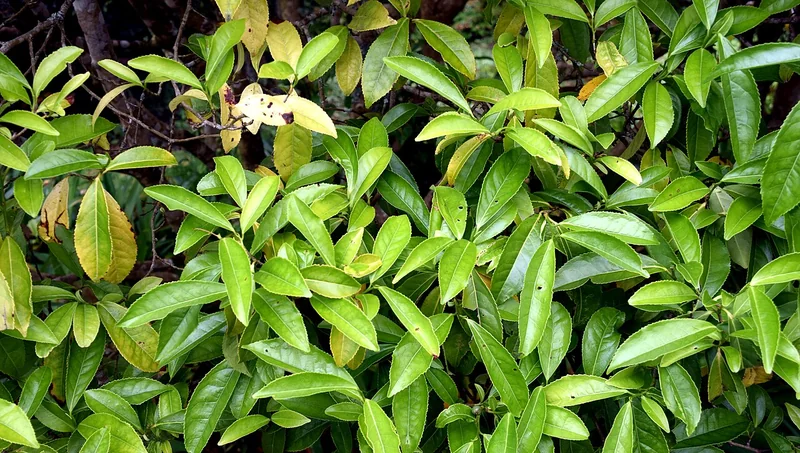
Camellia sinensis var. assamica is the large-leafed variety of the tea plant, originally discovered growing wild in Assam, northeastern India, in the 1820s–1830s. While the Chinese tea plant (var. sinensis) had been cultivated for over two millennia, the Assam variety was a separate, independent domestication — taller, with leaves up to 20 cm, adapted to tropical lowland climates rather than the cool highlands suited to Chinese plants. Var. assamica produces a tea with bold, full body, strong colour, and pronounced tannin structure, making it the dominant base for black teas from Assam, Sri Lanka, Kenya, Uganda, and other major producing regions. It is also used in traditional Assamese cooking and has been grown by local communities long before British colonial commercial development.
Quick facts
- Type
- Tea Plant
- Origin
- Assam, northeastern India; also found wild in Yunnan, Burma, and Southeast Asia
Discovery and Colonial Tea Development
The British East India Company's dependence on Chinese tea imports created significant commercial pressure to find alternative sources within British-controlled territory. In 1823, the Scottish adventurer Robert Bruce encountered wild tea plants being used by the Singpho people of Assam and reported the discovery to colonial authorities — though it was his brother Charles Alexander Bruce who documented and promoted the find most actively. By 1839, tea produced from Assam plants was being sold in London. The colonial tea industry in Assam was developed through large plantations (tea estates) worked under indentured labour systems, with land cleared and planted at large scale. The Assam variety's vigorous growth, larger leaf yield, and stronger flavour suited to British palates driving demand for milk tea made it commercially ideal. By the late 19th century, Assam had surpassed China as Britain's primary source of tea, and the Assam plant was also transplanted to Ceylon (Sri Lanka), East Africa, and other colonial territories.
Botanical Characteristics
Camellia sinensis var. assamica is a significantly larger plant than var. sinensis — in its wild form, it grows as a tree reaching 10–15 metres. Leaves are large (10–20 cm), broadly elliptic, with a more pronounced point and a thinner, less waxy texture than Chinese variety leaves. The plant thrives in tropical conditions: temperatures of 20–35°C, abundant rainfall (150–300 cm annually), and lowland or low-altitude terrain. Its growth rate is faster than var. sinensis, producing more leaf material per plant but requiring more intensive management. The leaf composition differs: var. assamica has higher polyphenol and catechin concentrations, which produce the stronger, more astringent character associated with Assam black tea. The large leaves are well-suited to CTC (cut, tear, curl) processing — the industrial production method used for tea bag tea.
Indigenous Use and Pre-Colonial History
Before the British commercial tea industry, the Singpho, Khamti, and other communities in Assam and neighbouring areas had their own traditions of using the wild assamica plant. Some consumed it as a fermented food — leaves pickled and eaten with oil and garlic — a tradition related to the Burmese lahpet (fermented tea leaves). Others brewed it as a beverage in forms quite different from Chinese tea preparation. This pre-colonial use establishes that var. assamica was not simply a 'wild plant' discovered by British observers but a culturally used resource with its own local traditions. The Burmese tradition of eating fermented tea (lahpet) continues today and is considered a national dish in Myanmar — distinct from the beverage tradition but derived from the same plant.
Sources & further reading (2)
- encyclopedia — accessed 2026-05-07
- encyclopedia — accessed 2026-05-07
Frequently asked questions
Is Assam tea only made from Camellia sinensis var. assamica?
Most commercial Assam tea uses var. assamica or hybrids between assamica and sinensis. However, some specialty Assam teas from smaller estates use clonal selections that may have mixed ancestry. The term 'Assam tea' refers primarily to geographic origin (Assam, India) rather than being a strict botanical classification — but the dominant plant in Assam production is overwhelmingly var. assamica due to its adaptation to local conditions and high yield.
Why is Assam tea associated with milk tea and strong brews?
Camellia sinensis var. assamica has higher polyphenol and theaflavin concentrations than var. sinensis. Theaflavins are the compounds responsible for the deep amber-red colour and the robust, brisk, malty character of black Assam tea. The strong flavour and colour stand up well to the addition of milk — which softens astringency and enriches body. This characteristic made Assam tea particularly suited to the British preference for milk tea, driving its commercial adoption and dominance in the British tea market.
What is the relationship between the Assam tea plant and Burmese lahpet?
Lahpet (လက်ဖက်) is a Burmese dish of fermented tea leaves consumed as food — eaten in salads with oil, garlic, dried shrimp, sesame seeds, and peanuts. It represents a distinct cultural use of Camellia sinensis var. assamica that predates British commercial development and is unrelated to the beverage tradition. The tea leaves are fermented under pressure for months. Lahpet is considered a national dish in Myanmar and is served at social gatherings and significant occasions. The tradition demonstrates that the Assam tea plant has culturally meaningful use patterns across the region independent of British colonial tea history.