Camellia sinensis (Chinese Tea Plant)
The small-leaf Chinese tea plant — source of green, white, yellow, and oolong teas cultivated for over two millennia.
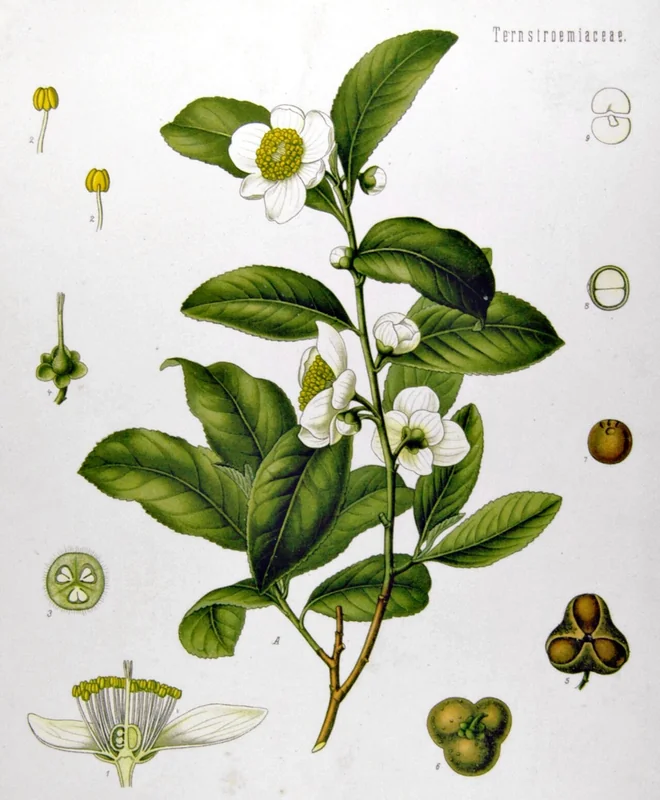
Camellia sinensis var. sinensis, the Chinese variety of the tea plant, is an evergreen shrub in the family Theaceae native to southwestern China. It is the botanical source of green, white, yellow, oolong, and most fine black teas. Distinguished from its Assam cousin (var. assamica) by smaller leaves, greater cold tolerance, and more nuanced flavour compounds, var. sinensis is the primary plant behind East Asian tea culture — Japanese green teas, Chinese oolongs, Taiwanese high-mountain teas, and Darjeeling fine teas all depend on this variety or its cultivars. Centuries of selective cultivation have produced hundreds of named cultivars optimised for specific tea types and regional climates.
Quick facts
- Type
- Tea Plant
- Origin
- Yunnan Province, China (likely center of origin); widely cultivated across East Asia
Botanical Profile
Camellia sinensis var. sinensis is a small-leafed evergreen shrub or small tree in the family Theaceae. Left unpruned, it can grow to 3–5 metres, but commercial cultivation keeps plants pruned to 60–100 cm for ease of harvest. Leaves are elliptic, 4–10 cm long, with a serrated margin and a characteristic pointed tip. The leaf surface is glossy on the upper side, with fine hairs (trichomes) on the underside of young leaves — these hairs are visible in white teas (Bai Hao Yinzhen) as the silver-white coating on buds. Flowers are small, white, five-petalled, and fragrant, appearing in autumn. Seeds are large, oily, and non-edible for tea purposes but were historically pressed for oil. The plant is adapted to acidic soils (pH 4.5–6.0), high humidity, and cool, misty growing conditions — which is why high-altitude tea gardens (Darjeeling, Uji, Alishan) produce distinctive quality.
Domestication and Global Spread
The wild ancestor of Camellia sinensis is believed to originate in the region of Yunnan Province, China, and adjacent areas of Burma and Assam. Archaeological and historical evidence places tea use in China as early as the Han dynasty (206 BCE–220 CE), with systematic cultivation documented in the Tang dynasty (618–907 CE). The spread of tea cultivation followed Buddhist and trade networks: through Korea and Japan (via Buddhist monks from China), into Southeast Asia and the Himalayan foothills, and eventually through colonial botanical transfer to South Asia, East Africa, and elsewhere. The Dutch and British East India Companies facilitated the transplanting of Chinese tea plants and knowledge to India (Assam, Darjeeling), Ceylon (Sri Lanka), and Java in the 18th–19th centuries. The Chinese variety (var. sinensis) produces smaller leaves and a more nuanced, complex flavour compared to the Assam variety (var. assamica), and remains dominant in East Asian tea production.
Cultivars and Their Role in Tea Quality
Within Camellia sinensis var. sinensis, hundreds of cultivated varieties (cultivars) have been developed through centuries of selection, clonal propagation, and cross-breeding. Notable cultivars include: Yabukita (やぶきた), which accounts for over 70% of Japanese tea production and is known for its balanced umami and green character; Longjing 43, a clonal selection used for premium Longjing production in Zhejiang; and Qingxin Oolong (青心烏龍), the dominant cultivar used for Taiwanese high-mountain oolongs. In Korea, the Seogwang and Boseong cultivars have been selected for local climate adaptation. Cultivar selection significantly determines the flavour potential of a tea before processing: different cultivars have different amino acid (theanine) concentrations, polyphenol profiles, and aromatic compound compositions, making cultivar identity an important quality marker in specialty tea trade.
Sources & further reading (2)
- encyclopedia — accessed 2026-05-07
- horticultural-reference — accessed 2026-05-07
Frequently asked questions
What is the difference between Camellia sinensis var. sinensis and var. assamica?
Camellia sinensis var. sinensis (Chinese type) produces small leaves (4–10 cm), is more cold-tolerant, and is the source of most green, white, yellow, and fine oolong teas. Camellia sinensis var. assamica (Assam type) produces large leaves (10–20 cm), grows naturally in tropical climates, and is the primary source of robust black teas from Assam, Sri Lanka, East Africa, and other major black tea producers. The two varieties have different flavour profiles — var. sinensis tends toward more delicate, complex, and astringency-managed character; var. assamica toward fuller body and bolder colour.
Why do high-altitude tea gardens produce different-tasting tea?
Higher altitude means lower average temperature, more cloud cover, and greater diurnal temperature variation (the difference between day and night temperatures). Slower growth under these conditions allows the plant to accumulate more amino acids (particularly L-theanine) and aromatic compounds before harvest. The result is tea with greater complexity, sweetness, and fragrance — and often less bitterness — compared to faster-growing lowland plants. This is the basis for the premium placed on teas from Darjeeling (India), high-mountain oolongs from Taiwan (Ali Shan, Li Shan), and Uji (Japan).
Are all teas made from the same plant?
Yes — green, white, yellow, oolong, black, and pu-erh teas are all produced from Camellia sinensis. The difference between tea types is entirely in how the harvested leaf is processed: the degree of oxidation (exposure to oxygen after cell damage), heat application (which stops oxidation), withering, rolling, and drying steps determine whether the final product is a fresh green tea or a fully oxidised black tea. Herbal infusions (chamomile, rooibos, peppermint) are not made from Camellia sinensis and are technically not 'tea' — they are tisanes.