Bi Luo Chun
Tightly spiral-rolled spring green tea from Dongting Mountain, Suzhou — with a characteristic natural floral fragrance.
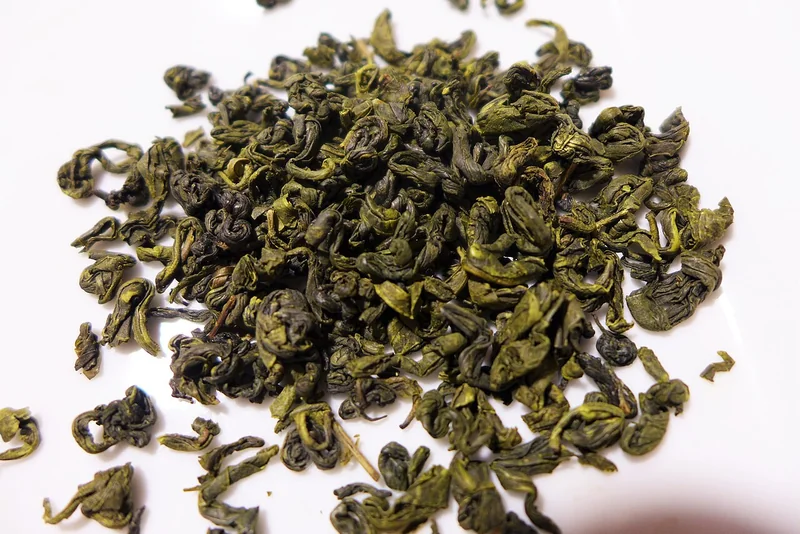
Bi Luo Chun (碧螺春, 'Green Snail Spring') is a prized Chinese green tea produced on Dongting Mountain in Suzhou, Jiangsu Province. The tea is notable for its distinctive tight spiral shape, achieved by rolling the tiny early-spring buds and leaves between the palms during pan-firing. A unique feature of Dongting production is the intercropping of tea plants with fruit trees — peach, plum, apricot, and loquat — whose roots and blossoms are said to impart a natural fruity-floral fragrance to the leaves. The tea requires extraordinary quantities of hand-picked material: approximately 60,000–70,000 individual young buds yield 500 grams of finished tea.
Quick facts
- Type
- Tea
- Origin
- China (Dongting Mountain, Suzhou, Jiangsu)
- Oxidation
- Green (unoxidised)
- Caffeine
- Medium
- Umami
- Light, subtle
- Astringency
- Low
- Sweetness
- Delicate, fruit-blossom sweetness
- Body
- Light
- Tasting notes
- peach blossom, apricot, fresh grass, honey
Spiral Shape and Production
Bi Luo Chun's characteristic tight spiral shape results from rolling the freshly pan-fired leaves between the palms of the tea worker's hands. After sha qing (kill-green) in the wok, while leaves are still warm and pliable, the worker gathers them into a small ball and rolls them in a circular motion. This action tightens the leaves into fine, curved spirals covered in visible white down (the fine hairs from young buds). The tiny buds used — ideally one bud and one or two leaves — contain a high density of fine hairs, making the finished tea visually distinctive. Because early spring buds are so small, the harvest is extremely labour-intensive.
Intercropping with Fruit Trees
The traditional Dongting Mountain gardens intermix tea plants with peach, plum, apricot, and loquat fruit trees at intervals of several metres. This intercropping is not merely agricultural tradition — it is considered a key factor in Bi Luo Chun's fragrance. The fruit trees' root exudates, falling blossoms, and microclimate effects are believed to contribute to the tea's distinctive fruity-floral character. Some tea researchers describe this as a form of natural aromatisation through the shared soil ecosystem. The intercropped gardens also shade the tea plants partially, moderating temperature and humidity. Genuine Dongting Bi Luo Chun carries a Geographical Indication designation.
Imperial Name and Market
The tea's modern name dates to the reign of the Kangxi Emperor (r. 1661–1722) of the Qing dynasty. According to historical accounts, locals originally called the tea 'xia sha ren xiang' (a fragrance that alarms even the gods), which the emperor — presented with the tea during a tour of Dongting — found crude and renamed 'Bi Luo Chun' (Green Snail Spring). Imperial patronage elevated the tea's status. Today, genuine Suzhou Dongting Bi Luo Chun is expensive and not commonly exported in quantity; much tea sold under the Bi Luo Chun name internationally is produced in Sichuan, Zhejiang, or Yunnan using the same shape but different cultivars and growing conditions.
Sources & further reading (2)
- encyclopedia — accessed 2026-05-07
- specialty-reference — accessed 2026-05-07
Frequently asked questions
Why does Bi Luo Chun have a fruity aroma if no fruit is added?
The traditional Dongting Mountain gardens intercrop tea plants with fruit trees including peach, plum, and apricot. The shared root systems, fallen blossoms, and microclimate effects of the orchard environment are considered responsible for the tea's natural fruit-blossom fragrance. No fruit is added during processing; the fragrance is a product of the growing environment and the young bud composition.
How many tea buds does it take to make 500 grams of Bi Luo Chun?
Approximately 60,000–70,000 individual hand-picked buds are required to produce 500 grams of finished Bi Luo Chun. This accounts for the tea's premium price. The picking window is very short — the tiny spring buds are only available for several weeks — and each bud must be hand-plucked to avoid bruising.
What water temperature suits Bi Luo Chun?
75°C is generally recommended for Bi Luo Chun. Lower temperatures (70–75°C) are preferred for premium grades because the young buds are delicate and higher temperatures can produce excessive bitterness. The tea can be brewed by adding leaves to the cup first, then pouring water at an angle to watch the spiral leaves slowly sink — a traditional appreciation method called shui zhong ya (submerging in water).