Assam
India's most productive tea region — full-bodied, malty black teas from the Brahmaputra valley's lowland gardens.
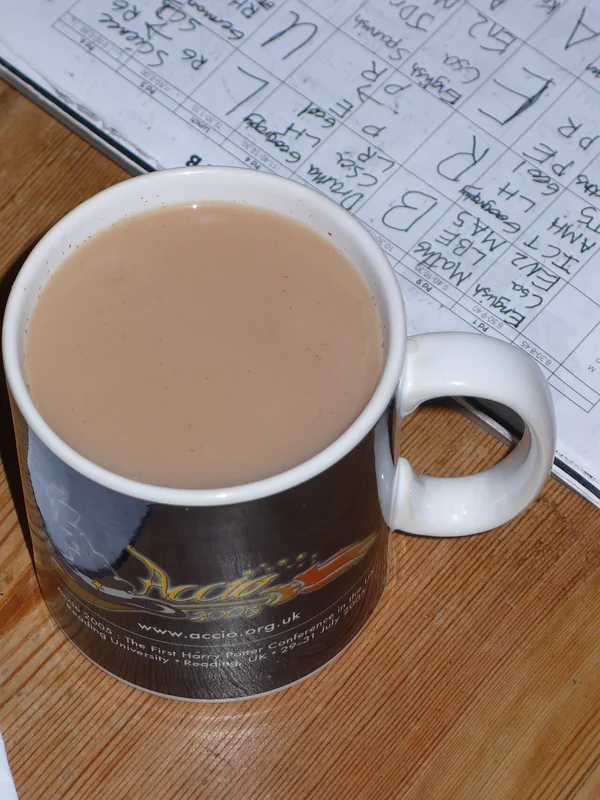
Assam is both a state in northeastern India and the designation for the black teas produced there — the world's largest tea-producing region by volume. The Brahmaputra River valley, lying between the Himalayan foothills to the north and the Patkai range to the east, provides a flat, hot, humid growing environment suited to Camellia sinensis var. assamica, a large-leaf variety of the tea plant with a native range in the Assam-Yunnan corridor. Assam teas are known for their full body, strong malt character, and reddish-amber infusion. They are a primary component of CTC (cut, tear, curl) teas used in English breakfast blends and masala chai.
Quick facts
- Type
- Tea
- Origin
- India (Brahmaputra Valley, Assam State)
- Oxidation
- Black (full)
- Caffeine
- High
- Astringency
- High, especially in CTC grades
- Sweetness
- Malt-like sweetness, best with milk
- Body
- Full, heavy
- Tasting notes
- malt, dark chocolate, earth, amber honey
Discovery and Commercial History
Tea plants growing wild in Assam were brought to the attention of the British East India Company in the 1820s. Robert Bruce, a Scottish adventurer, encountered wild tea plants near Sadiya in 1823 through the Singpho chief Bessa Gam; his brother Charles Alexander Bruce subsequently documented the discovery and sent samples to botanical experts. Official confirmation that these were indeed tea plants — specifically Camellia sinensis var. assamica — arrived in 1838. The first commercial shipment of Assam tea reached London in 1839. By the mid-19th century, the British had established a large plantation industry in Assam using indentured labour, and Assam became the backbone of British tea supply, eventually displacing Chinese imports.
CTC Processing
The majority of Assam tea (estimated at 90 percent of production) is processed using the CTC method — cut, tear, curl — invented in 1930 by William McKercher. In CTC processing, withered leaves pass through a series of cylindrical rollers with interlocking teeth that simultaneously cut the leaf tissue, tear it apart, and curl the fragments into small pellets. This mechanical process breaks open more leaf cells than orthodox rolling, accelerating oxidation and producing a strong, consistent infusion that extracts quickly. CTC teas are ideal for tea bags and masala chai, where a bold, fast infusion is required. Orthodox Assam, produced by traditional rolling, accounts for a smaller share of production and commands premium prices for its more nuanced flavour.
First and Second Flush
Assam has two main quality flushes. The first flush (March–May) produces lighter, more delicate teas following the dry winter period; these are less typical of Assam's characteristic malt profile and are sometimes called 'spring Assam.' The second flush (June–July) is considered the peak of Assam quality and character. Second-flush Assam displays the strong malt note, full body, and golden tips that define premium Assam. These teas also include TGFOP (Tippy Golden Flowery Orange Pekoe) grades, where the presence of golden tip leaves (from buds) indicates higher quality. The term 'Orange Pekoe' (OP) refers to the leaf grade, not a flavour or ingredient.
Sources & further reading (2)
- encyclopedia — accessed 2026-05-07
- government-data — accessed 2026-05-07
Frequently asked questions
What does 'malty' mean in Assam tea?
'Malty' describes a flavour note reminiscent of malted barley or malted milk, associated with specific compounds — particularly 2-acetyl-1-pyrroline and furan derivatives — that develop during the heavy oxidation characteristic of Assam black tea processing. The malt note is more pronounced in second-flush Assam and in orthodox-processed teas. It is considered a quality marker for Assam specifically.
What is the difference between CTC and orthodox Assam?
CTC (cut, tear, curl) Assam is mechanically shredded into small pellets, producing a fast-brewing, strong, consistent infusion used primarily in tea bags, breakfast blends, and masala chai. Orthodox Assam is processed by traditional rolling that keeps the leaf more intact, producing a more nuanced, less aggressive flavour with more complexity at the cost of longer brew time and lower consistency. Orthodox Assam is more common in specialty tea markets.
Why is Assam used in English breakfast tea?
Assam's full body, high astringency, and strong malt character stand up well to milk, making it ideal for the British style of tea drinking that developed in the 19th century. English breakfast blends typically combine Assam with other black teas (Ceylon, Kenyan) to achieve a balanced, brisk infusion. The bold character of Assam provides the backbone of these blends.