Senecio mandraliscae
Senecio mandraliscae (Blue Chalksticks) Care Guide
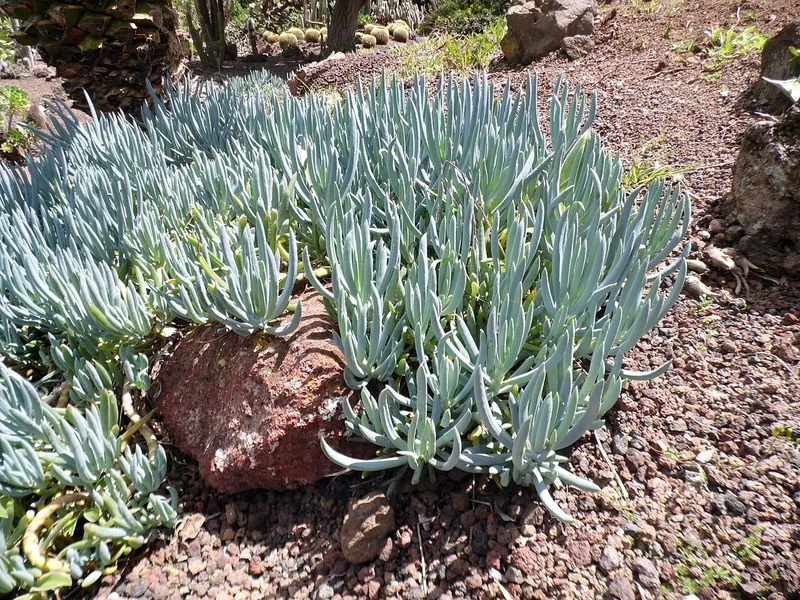 Featured photosenecio-mandraliscae.jpg
Senecio mandraliscae, sold as Blue Chalksticks, is a member of the *Curio* / *Senecio* / *Othonna* group of succulent Asteraceae from southern Africa. A South African ground-cover succulent with cylindrical pale blue-grey finger-like leaves on short stems, forming dense low spreading mats. Widely used in Mediterranean-climate landscaping. Modern taxonomy has separated several former *Senecio* succulents into the genus *Curio*, but plants are still commonly sold under the older Senecio names at retail.
Care facts at a glance
- Light
- Bright indirect
- Water
- Water deeply when the mix is fully dry, typically every 2 to 3 weeks.
- Humidity
- 30–50 %
- Temperature
- 10–27 °C
- Soil
- Free-draining cactus or succulent mix with extra perlite or pumice.
- Origin
- Southern Africa, mostly the Western and Eastern Cape and Namibia.
- Mature size
- Trailing stems to 60 cm or more in mature plants.
Overview
Senecio mandraliscae sits in the broader Curio/Senecio/Othonna succulent radiation across southern Africa. A South African ground-cover succulent with cylindrical pale blue-grey finger-like leaves on short stems, forming dense low spreading mats. Widely used in Mediterranean-climate landscaping. The succulent leaves and trailing stems are an adaptation to the seasonally dry Cape habitats where most species grow. Modern molecular work has split the leafy-succulent species into Curio and the bulb-like ones into Othonna, but retail labels still mix the genus names freely.
Care Priorities
- Bright filtered light or a few hours of direct morning sun.
- Free-draining gritty mix; sustained moisture rots the roots.
- Water deeply, then let the mix dry fully.
- Cool dry winter rest below 15 °C encourages flowering.
Common Problems
Stretched stems are insufficient light. Mushy base is overwatering. Aphids cluster on flower buds and are easy to dislodge with a strong water spray. Many species drop older leaves naturally as part of the seasonal rest cycle.
Sources & further reading (2)
- encyclopedia — accessed 2026-04-29
- botanical-garden — accessed 2026-04-29
Frequently asked questions
Why are the leaves so blue?
S. mandraliscae leaves are coated in a thick waxy bloom (epicuticular wax) that scatters short-wavelength light and gives the plant its striking blue-grey colour. The wax also reflects UV and reduces water loss in habitat.
Are these really Senecio or Curio?
Modern molecular taxonomy has split the succulent species formerly in *Senecio* into a separate genus *Curio*, alongside the unchanged true *Senecio* and the bulb-like *Othonna*. Retail labels often still use the older Senecio names, which is why both names appear on plant tags.
Can I propagate from broken stems?
Yes — stem cuttings root readily. Snap a healthy stem at a node, let the cut callus for a day or two, and lay the cutting on dry succulent mix. Roots typically appear within two to three weeks.