Goeppertia crocata
Goeppertia crocata (Eternal Flame) Care Guide
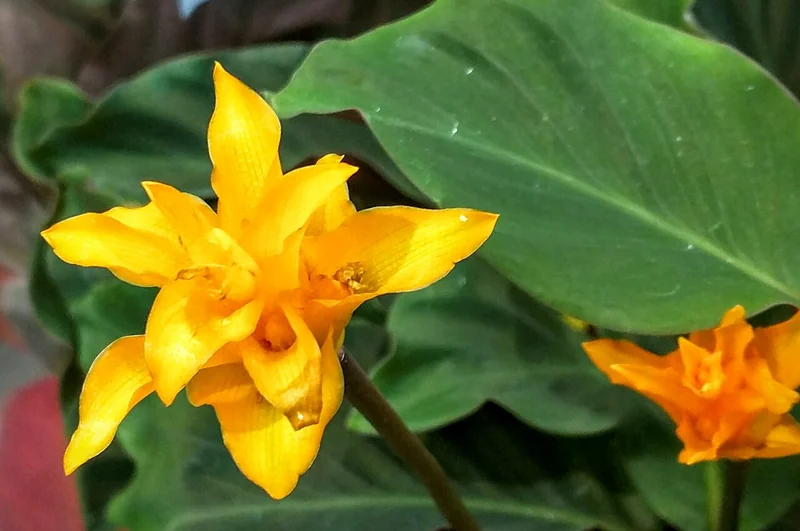 Featured photogoeppertia-crocata.jpg
Goeppertia crocata, formerly Calathea crocata, is the eternal flame plant — one of the very few calatheas grown primarily for its flowers rather than foliage. The bright orange-red flower bracts emerge on tall stems and last for weeks, hence the eternal flame name. The leaves are dark green with purple undersides. It is more humidity-demanding than other calatheas.
Care facts at a glance
- Light
- Bright indirect
- Water
- Water when the top 1 to 2 cm of mix has dried.
- Humidity
- 60–80 %
- Temperature
- 18–27 °C
- Soil
- Peat-rich, well-draining mix with perlite.
- Origin
- Forests of Brazil.
- Mature size
- 30 to 45 cm tall.
Overview
Goeppertia crocata is one of a handful of calatheas grown for flowers. The orange flame is composed of long-lived bracts; the small true flowers inside are insignificant.
Care Priorities
- Soft filtered light keeps the leaves dark and the flame bright.
- Filtered water; calatheas are very sensitive.
- Hold humidity above 60 percent.
- Trim spent flame stalks at the base after they fade.
Common Problems
Crispy edges are dry air or hard water. No flowers usually means insufficient light or maturity. Yellow leaves are overwatering.
Sources & further reading (2)
- encyclopedia — accessed 2026-04-28
- botanical-garden — accessed 2026-04-28
Frequently asked questions
How long do the flames last?
Each bract cluster lasts 4 to 8 weeks in good conditions, with the colour gradually deepening before fading.
Why is it called eternal flame?
The bright orange bracts and their long persistence give the plant its trade name. The bracts, not the small true flowers, are the showy part.
Will it re-bloom?
Yes, on mature plants in good conditions — usually once a year. Some growers report multiple flushes with bloom-booster feeding.