Canis lupus familiaris
Norwegian Lundehund
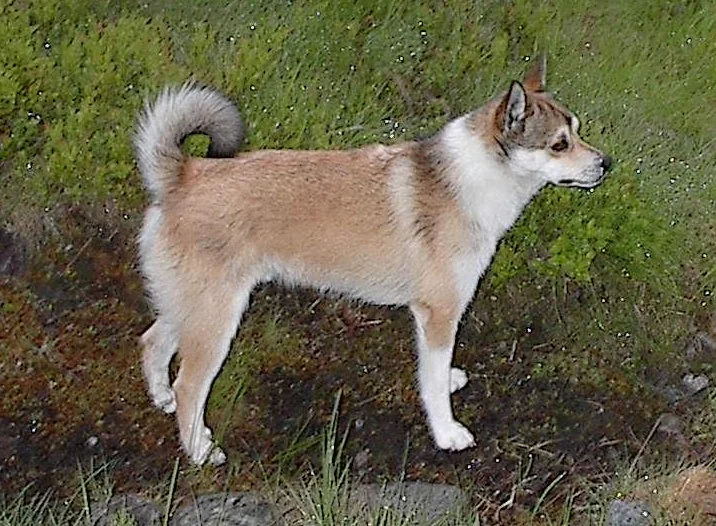 Featured photonorwegian-lundehund.jpg
The Norwegian Lundehund is a Norwegian Lofoten-Islands puffin-hunting Spitz with six toes — rebuilt from 6 dogs in 1963. The Norwegian Lundehund (lunde = puffin, hund = dog) was developed on the Norwegian Lofoten Islands as the puffin-hunting dog — the breed has six functional toes on each paw (instead of four), an unusually-flexible neck (the head can fold backward to touch the spine), prick-and-fold ears that close to keep out moisture, and unusual joint flexibility — all adaptations for retrieving puffins from narrow rocky cliff crevices.
Quick facts
- AKC group
- Non-Sporting
- Origin country
- Norway (Lofoten Islands)
- Origin period
- Antiquity (rebuilt from near-extinction 1963)
- Coat type
- Short
- Coat colors
- Reddish Brown to Fallow Yellow (with white markings or sable, with darker mask)
- Average lifespan
- 10-14 years
- Recognition
- AKC 2011 · FCI 1965 · UKC 2011 · Group 5 — Spitz and Primitive Types (Section 2: Nordic Hunting Dogs)
Origin
The Norwegian Lundehund (Norwegian lunde 'puffin' + hund 'dog') was developed on the Norwegian Lofoten Islands — particularly on the islet of Værøy — as the puffin-hunting dog. The breed has remarkable physiological adaptations for retrieving Atlantic puffins from narrow rocky cliff crevices: six functional toes on each paw (instead of the standard four, with two well-developed dewclaws acting as additional toes), an unusually-flexible neck (the head can fold backward to touch the spine), prick-and-fold ears that close to keep out moisture and dirt, and unusual elasticity in the shoulder joints (the front legs can extend straight out to the sides, perpendicular to the body). The breed was nearly extinct in 1963, when a distemper outbreak combined with the post-1932 ban on puffin hunting reduced the population to just six surviving dogs. Eleanor Christie of Hamar rebuilt the breed from these six dogs and the modern Lundehund population descends from her work. The AKC admitted the breed in 2011.
Recognition
The American Kennel Club admitted the breed in 2011, the United Kennel Club followed in 2011, and the Federation Cynologique Internationale published the international standard (FCI No. 265) in 1965. The FCI assigns the breed to Group 5 — Spitz and Primitive Types (Section 2: Nordic Hunting Dogs).
Standard
The AKC and FCI standards describe a small, agile, alert, rectangular-built Spitz with several unique physiological features. The defining features are the six functional toes on each paw (with two well-developed dewclaws), the unusual neck flexibility (the head can fold backward to touch the spine — used to manoeuvre in narrow puffin burrows), the closing prick-and-fold ears, and the highly-flexible front leg joints. The short, dense, harsh double coat is recognized in reddish-brown to fallow-yellow (with white markings) or sable with a darker mask. Males stand 35-38 cm at the withers, females 32-35 cm.
Sources & further reading (3)
- kennel-club-registry — accessed 2026-04-30
- encyclopedia — accessed 2026-04-30
- fci-standard — accessed 2026-04-30
Frequently asked questions
What is the Norwegian Lundehund's AKC group?
The American Kennel Club places the Norwegian Lundehund in the Non-Sporting Group. The Non-Sporting Group is the AKC's residual category for breeds whose modern role does not fit the older Sporting / Hound / Working / Terrier / Toy / Herding rubrics; the Bulldog, Dalmatian, and Poodle sit here. The breed's foundation working role was as a Norwegian Lofoten-Islands puffin-hunting Spitz with six toes — rebuilt from 6 dogs in 1963.
When was the Norwegian Lundehund officially recognized?
The American Kennel Club admitted the breed in 2011; the United Kennel Club followed in 2011; the Federation Cynologique Internationale published the international standard (FCI No. 265) in 1965.
What is the average lifespan of a Norwegian Lundehund?
Kennel-club longevity surveys place the Norwegian Lundehund's average lifespan in the 10-14 years range. The figure here represents the spread reported by the major parent-club studies and the Kennel Club (UK) purebred-dog health surveys.