Canis lupus familiaris
Miniature Schnauzer
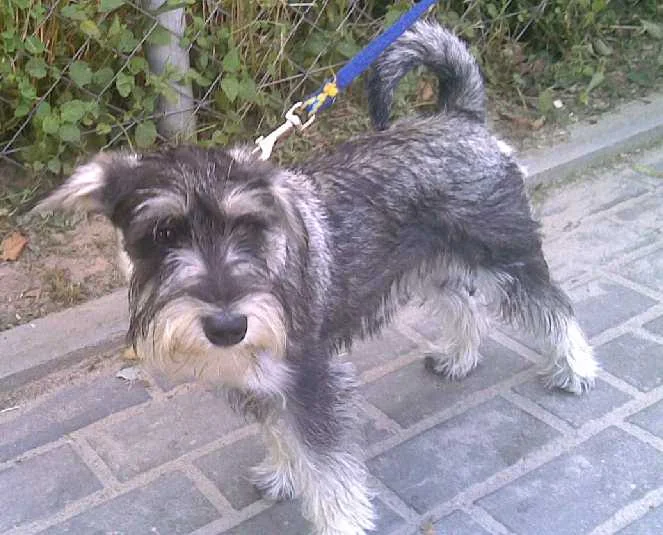 Featured photominiature-schnauzer.jpg
The Miniature Schnauzer is the smallest of the three Schnauzer breeds and one of the most popular dog breeds in the United States and Europe. Developed in Germany in the late 19th century by crossing the Standard Schnauzer with the Affenpinscher and possibly the Poodle and Pomeranian, the breed was produced as a smaller farm dog capable of ratting and vermin control. It retains the Schnauzer's characteristic bushy eyebrows, long beard, and wiry double coat, in salt-and-pepper, black and silver, or solid black. The AKC recognised the breed in 1926. Males and females stand 30–36 cm.
Quick facts
- AKC group
- Terrier
- Origin country
- Germany
- Origin period
- Late 19th century
- Coat type
- Wirehaired
- Coat colors
- Salt and Pepper, Black and Silver, Black
- Average lifespan
- 12-15 years
- Recognition
- AKC 1926 · FCI 1954 · UKC 1948 · Group 2 — Pinscher and Schnauzer-Molossoid Breeds, Swiss Mountain and Cattle Dogs (Section 1.3: Schnauzers)
Origin
The Miniature Schnauzer was developed in the Württemberg and Bavaria regions of Germany during the 1870s–1890s as a smaller ratting and vermin-control dog derived from the Standard Schnauzer. Breeders crossed the Standard Schnauzer with the Affenpinscher — a small, wiry-coated toy-type dog — and possibly with miniaturised poodle and spitz types to reduce size while retaining the Schnauzer's working character, wiry coat, and characteristic beard and eyebrows. The first documented Miniature Schnauzer in the show ring was Findel, exhibited in Hamburg in 1879.
Recognition
The Pinscher-Schnauzer-Klub (PSK), Germany's principal registry for schnauzer and pinscher breeds, formally registered the Miniature Schnauzer in the early 20th century. The AKC recognised the breed in 1926, but unlike the Standard and Giant Schnauzers — which the AKC places in the Working Group — the Miniature Schnauzer was assigned to the Terrier Group based on its size and ratting function. The FCI (FCI No. 183) recognises the breed in Group 2 alongside the other schnauzers.
Standard
The AKC and FCI standards describe a small, robust, squarely built dog with a long, rectangular head, pronounced bushy eyebrows, and a thick, flowing beard. The double coat has a wiry, harsh outer coat and a close, soft undercoat; body hair should be hand-stripped (not clipped) to maintain correct texture in the show ring. Accepted colours are salt-and-pepper, black and silver, and solid black; white is not acceptable under the AKC standard. Males and females both stand 30–36 cm.
Sources & further reading (3)
- kennel-club-registry — accessed 2026-05-07
- encyclopedia — accessed 2026-05-07
- fci-standard — accessed 2026-05-07
Frequently asked questions
What AKC group does the Miniature Schnauzer belong to?
The AKC places the Miniature Schnauzer in the Terrier Group — a unique classification among the three schnauzer sizes. The Standard and Giant Schnauzers are in the AKC Working Group; only the Miniature is in the Terrier Group, reflecting its size and its traditional function as a farm ratting dog analogous to terriers. The FCI, however, classifies all three schnauzer sizes together in Group 2 (Pinscher and Schnauzer types).
How was the Miniature Schnauzer developed from the Standard Schnauzer?
The Miniature Schnauzer was bred down from the Standard Schnauzer during the 1870s–1890s in Germany by crossing Standard Schnauzers with smaller breeds, primarily the Affenpinscher, to reduce body size while retaining the working character, wire coat, and characteristic beard and eyebrows. Poodle and Pomeranian crosses may also have been used. The first documented specimen, named Findel, was exhibited in Hamburg in 1879.
What are the recognised colours of the Miniature Schnauzer?
The AKC recognises three colours for the Miniature Schnauzer: salt-and-pepper (the classic Schnauzer banded-hair grey), black and silver (black with silver whiskers, brows, and leg feathering), and solid black. White is not acceptable under the AKC standard. Some other countries' kennel clubs, including those following FCI standards, also accept white as a colour variant, but the AKC and the American Miniature Schnauzer Club do not.