Canis lupus familiaris
Löwchen
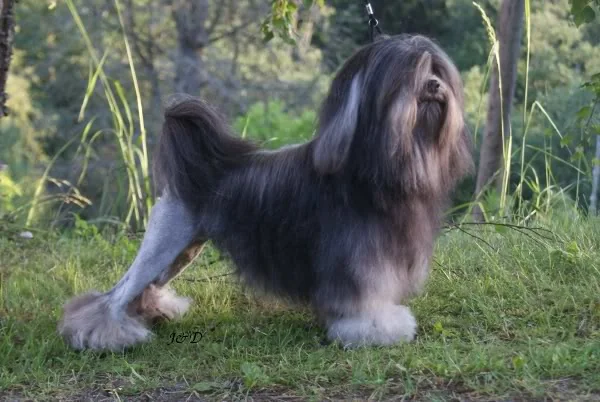 Featured photolowchen.jpg
The Löwchen is a 14th-century European 'little lion' court companion with the breed-defining lion clip. The Löwchen (German for 'little lion') is one of the oldest of the European companion breeds, depicted in 14th-century European art (woodcuts of Albrecht Dürer, paintings of Goya).
Quick facts
- AKC group
- Non-Sporting
- Origin country
- France / Germany
- Origin period
- 14th century (formalized 1944)
- Coat type
- Long
- Coat colors
- Any colour or combination — most common are white, black, lemon, golden, parti-colour
- Average lifespan
- 13-15 years
- Recognition
- AKC 1996 · FCI 1955 · UKC 1948 · Group 9 — Companion and Toy Dogs (Section 1: Bichons and related breeds)
Origin
The Löwchen (German for 'little lion'; the breed is registered as Petit Chien Lion in France) is one of the oldest of the European companion breeds, with depictions in 14th-century European art including woodcuts of Albrecht Dürer (early 16th century) and 18th-century paintings of Francisco Goya. The breed is named for its traditional 'lion clip' — the back half of the body shaved to leave a tassel at the tail and a mane around the head and shoulders, evoking the lion of medieval heraldry — which was a fashion at European courts from the 16th century onward, possibly as a way of mimicking lions for the amusement of the aristocracy. The breed was nearly lost in the 1944 Second World War with as few as 65 dogs surviving, and was rebuilt by Belgian breeder Madeleine Bennert and her German colleague Dr Hans Rickert from 1944 onward. The AKC admitted the breed in 1996.
Recognition
The American Kennel Club admitted the breed in 1996, the United Kennel Club followed in 1948, and the Federation Cynologique Internationale published the international standard (FCI No. 233) in 1955. The FCI assigns the breed to Group 9 — Companion and Toy Dogs (Section 1: Bichons and related breeds).
Standard
The AKC and FCI standards describe a small, bright, lively dog with the unique traditional 'lion clip' that gives the breed its name. The defining feature is the trim: the back half of the body, parts of the legs, and the base of the tail are shaved, leaving a leonine mane around the head, shoulders, and forequarters and a tassel at the tail tip. The coat itself is long, slightly wavy, soft, dense, and silky. Any colour or combination of colours is acceptable; white, black, lemon, golden, and parti-colour are most common. The breed stands 25-33 cm at the withers and weighs 4-8 kg.
Sources & further reading (3)
- kennel-club-registry — accessed 2026-04-30
- encyclopedia — accessed 2026-04-30
- fci-standard — accessed 2026-04-30
Frequently asked questions
What is the Löwchen's AKC group?
The American Kennel Club places the Löwchen in the Non-Sporting Group. The Non-Sporting Group is the AKC's residual category for breeds whose modern role does not fit the older Sporting / Hound / Working / Terrier / Toy / Herding rubrics; the Bulldog, Dalmatian, and Poodle sit here. The breed's foundation working role was as a 14th-century European 'little lion' court companion with the breed-defining lion clip.
When was the Löwchen officially recognized?
The American Kennel Club admitted the breed in 1996; the United Kennel Club followed in 1948; the Federation Cynologique Internationale published the international standard (FCI No. 233) in 1955.
What is the average lifespan of a Löwchen?
Kennel-club longevity surveys place the Löwchen's average lifespan in the 13-15 years range. The figure here represents the spread reported by the major parent-club studies and the Kennel Club (UK) purebred-dog health surveys.