Canis lupus familiaris
Keeshond
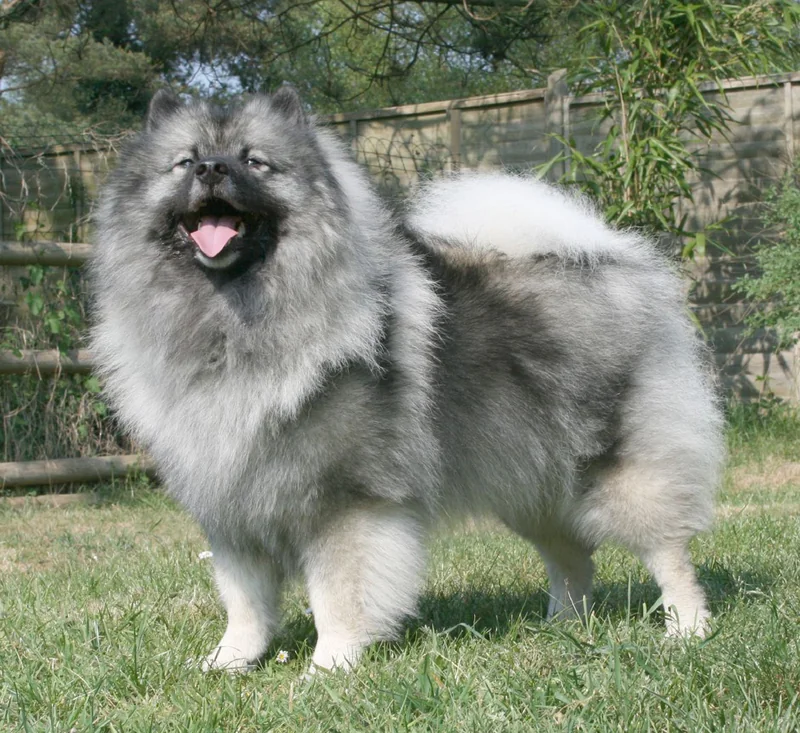 Featured photokeeshond.jpg
The Keeshond is a medium German/Dutch Spitz — symbol of the 1781 Dutch Patriot uprising. The Keeshond (named for the Dutch barge-dog of the 17th century, traditionally called 'Kees' as a generic Dutch given name) is the medium-sized variety of the German Spitz family (alongside the smaller Pomeranian and the larger Großspitz).
Quick facts
- AKC group
- Non-Sporting
- Origin country
- Netherlands
- Origin period
- 17th century (formalized 1925)
- Coat type
- Double
- Coat colors
- Wolf Grey (a mix of black, grey, and cream tipping with the breed's required black mask, ear tips, tail tip, and shoulder line)
- Average lifespan
- 12-15 years
- Recognition
- AKC 1930 · FCI 1957 · UKC 1948 · Group 5 — Spitz and Primitive Types (Section 4: European Spitz — variety: Wolfspitz)
Origin
The Keeshond is the medium-sized variety of the German/Dutch Spitz family — alongside the smaller Pomeranian and the larger Großspitz — and was traditionally kept on Dutch canal barges as a watchdog and ratter. The breed name comes from the 1781 Dutch Patriot political uprising: Cornelius de Gyselaar's dog Kees ('Kees' is a Dutch diminutive of Cornelius, used generically) was the symbol of the Patriot party against the House of Orange. After the Patriots' 1787 defeat by Prussian troops, the breed fell out of favour and was nearly lost; Baroness van Hardenbroek van Ammerstol rebuilt the breed in the 1920s and the FCI registered the Keeshond as a variety of the German Wolfspitz in 1957. The AKC admitted the breed in 1930.
Recognition
The American Kennel Club admitted the breed in 1930, the United Kennel Club followed in 1948, and the Federation Cynologique Internationale published the international standard (FCI No. 97) in 1957. The FCI assigns the breed to Group 5 — Spitz and Primitive Types (Section 4: European Spitz — variety: Wolfspitz).
Standard
The AKC and FCI standards describe a handsome, balanced, square-built Northern dog of striking colour — the wolf-grey coat with the breed's signature 'spectacles' marking around the eyes (a delicate pencilling of black lines from the outer corner of the eye to the lower corner of the ear, combined with shadings on the cheeks, gives the impression of spectacles). The thick, off-standing double coat is wolf-grey: a mix of black, grey, and cream tipping with the required black mask, ear tips, tail tip, and shoulder line. Males stand 45-46 cm at the withers, females 43-44 cm.
Sources & further reading (3)
- kennel-club-registry — accessed 2026-04-30
- encyclopedia — accessed 2026-04-30
- fci-standard — accessed 2026-04-30
Frequently asked questions
What is the Keeshond's AKC group?
The American Kennel Club places the Keeshond in the Non-Sporting Group. The Non-Sporting Group is the AKC's residual category for breeds whose modern role does not fit the older Sporting / Hound / Working / Terrier / Toy / Herding rubrics; the Bulldog, Dalmatian, and Poodle sit here. The breed's foundation working role was as a medium German/Dutch Spitz — symbol of the 1781 Dutch Patriot uprising.
When was the Keeshond officially recognized?
The American Kennel Club admitted the breed in 1930; the United Kennel Club followed in 1948; the Federation Cynologique Internationale published the international standard (FCI No. 97) in 1957.
What is the average lifespan of a Keeshond?
Kennel-club longevity surveys place the Keeshond's average lifespan in the 12-15 years range. The figure here represents the spread reported by the major parent-club studies and the Kennel Club (UK) purebred-dog health surveys.