Canis lupus familiaris
Gordon Setter
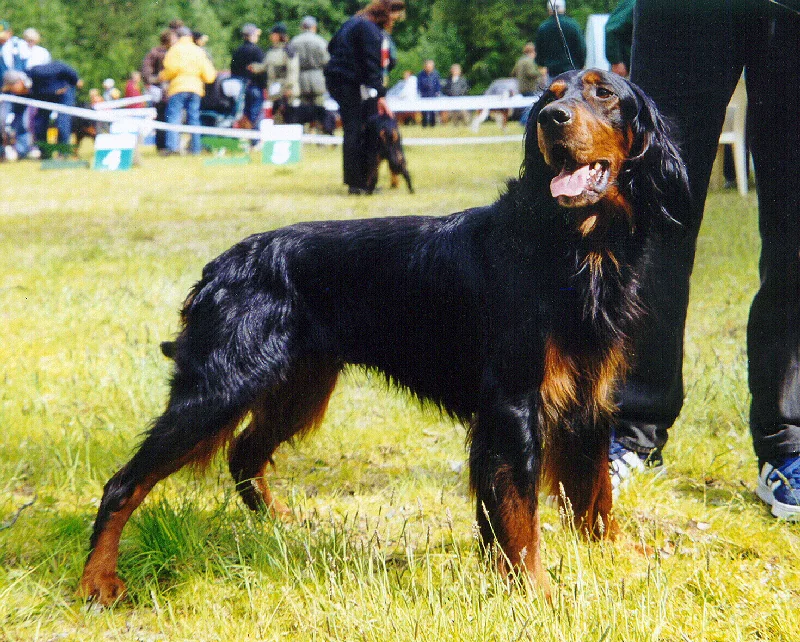 Featured photogordon-setter.jpg
The Gordon Setter is the largest and heaviest of the three setter breeds recognised by the AKC, and the only one of Scottish origin. It was developed and refined by the fourth Duke of Gordon at Gordon Castle, Banffshire, in the late 18th and early 19th centuries, where it was prized as an enduring bird dog suited to Scotland's rugged highland terrain. Its distinctive jet-black coat with rich mahogany-tan markings makes it one of the most visually striking sporting breeds. The AKC admitted the breed in 1884. Males stand 61–69 cm and weigh 25–36 kg.
Quick facts
- AKC group
- Sporting
- Origin country
- Scotland
- Origin period
- Late 18th century
- Coat type
- Long
- Coat colors
- Black and Tan
- Average lifespan
- 12-13 years
- Recognition
- AKC 1884 · FCI 1954 · UKC 1956 · Group 7 — Pointing Dogs (Section 2: British and Irish Pointers and Setters)
Origin
Gordon Castle in Banffshire, Scotland, was the crucible of the modern Gordon Setter. The fourth Duke of Gordon, Alexander Gordon (1743–1827), maintained a substantial kennel and selectively bred for a black-and-tan setter that could sustain long days on Scotland's heather-clad grouse moors, where stamina and a strong nose mattered more than the blistering pace suited to English lowlands. Collie blood may have been introduced to fix the black-and-tan pattern and add endurance. After the Duke's death, the kennel's reputation ensured the breed's name would be attached to him permanently.
Recognition
The Gordon Setter appeared in the AKC's first studbook in 1884. The name 'Gordon Setter' became the official designation to distinguish the breed from the English and Irish Setters, honouring the Duke of Gordon's founding role. Daniel Webster and George Blunt introduced the breed to North America in 1842, making the Gordon one of the earliest British sporting dogs to reach the United States. The Kennel Club (UK) and FCI (FCI No. 6) have also recognised the breed for well over a century.
Standard
The AKC standard describes a strikingly handsome dog of a good substantial build, not long in the leg and with substance and bone. The coat is soft and shining, straight or slightly waved but not curly, with a long, flat silky feathering on ears, under-belly, backs of legs, and tail. The colour is a rich coal-black throughout with tan markings — two clear spots above the eyes, on the muzzle sides, throat, chest, legs, and under the tail. Males stand 61–69 cm; females 58–66 cm.
Sources & further reading (3)
- kennel-club-registry — accessed 2026-05-07
- encyclopedia — accessed 2026-05-07
- fci-standard — accessed 2026-05-07
Frequently asked questions
What AKC group is the Gordon Setter in?
The AKC places the Gordon Setter in the Sporting Group. Within the Sporting Group, the three setter breeds — Gordon, Irish, and English — all belong to the pointing subtype: dogs that locate game by scent and then 'set' (crouch) or stand pointing to indicate the bird's position for the hunter. The Gordon was specifically bred for upland bird hunting on Scottish grouse moors.
How does the Gordon Setter differ from the Irish and English Setters?
The Gordon Setter is the largest and heaviest of the three setter breeds and the only one of Scottish origin. Its coat is black with tan markings, whereas the Irish Setter is solid red/chestnut and the English Setter is white with colored flecking (Belton pattern). The Gordon was also bred for stamina on rugged highland terrain rather than the faster pace suited to the flatter landscapes where English and Irish Setters traditionally worked.
When did the Gordon Setter arrive in the United States?
The Gordon Setter arrived in the United States in 1842, when Daniel Webster and George Blunt imported the first specimens from Gordon Castle. The breed was included in the AKC's first studbook when the organisation was established in 1884. The Gordon Setter Club of America was founded in 1924 to promote and protect the breed in North America.