Canis lupus familiaris
Flat-Coated Retriever
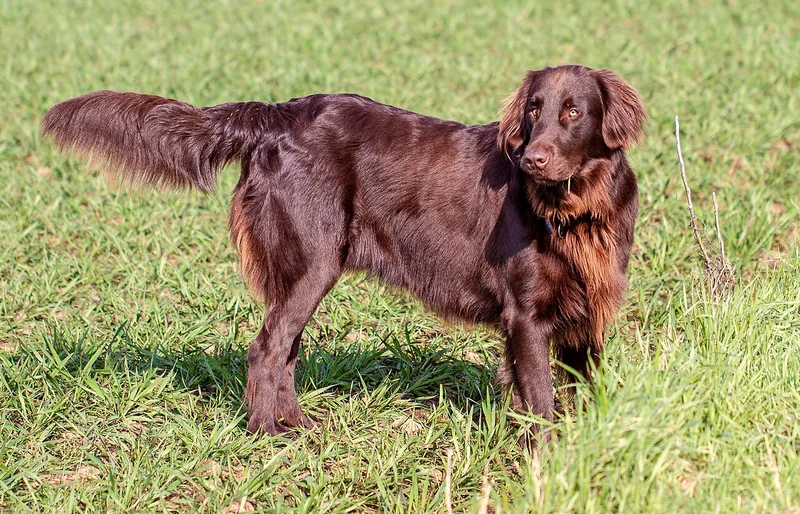 Featured photoflat-coated-retriever.jpg
The Flat-Coated Retriever is a medium-to-large British gundog developed in the second half of the 19th century as a dual-purpose land and water retriever. Its distinctive flat, dense, and lustrous coat — most often solid black, less commonly solid liver — and its exuberant, optimistic character set it apart from other retriever breeds. Bred primarily by S. E. Shirley, founder of The Kennel Club, in the 1860s–1880s, the breed dominated retriever classes at British field trials until the Golden and Labrador Retrievers eclipsed it in the 20th century. The AKC admitted the breed in 1915.
Quick facts
- AKC group
- Sporting
- Origin country
- England
- Origin period
- Mid-19th century
- Coat type
- Medium
- Coat colors
- Black, Liver
- Average lifespan
- 8-10 years
- Recognition
- AKC 1915 · FCI 1954 · UKC 1996 · Group 8 — Retrievers, Flushing Dogs, Water Dogs (Section 1: Retrievers)
Origin
The Flat-Coated Retriever was shaped principally by S. E. Shirley on his Ettington estate in Warwickshire during the 1860s–1880s. Shirley, who went on to found The Kennel Club in 1873, crossed the St. John's Water Dog (the ancestor common to all retriever breeds) with Collie-type herding dogs to achieve the flat, dense coat and willing, biddable temperament. Setter and Newfoundland blood likely contributed to the gene pool. The first breed classes at dog shows appeared in the 1860s, and by the 1870s the Flat-Coat was the dominant retriever at British field trials.
Recognition
The Kennel Club (UK) recognised the Flat-Coated Retriever as a distinct breed in the 1870s, and the breed's standard was refined by the Flat-Coated Retriever Society, founded in 1915. The AKC admitted the breed that same year. After a mid-20th-century decline in which the breed nearly disappeared, the Flat-Coated Retriever Society of America was formed in 1969 to support recovery. The FCI standard (FCI No. 121) was first established in 1954 and places the breed in Group 8.
Standard
The AKC and FCI standards describe a medium-to-large, elegant retriever with a clean outline and smooth action. The coat is the breed's hallmark — dense, fine in texture, as flat as possible to the body, with a substantial feathering on the ears, chest, forelegs, and tail. Solid black or solid liver are the only recognised colours; any other colour is a disqualification. Males stand 58–62 cm and weigh 27–36 kg; females 56–59 cm and 25–32 kg. The breed's expression should reflect its characteristic cheerful, optimistic nature.
Sources & further reading (3)
- kennel-club-registry — accessed 2026-05-07
- encyclopedia — accessed 2026-05-07
- fci-standard — accessed 2026-05-07
Frequently asked questions
What AKC group does the Flat-Coated Retriever belong to?
The AKC places the Flat-Coated Retriever in the Sporting Group alongside the other retriever breeds — Golden, Labrador, Chesapeake Bay, Curly-Coated, and Nova Scotia Duck Tolling. All retriever breeds were developed to fetch shot game for hunters; the Flat-Coat was originally a dual-purpose land and water retriever used on British estates in the Victorian era.
What colors does the Flat-Coated Retriever come in?
The AKC standard recognises only solid black and solid liver as acceptable colours for the Flat-Coated Retriever. No other color is permitted; a yellow, cream, or parti-colored coat is a disqualification. The black variety has historically been far more common, while liver dogs are rarer but equally correct within the standard.
When was the Flat-Coated Retriever recognised by the AKC?
The AKC recognised the Flat-Coated Retriever in 1915, the same year the Flat-Coated Retriever Society was founded in Britain. The breed had been recognised by The Kennel Club (UK) since the 1870s. After a period of near-extinction following World War II, breed clubs in both Britain and the United States led a successful revival from the 1960s onward.