Canis lupus familiaris
Finnish Spitz
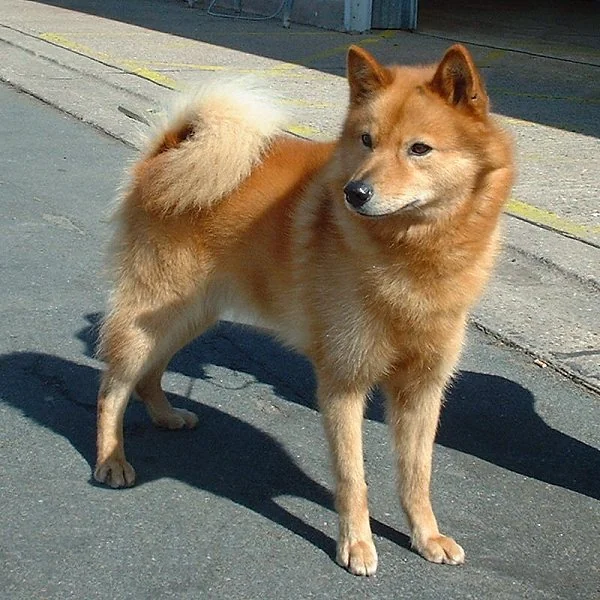 Featured photofinnish-spitz.jpg
The Finnish Spitz is a ancient Finnish 'bark pointer' tree-hunting Nordic Spitz — national dog of Finland. The Finnish Spitz is the national dog of Finland and an ancient Nordic hunting Spitz, descended from the same Eurasian Spitz landrace as the Karelian Bear Dog and the Norwegian Elkhound.
Quick facts
- AKC group
- Non-Sporting
- Origin country
- Finland
- Origin period
- Antiquity (formalized 1892)
- Coat type
- Double
- Coat colors
- Glowing Red-Gold (any shade from honey-amber through deep auburn)
- Average lifespan
- 12-15 years
- Recognition
- AKC 1988 · FCI 1956 · UKC 1948 · Group 5 — Spitz and Primitive Types (Section 2: Nordic Hunting Dogs)
Origin
The Finnish Spitz is the national dog of Finland and an ancient Nordic hunting Spitz, descended from the same Eurasian Spitz landrace as the Karelian Bear Dog and the Norwegian Elkhound. Genetic studies place the breed among the basal northern dog lineages. The breed has been used by Finnish hunters for at least 3,000 years to bay treed game — capercaillie, black grouse, hazel grouse, and squirrel — until the hunter arrives, with the dog signalling the location by continuous high-pitched yodeling barks (the breed is known as the 'bark pointer' for this signature working style). The breed was nearly lost in the 19th century when imported European hunting dogs interbred with the local landrace; Hugo Roos and Hugo Sandberg began the modern breed-rebuilding programme in 1892, and the breed was formally registered by the Finnish Kennel Club the same year. The AKC admitted the Finnish Spitz in 1988.
Recognition
The American Kennel Club admitted the breed in 1988, the United Kennel Club followed in 1948, and the Federation Cynologique Internationale published the international standard (FCI No. 49) in 1956. The FCI assigns the breed to Group 5 — Spitz and Primitive Types (Section 2: Nordic Hunting Dogs).
Standard
The AKC and FCI standards describe a small to medium-sized Nordic Spitz, almost square in outline, with a fox-like expression and lively bearing. The defining features are the small triangular pricked ears, the curled tail carried over the back, and the brilliant glowing red-gold double coat in any shade from honey-amber through deep auburn — the only acceptable colour. The double coat is thick: a soft, dense undercoat under a long, harsh, straight outer coat. Males stand 44-50 cm at the withers, females 39-45 cm.
Sources & further reading (3)
- kennel-club-registry — accessed 2026-04-30
- encyclopedia — accessed 2026-04-30
- fci-standard — accessed 2026-04-30
Frequently asked questions
What is the Finnish Spitz's AKC group?
The American Kennel Club places the Finnish Spitz in the Non-Sporting Group. The Non-Sporting Group is the AKC's residual category for breeds whose modern role does not fit the older Sporting / Hound / Working / Terrier / Toy / Herding rubrics; the Bulldog, Dalmatian, and Poodle sit here. The breed's foundation working role was as a ancient Finnish 'bark pointer' tree-hunting Nordic Spitz — national dog of Finland.
When was the Finnish Spitz officially recognized?
The American Kennel Club admitted the breed in 1988; the United Kennel Club followed in 1948; the Federation Cynologique Internationale published the international standard (FCI No. 49) in 1956.
What is the average lifespan of a Finnish Spitz?
Kennel-club longevity surveys place the Finnish Spitz's average lifespan in the 12-15 years range. The figure here represents the spread reported by the major parent-club studies and the Kennel Club (UK) purebred-dog health surveys.