Canis lupus familiaris
Dandie Dinmont Terrier
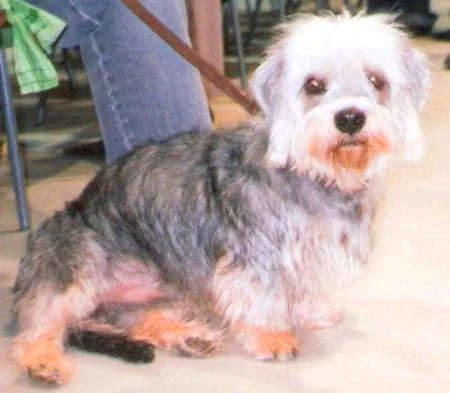 Featured photodandie-dinmont-terrier.jpg
The Dandie Dinmont Terrier is a small Scottish terrier with a uniquely long, curved body, short legs, a large distinctive silky topknot on the skull, and large, soulful eyes that give it an expression unlike any other breed. It is the only dog breed named after a fictional character — Dandie Dinmont, a farmer in Sir Walter Scott's 1814 novel 'Guy Mannering' — whose terriers gave the breed its permanent name. Developed on the border between Scotland and England for hunting otter and badger, it comes in two colours: pepper and mustard. The AKC recognised the breed in 1886.
Quick facts
- AKC group
- Terrier
- Origin country
- Scotland
- Origin period
- Early 18th century
- Coat type
- Wirehaired
- Coat colors
- Pepper, Mustard
- Average lifespan
- 12-15 years
- Recognition
- AKC 1886 · FCI 1954 · UKC 1912 · Group 3 — Terriers (Section 2: Small-sized Terriers)
Origin
The Dandie Dinmont Terrier was developed in the border country along the Cheviot Hills, straddling the modern boundary of Scotland and England, during the early 18th century. The breed was used by gypsies and rural farmers for otter and badger hunting along the banks of the rivers Tyne, Jed, Teviot, and Kale. Its ancestry is believed to include the Skye Terrier crossed with local short-legged terriers native to the border. The breed's low, curved body allowed it to pursue quarry through tight rock crevices and underground burrows.
Recognition
The breed became widely known after Sir Walter Scott's 1814 novel 'Guy Mannering' featured the farmer character Dandie Dinmont and his terriers 'Mustard' and 'Pepper'. Scott himself owned Dandie Dinmont Terriers at his Abbotsford estate. The Dandie Dinmont Terrier Club was founded in 1875, making it one of the oldest specialist dog breed clubs in the world. The AKC recognised the breed in 1886; the FCI (FCI No. 168) in 1954.
Standard
The FCI and AKC standards describe a long, low, somewhat weasel-like dog with a distinctive profile: a large, domed skull; a large, expressive, dark hazel eye; a silky, soft topknot covering the entire top of the skull; and a long body with a distinctive curve over the loins. The coat is a mixture of hard and soft hair, giving a crisp feel — neither wiry nor fluffy. Two colours are recognised: pepper (dark bluish-black to light silvery-grey) and mustard (reddish-brown to pale fawn). Both have lighter coloured topknots. Males and females stand 20–28 cm and weigh 8–11 kg.
Sources & further reading (3)
- kennel-club-registry — accessed 2026-05-07
- encyclopedia — accessed 2026-05-07
- fci-standard — accessed 2026-05-07
Frequently asked questions
Why is the Dandie Dinmont Terrier named after a fictional character?
The breed's name comes from Dandie Dinmont, a jovial border farmer character in Sir Walter Scott's 1814 novel 'Guy Mannering'. In the novel, Dandie Dinmont keeps a pack of small terriers named Mustard and Pepper, which became associated with the real breed type found in the Scottish border region. After the novel's publication, enthusiasts began calling their border terriers 'Dandie Dinmont's terriers', and the name became permanent. The Dandie Dinmont Terrier is the only breed named after a fictional character.
What are the two coat colours of the Dandie Dinmont Terrier?
The Dandie Dinmont Terrier comes in only two colours: pepper and mustard, directly referencing the names given to the fictional Dandie Dinmont's dogs in Scott's novel. Pepper ranges from dark bluish-black to a pale silvery-grey, with the topknot and leg feathering in silver or off-white. Mustard ranges from reddish-brown to pale fawn, with the topknot a creamy-white or pale fawn. No other colours are permissible under the AKC or FCI standards.
When was the Dandie Dinmont Terrier recognised by the AKC?
The AKC recognised the Dandie Dinmont Terrier in 1886 as one of the early cohort of British terrier breeds admitted to the AKC studbook. The Dandie Dinmont Terrier Club was founded in Britain in 1875, predating AKC recognition by over a decade, and is one of the oldest specialist breed clubs in the world. The FCI recognised the breed in 1954 (FCI No. 168).