Canis lupus familiaris
Scottish Terrier
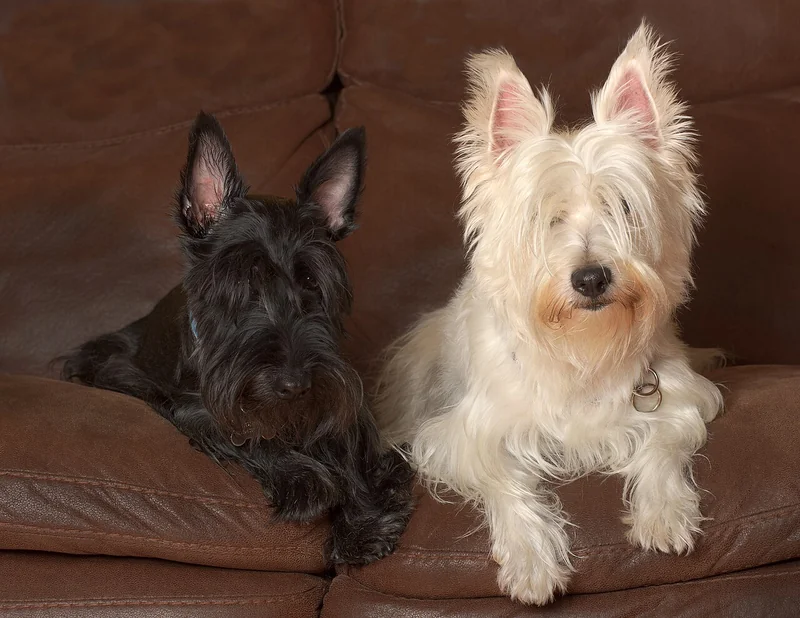 Featured photoscottish-terrier.jpg
The Scottish Terrier is a Aberdeen-formalized 1879 Highland working terrier — black, bearded, with pricked ears. The Scottish Terrier descends from the rough-coated landrace working terriers of the Scottish Highlands.
Quick facts
- AKC group
- Terrier
- Origin country
- Scotland
- Origin period
- 19th century (formalized 1880)
- Coat type
- Wirehaired
- Coat colors
- Black, Wheaten, Brindle (any shade)
- Average lifespan
- 11-13 years
- Recognition
- AKC 1885 · FCI 1955 · UKC 1934 · Group 3 — Terriers (Section 2: Small-sized Terriers)
Origin
A rough-coated working terrier landrace existed across the Scottish Highlands by the 18th century, used to dispatch vermin (foxes, badgers, rats) on the local farms. By the 19th century the landrace had begun to differentiate into the regional types now known as the Scottish Terrier (the Aberdeen district), the West Highland White Terrier, the Cairn Terrier, and the Skye Terrier. The Scottish Terrier as a distinct registered breed was formalized at a meeting in Aberdeen in 1879; the breed was originally called the Aberdeen Terrier. The Scottish Terrier Club (England) was founded in 1881 and J. B. Morrison published the first written breed standard the following year.
Recognition
The American Kennel Club admitted the breed in 1885, the United Kennel Club followed in 1934, and the Federation Cynologique Internationale published the international standard (FCI No. 73) in 1955. The FCI assigns the breed to Group 3 — Terriers (Section 2: Small-sized Terriers).
Standard
The AKC and FCI standards describe a small, compact, short-legged, sturdily-built dog of good bone and substance, the heaviness in proportion to size making the breed look heavier than it is. The defining feature is the long head with a flat skull, prominent eyebrows and beard, and small, pricked ears. The double coat consists of a dense, soft undercoat under a hard, wiry, weather-resistant outer coat. Recognized colours are black, wheaten, and brindle (any shade — black brindle, red brindle, silver brindle). The breed stands 25-28 cm at the withers.
Sources & further reading (3)
- kennel-club-registry — accessed 2026-05-04
- encyclopedia — accessed 2026-05-04
- fci-standard — accessed 2026-05-04
Frequently asked questions
What is the Scottish Terrier's AKC group?
The American Kennel Club places the Scottish Terrier in the Terrier Group. The Terrier Group gathers breeds developed to hunt and dispatch vermin or to go to ground after fox and badger; the name derives from the Latin terra ('earth'). The breed's foundation working role was as a Aberdeen-formalized 1879 Highland working terrier — black, bearded, with pricked ears.
When was the Scottish Terrier officially recognized?
The American Kennel Club admitted the breed in 1885; the United Kennel Club followed in 1934; the Federation Cynologique Internationale published the international standard (FCI No. 73) in 1955.
What is the average lifespan of a Scottish Terrier?
Kennel-club longevity surveys place the Scottish Terrier's average lifespan in the 11-13 years range. The figure here represents the spread reported by the major parent-club studies and the Kennel Club (UK) purebred-dog health surveys.